The Other Seat That Just Got Valuable: The One Holding the Compass

I argued the CTO just became the most valuable seat in the building. Here's the other one, and I'd rather be honest about it than self-serving: the visionary. AI strips out the bureaucracy, the headcount, and the delay that used to kill good ideas on the way down the org chart. What's left is a very fast machine that will build absolutely anything, including nonsense. Somebody still has to point.
A few days ago I made the case that the CTO just became the most valuable seat in the building. I stand by every word of it.
But I owe you the other half, and this one isn't self-serving, which is probably why you should trust it more. There's a second seat that gained just as much. Maybe more.
The visionary. The CEO. The person who decides what should exist and gets everyone pulling the same direction.
I want to be upfront: this is not my gift. My business partner and mentor, Brandon Gosselin, has it, and watching him do it is genuinely impressive to me in a way technical skill isn't, because I understand technical skill from the inside. He can walk into a room, paint a picture of where we're going, and have everyone leave aligned and actually fired up about it. I cannot do that. I can build you almost anything, but casting a vision that unites people is a different muscle and he's got it. He's the one who taught me most of what I know about running a company, including pointing me at what I was actually good at before I had words for it.
So here's why that muscle just became worth a lot more.
Vision used to die on the way down
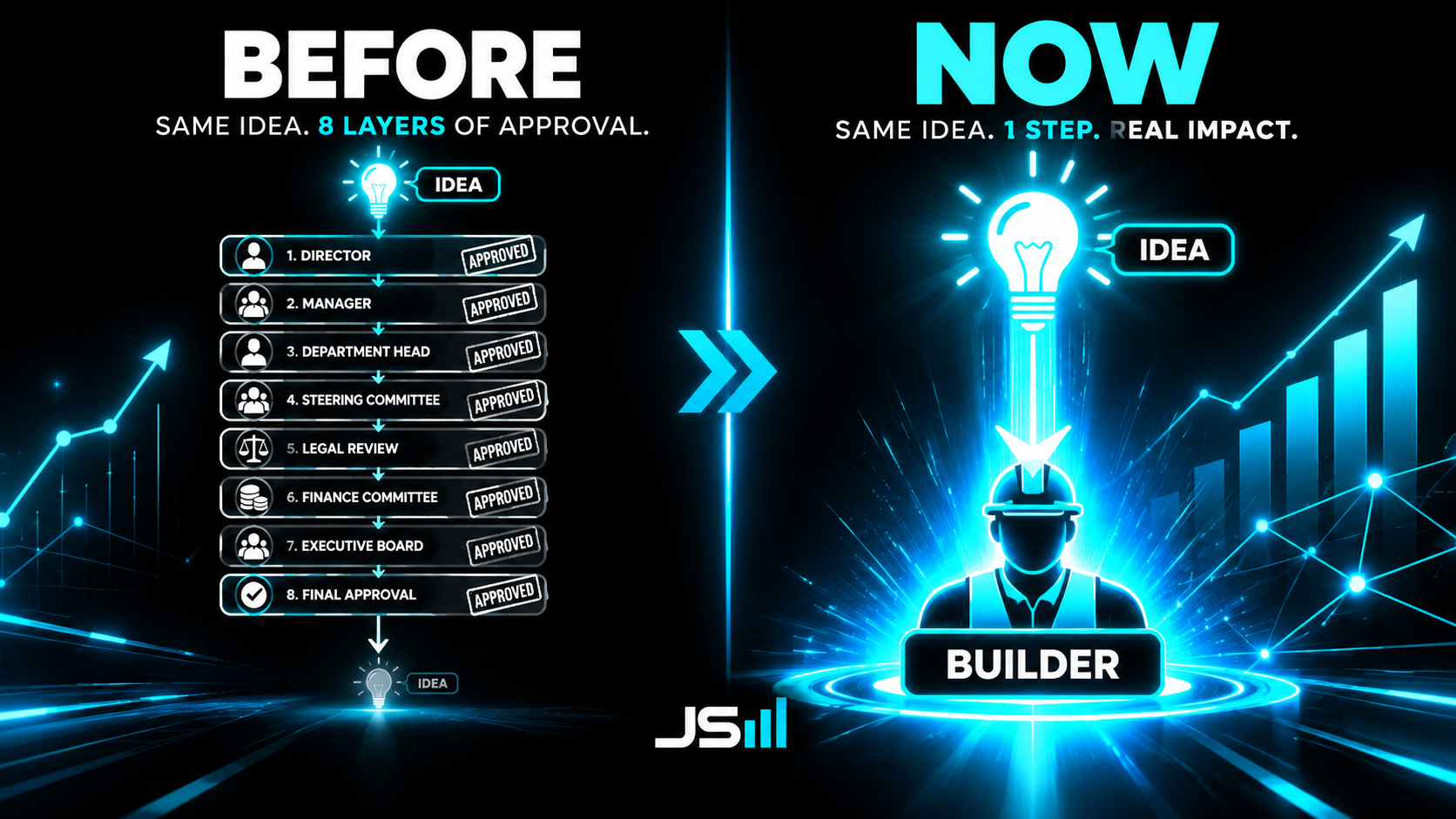
Here's the thing about vision in a traditional company: having it was never the hard part. Plenty of leaders could see where things were going. The hard part was that the idea had to survive the trip down the org chart.
It gets handed to engineering, which is already six months behind. It goes into a queue. It gets scoped, then re-scoped. It touches four departments, each of which has a reason it can't happen this quarter. It goes to a committee. Somebody asks for a deck. By the time anything ships, it's eighteen months later, it's been sanded down to a version nobody's excited about, and the market has moved.
That's not a vision problem. That's a transmission problem. The signal was fine, the wire was bad.
And bureaucracy isn't even malicious, that's what people get wrong. It's what naturally accumulates when you have a lot of people who all need to coordinate. Every layer exists because at some point somebody got burned and added a check. Then you wake up and the company can't turn. It's also a big piece of why 94% of corporate AI initiatives fail: the initiative isn't the problem, the eleven rooms it has to pass through are.
AI cuts the wire problem three ways
Less headcount, less bureaucracy. I argued in the experts piece that AI deletes the grunt work layer, not the expert layer. Your CTO who understands architecture is one of the last on the chopping block. Your COO who knows which process is broken is fine. Your CMO who knows what makes a plumber stop scrolling is fine. The people doing the manual execution underneath them are the ones AI genuinely does better. Which means a twenty person company becomes five or six experts. And a five person company does not have bureaucracy. It just doesn't have room for it.
Faster decisions. Fewer people to align means fewer meetings to align them. The decision that used to take three weeks of calendar tetris now takes a conversation. The visionary's thinking reaches the people who act on it the same day he has it.
The builders move at an absurd pace. This is the big one. I put real numbers on it in the ROI piece, and the short version is that a $200 subscription did what used to take a funded team. When the CTO can take a direction and have a working version by Friday instead of next quarter, the vision stops being a document and starts being a thing you can look at. And then iterate on. The loop from "here's where we should go" to "here it is, what do you think" collapsed from quarters to days. That's also the entire argument for building ugly and fast: get the real thing in front of people before the idea goes stale.
Put those together and the bottleneck on a good idea is no longer execution. It's whether the idea was any good. Which puts enormous weight back on the person generating them.
A fast engine with no driver

Let me be honest about my own seat, because the symmetry is the whole point.
A CTO with no direction isn't worthless, but he's close. He's a very fast engine with nobody at the wheel. The ability to build anything is not the same as the judgment of what's worth building, and judgment is the actual moat now.
And I'll turn that on myself: software developers build genuinely weird stuff when left alone. Long before AI, I spun up all kinds of pointless programs. A little ping pong animation. Things that solved no problem whatsoever. I still do it on days off, honestly, because it's fun. That instinct, "I wonder if I can make this work," is exactly what makes someone good at building, and it is exactly why that person should not be the one deciding the roadmap by himself. Ask me about the three businesses I killed if you want the long version of what happens when I'm the only one steering.
Now hand that same instinct AI leverage. Now I can produce ten times the volume of beautifully architected things nobody asked for. The engine got faster. It did not grow a steering wheel.
Somebody has to say: that's interesting, build this instead, because this is the thing that creates value, that people will actually pay for, that serves the mission. Whether that mission is a market, a cause, or the kingdom, somebody has to aim it.
The part I didn't expect: the visionary is a systems builder too

Here's the thing I've come to appreciate, and I don't think it gets said enough.
We talk about leadership like it's a charisma skill. Stand up, give the speech, inspire the troops. That's part of it. But the part I actually watch my partner do is closer to engineering, and it took me a while to recognize it because it doesn't look like my kind of engineering.
Picture the team. One guy who deeply understands marketing, what makes people look, click, and buy. One guy who can look at any operation and tell you exactly which process is bleeding. One guy who's freakishly good with technology. Three strong, specific, fairly narrow gifts.
Now: who figures out what each of them should be pointed at? Who notices that the marketing guy's instinct about the offer is the thing that unlocks the whole quarter, and the tech guy should drop what he's doing and build that instead? Who sees that the ops guy is wasted on a reporting project and should be fixing fulfillment?
That's the leader. And that is systems thinking, straight up. I've always written about systems thinking as a technical skill, understanding how components connect, seeing where the whole thing breaks. But a team is a system. People are the components. Their strengths are the capabilities, their blind spots are the failure modes, and arranging them so the outputs line up is architecture work. It's just done in people instead of code.
And honestly, it's harder than my version. My components do what I tell them. His have opinions.
I'm going to write a full piece on this because I think it's underrated, but here's the short version of why I'm convinced: that's how I got here. Don't ask me about the first three startups. Somebody looked at a guy who'd failed at three businesses and correctly identified that the problem wasn't effort or intelligence, it was that I'd been pointed at the wrong thing the whole time. He pointed me at the technical seat. Now I run a tech company.
Nothing about me changed. The direction did. That's the job.
And the COO needs it too
Same logic one seat over. A COO without a vision to serve will optimize. Ruthlessly. Every process will get tighter, every workflow cleaner, every cost trimmed.
And the company will slowly stop going anywhere. Operations without direction becomes maintenance. You get a beautifully running machine, perfectly efficient, headed nowhere in particular. That's how competent companies stagnate without ever doing anything obviously wrong. It's also why knowing what not to automate matters as much as knowing what to: efficiency pointed at the wrong process just gets you to the wrong place faster.
The actual point: it's a team, and that's not a cop-out

I'm not going to pretend one seat wins.
Vision with no technical ability is a beautiful keynote about a product that doesn't exist. I've watched people pitch things that cannot be built, with total confidence, and it's painful. The structure underneath has to actually hold.
Technical ability with no vision is what I just described. Fast, capable, pointed at nothing.
Operations with no vision is a well-run treadmill.
And none of the three does anything without somebody who can actually sell the thing once it exists. Nobody is self-made, and no seat is self-sufficient either. I tell Brandon he's Jobs and I'm Wozniak, and we laugh about it every time because it's accurate. Jobs without Wozniak is a pitch deck. Wozniak without Jobs is a brilliant machine in a garage nobody ever hears about. The pairing is the thing, not either half.
Why the visionary's job gets harder, not easier

Here's the part I think gets missed in all the "AI makes everything easy" talk.
When execution was the bottleneck, a mediocre decision was cheap. It took so long to build that the market would correct you before you'd shipped it, and the delay was accidentally protective.
Now? A bad call gets built. Fast. Fully. You will have a polished, working version of the wrong thing by next week, and you'll have spent real money and real attention on it. Speed is only an advantage if the direction is right. Pointed wrong, speed is just how fast you reach the wall.
So the premium on the person holding the compass went up, not down. Fewer people to hide a bad decision behind, less delay to catch it, more capacity to build it before anyone notices. Which also means the leader has to be able to say "I was wrong" quickly and out loud, because the window to catch a bad direction just got a lot shorter.
And the other half of the job, the unglamorous half, is alignment. Getting a small team of strong-willed experts to genuinely pull the same direction is harder than it sounds, not easier, because each of those five people is now capable of running off in their own direction at ten times the speed. The uniting part isn't soft skills fluff. It's load-bearing.
What a visionary should actually be pointing at
Since I'm handing the compass this much credit, let me be concrete about where I've watched it matter.
It's deciding to plug AI into the five places that move revenue and leave the handshake alone, instead of automating everything because you can. That's not a technical call. That's a judgment call about what the business is actually for.
It's noticing the sawdust you're already producing and selling it, instead of chasing the shiny new line of business. It's recognizing that distribution is the real bottleneck, not product. It's deciding to give the CRM away for free because the ecosystem is worth more than the subscription.
Every one of those is a direction, not a build. The build was the easy part.
The takeaway
The CTO seat got more valuable because the typing stopped being the bottleneck.
The visionary seat got more valuable because the bureaucracy, the headcount, and the eighteen month delay stopped being the bottleneck. The idea now actually reaches the thing that builds it, intact and quickly.
Which leaves one question that didn't used to be the hard one: was it the right idea?
If you can see where things are going, aim the right person at the right problem, and get everyone moving together, that was always worth something. It's worth considerably more now that nothing stands between your call and a working version of it.
And if you've got the vision but no machine to point at it, that part we can help with.
Want to talk about what you're building?
Get in touch