The Only Skill That Matters in 2026 Is Systems Thinking
Controversial take for 2026: the most valuable skill isn't coding, it's systems thinking. AI is an incredible engine, but an engine still needs a driver. Anyone can spin up slop in Claude Code; hardening it, catching the failure modes, and steering it is the actual skill. It's why an AI website builder makes garbage and a real system doesn't, and why the "one-person billion-dollar company" is further off than the hype (see the app that shipped HIPAA data on open URLs). Learn to steer.
Here's a take that'll ruffle some feathers: in 2026, the most valuable skill you can have has almost nothing to do with how well you can code. It's systems thinking. And AI, ironically, is the thing that made it king.
Let me explain, because this matters whether you write software or run a landscaping company.
AI is an incredible engine. It still needs a driver.
AI is the greatest leverage tool I've ever touched. The speed is genuinely absurd. I documented just how many working versions of our software I shipped in a matter of months. It's a monster of an engine.
But an engine isn't a car. Drop the most powerful engine on earth into a vehicle with nobody behind the wheel and you don't get a Ferrari, you get a very expensive wreck. Someone still has to steer. That "someone" is systems thinking: the ability to see how all the pieces fit, where they'll break, and where you actually want to go.
Watch what AI does without a driver
My AI makes genuinely great architecture decisions now, but only because I've shaped how it thinks, pushing it toward the tradeoffs most people miss. Left to its own defaults, it doesn't do that. I've literally watched it confidently recommend Airtable as a backend. (Airtable as a backend is garbage, and yes, I'm doing a full review on it soon.)
This is the entire difference between an "AI website builder," which is really just a single ChatGPT call spitting out generic slop, and an actual beautiful, well-architected AI-built site like the one you're reading this on. Same underlying AI. Wildly different results. The gap is the systems thinking steering it. (I went deep on this in my piece On Architecture.)
The uncomfortable part
Now the controversial bit. A lot of entry-level work is going to get automated away. I don't think that's a purely good thing, that's a conversation for another day, but pretending it isn't happening helps nobody. It's where the market is heading. (I wrote about what should and shouldn't get automated in On Automation.)
Here's the flip side, and it's where all the opportunity lives. Anyone can open Claude Code and spin up slop. That part is now trivial. What isn't trivial is hardening that thing so it survives the real world, catching the weird edge cases, seeing the failure modes before they bite, and stripping the tedious decisions off your plate so your brain is free for the hard problems. (That last part is a whole job I handed to Joe 3.5, my AI executive assistant, who is definitely not writing this while I drive to grab my morning coffee. Eyes on the road, I promise, I sent this over before I pulled out.) None of that is a button. It's a skill. And it's the skill.
Take your A-players, your top-tier engineers, your people who instinctively see how systems fail, and plug AI into them, and you didn't replace them. You handed them a superpower. You leveled them up tenfold.
You can level up your whole team, not just the stars
And this isn't only for the A-players. Here's a real example from last week. I brought a sharp new guy named Chris onto the team, and I had him use Claude Code to transcribe and analyze some video. Out of the box, it couldn't do it. So I built what's called a "skill," think of it as an executable set of instructions that teaches the AI how to do a specific thing it couldn't before. Like a fire flower in Mario, it powers the AI up. With the skill I made, Chris's AI could suddenly analyze the video no problem. (I'll do a whole article on skills soon.)
That's the point. Systems thinking isn't just about writing better code. It's about designing the tools and guardrails that level up your entire team. That's a force multiplier no chatbot hands you for free.
About that "one-person billion-dollar company"
Which brings me to all the breathless headlines about the "no-employee company" or the "one-person billion-dollar company" run entirely by AI. My honest take? That's a lot further off than the hype suggests.
Look at the recent healthcare-app disaster where someone shipped an app with HIPAA-sensitive patient data sitting on unauthenticated URLs. If that were some obscure vulnerability only an elite white-hat could sniff out, fine, mistakes happen. But that's not what it was. That's cybersecurity 101. That's exactly the kind of failure mode a real systems thinker catches in their sleep and an over-eager, unsupervised AI sails right past.
That's the whole argument in one story. The AI didn't lack horsepower. It lacked a driver.
The takeaway
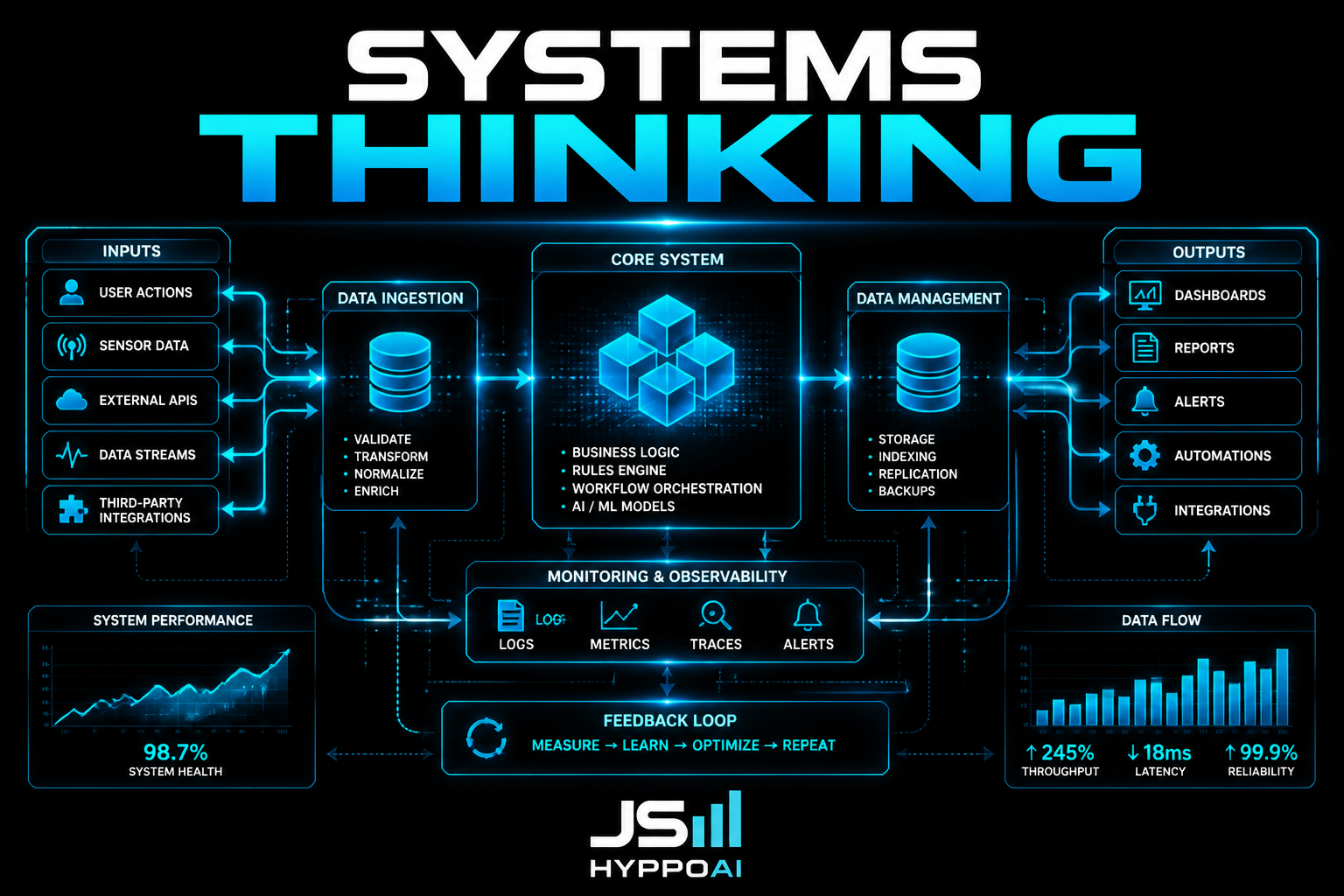
So if you're wondering what to actually get good at while everyone else panics about AI: get good at seeing systems. How things connect, how they fail, how they scale, where the real leverage hides. Learn to steer. The engine has never been more powerful, and that is exactly why the driver has never been worth more.
Want the engine and the driver?
We build with both, the AI horsepower and the systems thinking to steer it. That's what we do at HyppoAI.
Want to talk about what you're building?
Get in touch