You're in the Top 2%. Relax a Little.

PNC just put out two charts that should change how hard you're beating yourself up. Only 2.2% of US households pay for AI at all, and the average subscriber spends about $31 a month. If you're on a $200 plan running coding agents, you're not behind. You're in a rounding error of the population. Here's why that matters, and the one thing that actually separates the 0.1% from the people collecting prompt tricks.
Founders put an absurd amount of pressure on themselves. I'd know. Source: me.
The AI version of that pressure is specific and relentless. Keep up with every model release. Read every thread. Rip apart every new tool to see if it's better than the one you just finished wiring in. Squeeze more out of what you've already got. There's a constant low hum of "everyone is moving faster than you and you are falling behind."
Then somebody sends you a chart and you realize the hum is a lie.
The charts
PNC Research put out two numbers in July that I haven't been able to stop thinking about.
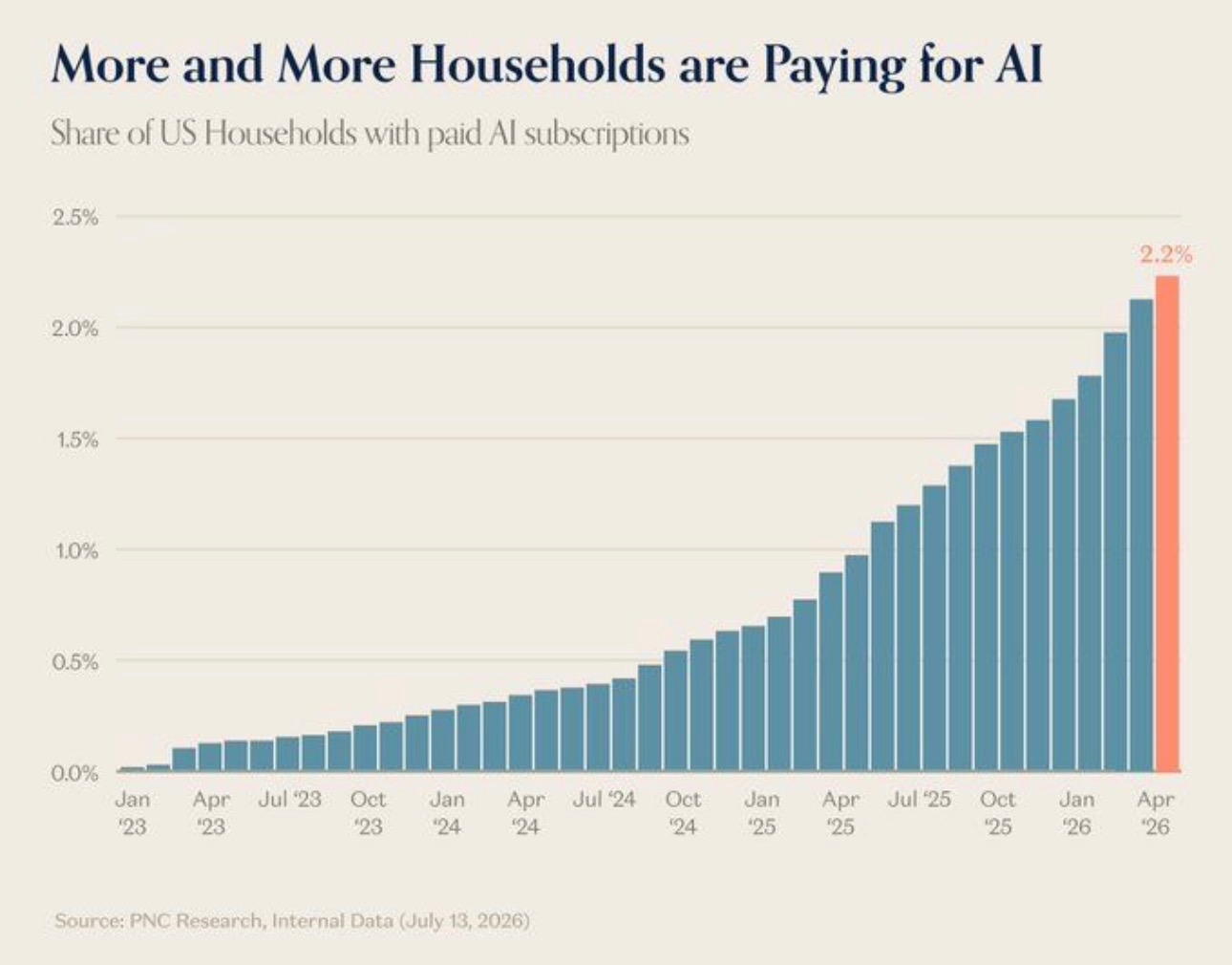
Share of US households with a paid AI subscription, as of April 2026: 2.2%.
Read that again. Not 22%. Two point two. After three and a half years of nonstop coverage, every company on earth bolting "AI" onto their homepage, and a genuine technological revolution, roughly one household in forty-five pays for any of it.
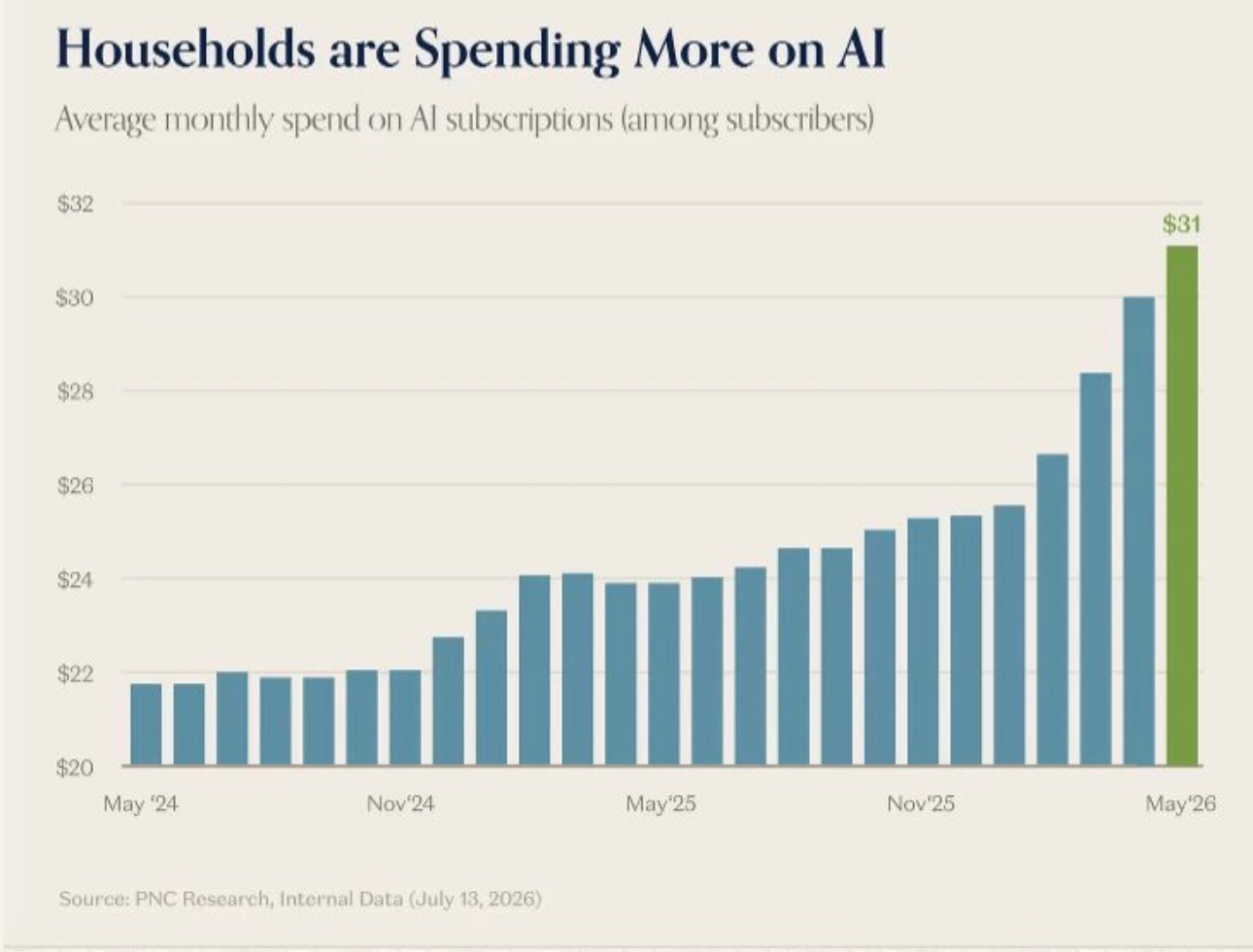
And among the people who do pay, the average spend is about $31 a month. Rising, sure. But $31 is one consumer subscription. That's a ChatGPT Plus seat. Maybe a Teams seat if they're splitting it. It is almost certainly not a coding agent, and it is definitely not a stack.
Now look at your own credit card statement.
Do the math on yourself
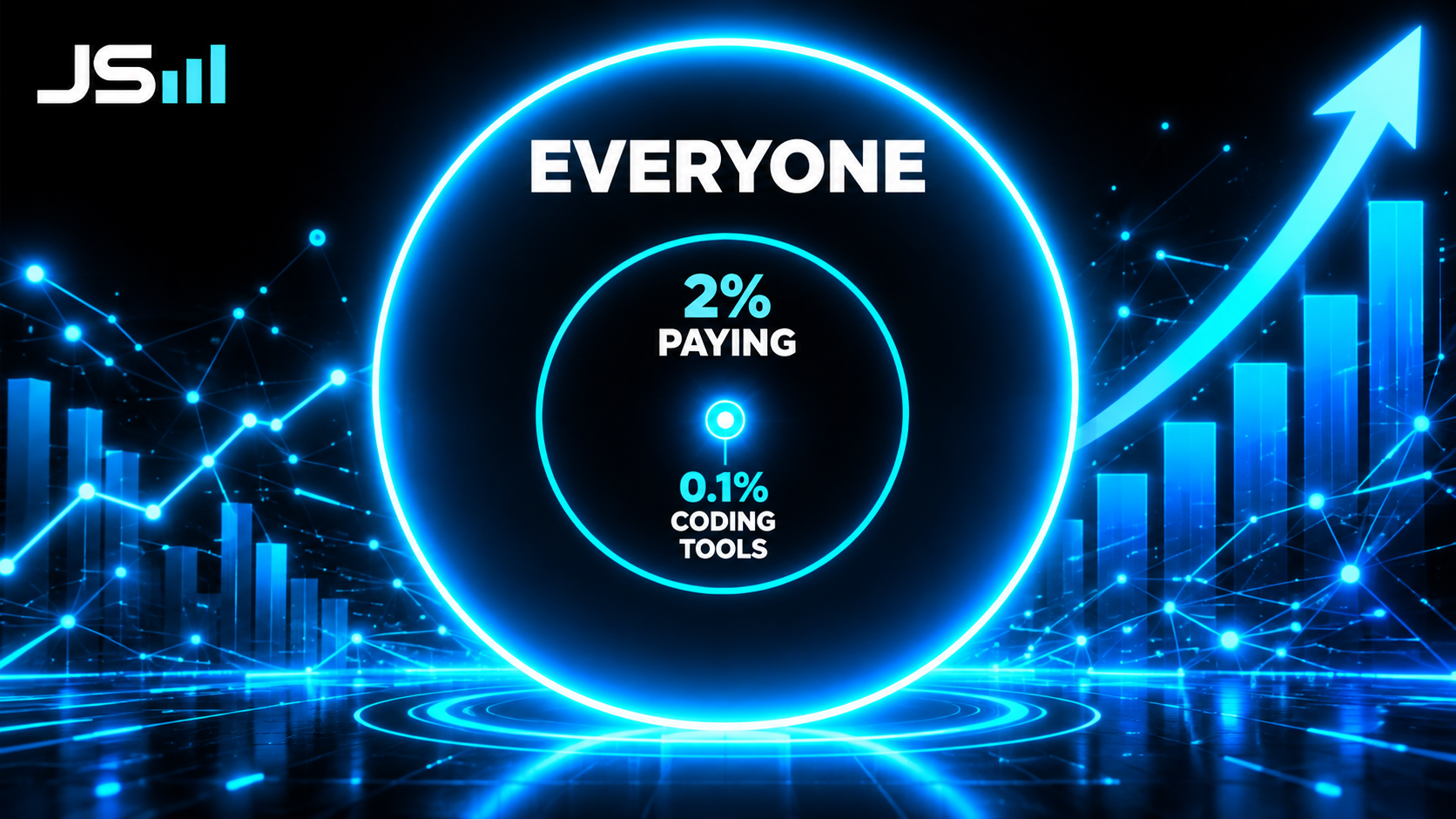
If you pay for AI at all, you are in the top 2% of the country on this. Full stop. That's not a motivational reframe, it's division.
And if you're like me, on a $200 a month plan running Claude Code, plus whatever else is on the stack, you're not in the 2%. One of my mentors, Rich, put it at the top 0.1%, because that's roughly who pays for AI coding tools at all. And that number doesn't even account for how you use them. It just counts the subscription.
So when you're lying awake convinced you're behind: behind who? Statistically, you are standing in a room with almost nobody in it.
What that actually buys you
This isn't just a feel-good stat. The gap in capability is real, and it's enormous.
Here's my own receipt. Building our platform the traditional way, a full software team, six years and a seven-figure budget would be a reasonable estimate. We did it in about six months with a very caffeinated version of me and AI tooling. That's roughly twelve times the speed at a fraction of the cost. I didn't pull off some Elon ten-year-plan-in-six-months miracle, but I'll take 12x.
I've written about that leverage from a few angles: the judgment it takes to steer it, how it collapses the time from idea to shipped product, and why it makes real expertise more valuable, not less. That last one matters here. If you have deep domain knowledge and you're running these tools hard, the two compound. The tool amplifies whatever expertise you point it at. Which, let's be honest, is why you're probably technical if you're paying $200 a month for a coding agent in the first place.
But paying isn't the thing. This is the thing.

Let me be clear about what separates the 0.1% from the 2%, because it is not the size of the invoice.
I am not in the "learn to prompt ChatGPT better" camp. Prompt tricks are cute. "Here are 7 prompts that will change your life" is content, not capability. That's what most of the 2.2% is doing, and good for them, genuinely.
The real thing is using it to iterate at obscene speeds. Build, test, see what breaks, fix it, go again. Launch the rocket, watch it explode, learn exactly why, launch a better one. Hedge your bets, keep a human on the judgment calls, and embed the thing into how your business actually operates instead of treating it as a chat window you visit.
That's the difference. One group collects tips. The other group ships.
Why this also tells you what not to build
Quick aside for the builders, because these numbers have a strategy implication.
If your entire product is a thin wrapper around somebody else's model, you don't have a moat. You have a temporary gap in the model's capabilities, and the model is going to close it on its own schedule, for free, in a release you don't control. I'd put a lot of the voice AI layer in this bucket too, Vapi included. The moment the underlying model gets good enough, the wrapper's advantage evaporates.
The durable version is the opposite: take the model and wire it into real operations, against real specialized knowledge, inside a system you own. When the model gets better, that gets better too, and you keep the whole upside. Squeeze what you already have instead of renting a feature.
The takeaway
Running a software startup is a high-pressure job and I'm not going to pretend otherwise. But the specific fear that you're falling behind on AI does not survive contact with the data.
2.2% of households pay anything. The average one spends $31. If you're on a $200 plan with coding agents running, you're in a sliver of a sliver, and your ability to create and execute right now is genuinely absurd compared to a few years ago.
And the best part: the technology only gets better from here. Every model release makes your leverage bigger without you doing anything. The hum telling you to hurry is mostly noise.
Keep iterating. Keep shipping. Ease off your own throat a little.
And if you want this leverage embedded in your actual business instead of sitting in a browser tab, that's what we do.
Want to talk about what you're building?
Get in touch