Every Business Has Thresholds. The Only Move Is the Next Step.

Your product is duct tape. Or it's not sticky enough. Or you realize your competitors are lazy and you should build your own. Or you need to crack paid ads, because once you do, the thing prints. These are thresholds, and you don't get to think your way across one. I'm standing on one right now. Here's the only advice I've got, plus the framework I use to tell a fast decision from a slow one.
I've written a lot about the stages of this. The duct tape and chewing gum product that started as six boxes on a piece of paper. The month I did $953 in revenue. The phone call where a client told me he broke a million.
What I haven't written about is the gap between those stages. Because they're not a smooth ramp. They're a series of thresholds, and at each one you're standing at the edge of something you can't see into.
I'm at one right now. So let's talk about them.
What a threshold looks like

A threshold is a moment where the thing that got you here will not get you there, and the next move is genuinely uncertain. Not hard. Uncertain. Those are different, and uncertain is worse.
Mine have looked like this:
The product is duct tape. It works, barely, held together by a form and a Zapier endpoint. Customers are using it. You know it's fragile. Do you rebuild it properly, with no guarantee the rebuild is worth it?
The product isn't sticky enough. You sell something, people buy it, and then they leave. That was me. I lost half my customers because what I'd built was useful but easy to walk away from. Do you keep selling it harder, or do you go build the thing people can't leave?
Your competitors are lazy and you realize you could just build it yourself. This one's a monster. I was running my whole business on somebody else's platform, paying rent, living with their decisions. Building my own meant two years of work and a very real chance of ending up with nothing. I did it anyway, and that platform is the company now. But on the day I decided, it was a coin flip with my life savings on it.
You have to crack paid acquisition. This is the one I'm standing on today. Because sales is just a system, and paid ads are the most leveraged version of that system there is. Get it working and the thing prints. Don't, and you're burning money while you learn. I've already written about the free-thing-as-filter approach we're using to attack it, and the morning I was wrong about consent and our opt-in rate went from nobody to six out of seven. That's progress. It is not across yet.
Notice none of those are "work harder." Working harder is what you do on a flat stretch. At a threshold, more effort in the current direction accomplishes nothing. You have to go somewhere you haven't been.
The only advice I actually have
Take the next step.
That's it. That's the whole thing. I've been looking for something smarter to say for about four years and I don't have it.
You don't need the full plan. You can't have the full plan, that's what makes it a threshold. You need the next step, and then you need to be standing somewhere new, where you can see things you couldn't see before.
I've done this enough times to trust it

When I was 20, in the middle of a pandemic, I moved to Florida alone. I didn't have a great reason. It felt like the next step. Five years later my entire family lives down here. Apparently I was a trailblazer, which is a generous word for "went first and hoped."
My first amateur fight, I was terrified. Genuinely. My coach pulled out the Man in the Arena speech and told me that even if I got brutally beaten, I'd have done more than most people ever do. Spoiler: I did not get brutally beaten. But I didn't know that beforehand, and that's the point. The information wasn't available until I was in the ring.
Starting the first company. Then the second. Then the third, all three of which died. Then this one. Moving up to Brevard County and knocking on what felt like every single door in the county for a year and a half.
Every one of those was a threshold, and every one of them I crossed with no idea how it would go. Some went badly. Three of them literally died. And I'm still here, in business number four, with the best company I've ever built.
So I'm not telling you to be brave because bravery is noble. I'm telling you because I have a sample size now, and the pattern is that stepping forward with incomplete information beat standing still every single time, including the times it failed.
What you actually get from stepping
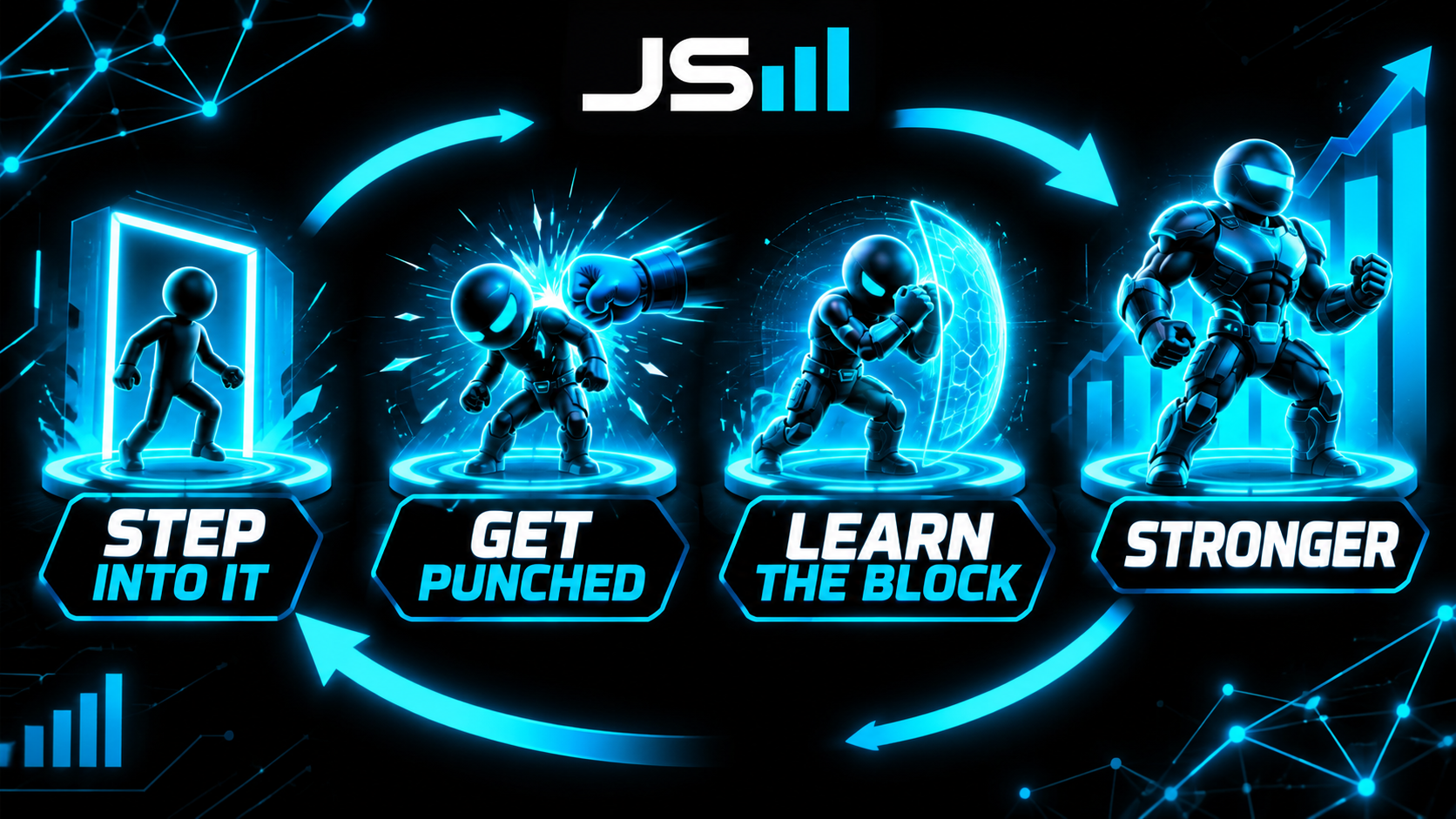
Here's the part that'll land for the engineers reading this.
When you step into the unknown, you get two things: information, and hardening.
Information is obvious. You can't learn whether paid ads work for your offer by thinking about it. You learn it by spending money and reading what comes back. The data does not exist until you move.
Hardening is the better one. You know how edge cases punch you in the face? You ship something, reality hits it with a case you never imagined, it breaks, and then you write a guard against that specific thing. Your system is now permanently stronger in a way it could not have been through planning, because you didn't know that case existed.
That's what crossing a threshold does to a founder. You get punched. You learn the block. The next version of you has a defense you couldn't have designed in advance. It's an iteration loop. The only input is actually stepping into the ring.
And the clock is the whole reason this matters. Time is limited. I could coast right now if I wanted to, the company's doing well, I've got clients I like. Coasting is available. But there are only so many iterations in a life, and standing still burns them at the same rate as moving.
Not every step. The framework.

Now let me add the thing that keeps "just take the next step" from being reckless, because taken literally that advice will eventually get somebody hurt.
I stole this framework from Elon and it's the most useful decision rule I have:
Reversible decisions, where failure is cheap and easy to fix, you make at a speed nobody else operates at. Don't deliberate. Don't schedule a meeting. Just go. Try the ad angle, ship the feature, make the call, send the email. If it's wrong, you undo it and you've lost an afternoon and gained information. Most people agonize over these, and that's where they lose years. Build the ugly version and find out.
Irreversible decisions, where the door closes behind you, you make slowly and deliberately. Signing a long lease. Taking money. Firing somebody. Betting the company on one direction. For these, slow is correct. Gather everything, talk to the people who've been there, sit with it. The cost of being wrong isn't an afternoon, it's years.
The mistake almost everyone makes is doing it backwards. They spend three weeks on a reversible decision and then make an irreversible one on a vibe at 11pm. If you only take one thing from this article, take that.
I've got a big one coming up. It's in the second category. So I'm moving slowly on that one and extremely fast on everything around it.
Decades and weeks
There's a line I keep coming back to: there are decades where nothing happens, and weeks where decades happen.
That's thresholds. Most of your days are flat, and that's fine, that's where the work gets done. But every so often a few weeks show up that determine the next ten years. The move I made to Florida was a few days of deciding. Choosing to build our own platform instead of renting one was one conversation. Those weeks did more than the years around them.
You usually can't tell which weeks they are while you're in them. You can only tell that you're at a threshold, which is a clue.
A tangent on decision fatigue, since I'm here
Related and slightly ridiculous. If the big decisions are the ones that matter, then every small decision you make is drawing down a budget you should be spending elsewhere. Decision fatigue is real and it's dumb that it costs what it costs.
So I'm seriously considering the Steve Jobs move. Pick one outfit, buy thirty of it, never think about it again. I'm leaning black shirt. If you've got opinions, I'm taking them, because I'd rather spend the deliberation on the vault door.
The takeaway
You're going to hit thresholds. Your product's going to be duct tape, or not sticky enough, or your competitors are going to be lazy enough that you realize you should build it yourself, or you're going to have to crack a channel you've never cracked.
At each one, the thing that got you here won't get you there, and you won't be able to see across. So move fast on anything you can undo, slowly on anything you can't, and then take the next step.
Worst case is sometimes genuinely bad. I'm not going to pretend otherwise. But as long as there's a worst case you can still describe, there are moves left on the board. Dead businesses one through three are the receipts.
A little grim for a Friday night. Take the step anyway.
And if the threshold you're standing on is a technical one, that's the kind we help people across.
Want to talk about what you're building?
Get in touch