The Whole Company Started as a Sketch on a Piece of Paper

I found the original drawing. Six boxes, a crossed-out word, no name for the thing. It was an internal tool I built because posting photos to social media was a pain, held together by a HighLevel form, a Zapier endpoint, and middleware I can't explain. Eighteen months later it's business number four, a platform I own, and a client who just broke a million. The journey of a thousand miles really does begin with one ugly step.
I'm apparently in a publishing mood today, so here's one more, and this one's a little different. It's not a take. It's a drawing.
There's an old line, Chinese I think, Lao Tzu if the internet is to be trusted: the journey of a thousand miles begins with a single step. I've written a lot about testing and iterating, about the valley of despair, about what it's like to be a founder with what we'll generously call a unique skill set. What I haven't shown you is where the single step actually was.
One thing before I do, because it would be dishonest to skip it. I write a lot about things I've done, and that's the nature of a blog written in the first person. But I would not be sitting here today without the mentors I've had. Not as a nice sentiment, as a load-bearing fact. People with no obligation to help me looked at what I was doing and told me the truth about it, repeatedly, and that changed the outcome. Nobody is self-made, and I've got a full article coming on mentorship specifically, because it's probably the highest-leverage thing in my whole story. Keep that in the back of your mind while you read this, because one of them shows up halfway through and changes everything.
Okay. Here's the sketch.
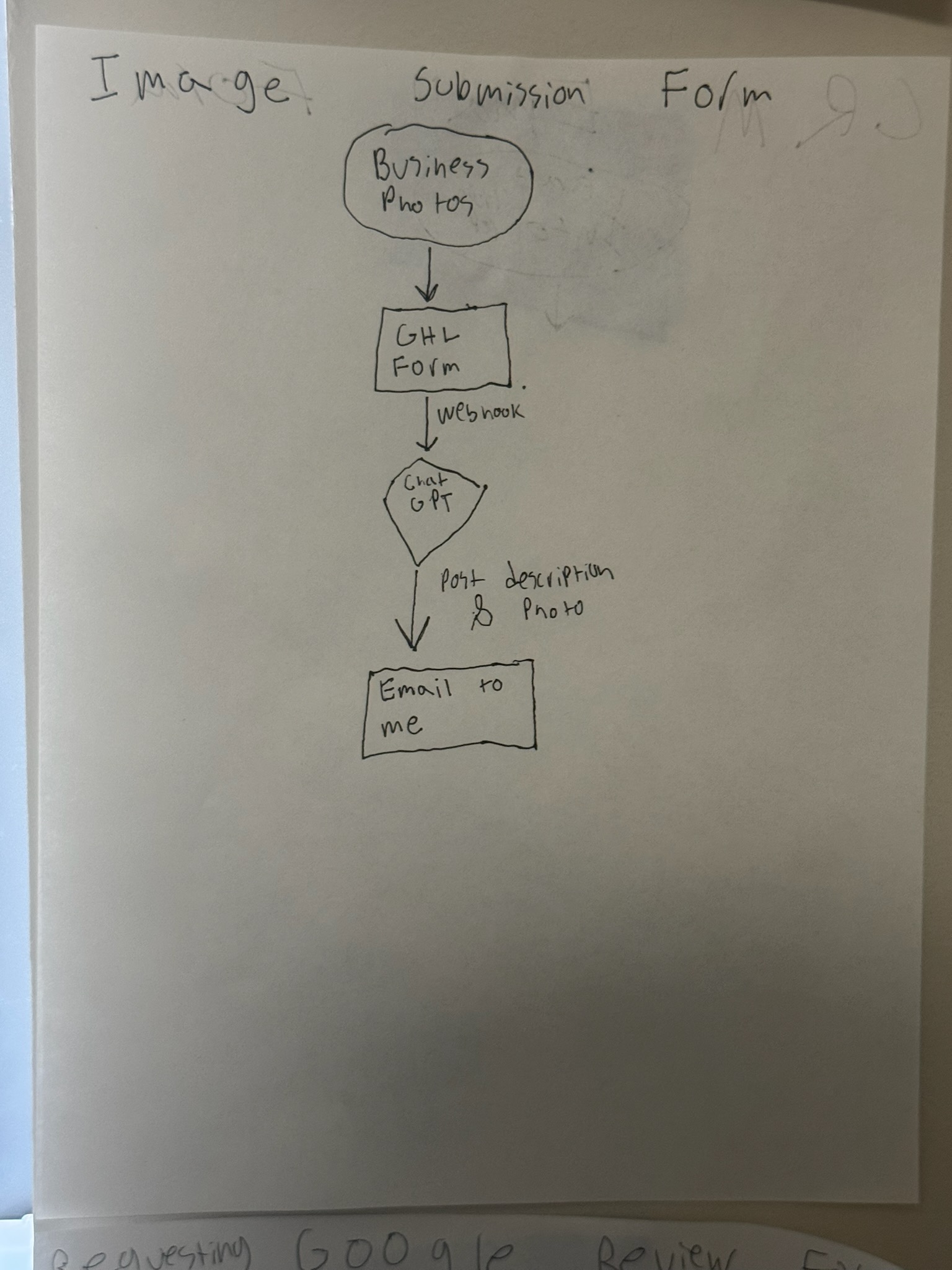
What you're looking at
That's a sketch I made when I first started this business, before we knew what we were doing. And I want to be precise: we really did not know what we were doing. The original plan was to be a funnel agency. A marketing shop. Fun fact, we still do that, and we do it very well, but it's AI-powered now, so it's different, I swear.
I was sitting around sketching things I might be able to sell, and I noticed something that annoyed me personally. Posting photos to social media was a huge pain. Take the picture, write the caption, log into every account, post it everywhere, repeat. For a business owner that's a chore that never gets done, which is why most local business pages have one post from 2023.
So I drew what I wished existed. Read the boxes:
Business photos. Into a form. Form fires a webhook. ChatGPT writes the post description. Post and photo get emailed to me so I can approve it.
That's it. That's the whole idea. Submit a picture, AI writes the post like you would, it goes out everywhere. And notice the last box, "email to me." The approval step. Human in the loop, before I had the phrase for it. We built that exact feature in later, on purpose, because the logic was already right there on the page. You can see the whole shape of the thing in six boxes and a crossed-out word.
How it actually worked, which you should not copy
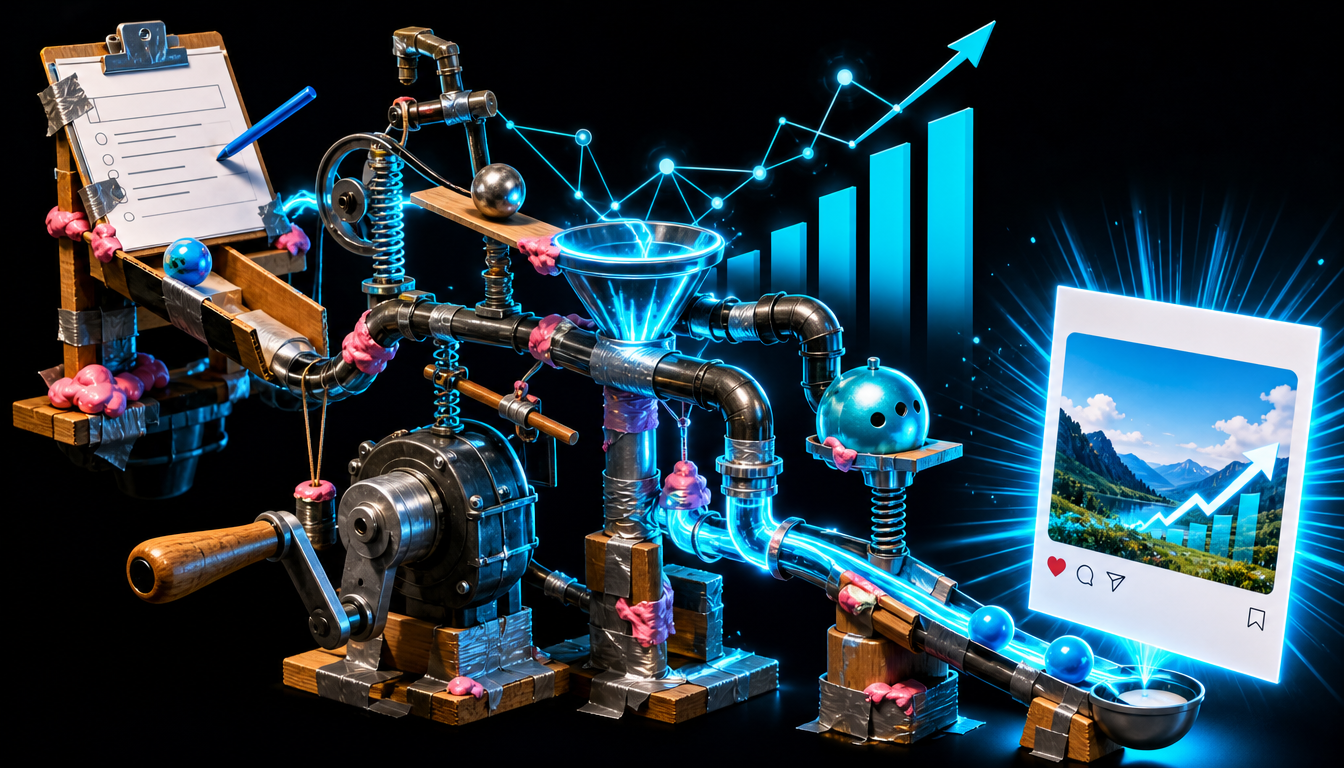
Don't ask what was under the hood. I'll tell you anyway because it's funny now.
It was a HighLevel form. That fed into some middleware I built for reasons I can no longer reconstruct. That got duct-taped into a Zapier endpoint, because the social posting tool I was using didn't have an API, so the only way to talk to it was through Zapier. Yes, me. The guy who now tells you never to put your logic in Zapier. That was my entire stack. HighLevel, Zapier, gum, prayer.
Here's my favorite part. The Zapier bill was annoying me, so I decided I'd reverse engineer the posting tool's private API to cut it out. The day I started doing that, they released a public API. I remember just staring at the announcement. The universe has a sense of humor.
And in all seriousness: do not reverse engineer someone's API. I didn't know better at the time. It's a big no-no, it's not how I'd operate today, and I would never do it again. I'm telling you so you don't.
While I'm confessing. In college we had a chemistry lab where you had to run a titration and end up with a pink solution. My brother and I thought the smart move was to dilute red Gatorade with water until it turned pink and submit that. I'd love to call it entrepreneurial thinking. It was not. It was me being young and dumb. Don't submit diluted Gatorade, and don't reverse engineer APIs. Both of those are the same mistake wearing different clothes: shortcuts that feel clever and aren't.

From "huh, that's handy" to a product

So I built the ugly version and started using it myself. It was an internal tool. It saved me time. That's all it was for.
Then my business partner looked at it and said, you should sell that.
And here's the mentor thing I mentioned up top, in action. I had the reaction I have every time he says something obvious that I missed: wait, that actually makes sense. I hadn't put two and two together. Of course I hadn't, that's his gift, not mine. I was looking at a chore I'd automated. He was looking at a product. One sentence from him turned an internal tool into a company.
So it became the ASP form, and we landed our first clients on it. Boom, boom, boom.
Don't ask how that chapter ended. Fine, I'll tell you. I lost half my customers, because it wasn't sticky enough on its own. That's the month I did $953 in revenue, and I've written that whole story. People still use ASP. It's just the entry rung now, not the main offer. The main offer is the entire machine, and that machine exists because the first ugly box on a piece of paper led to the second one.
What I want you to take from the drawing

I never thought I'd be a software founder. I had no idea I'd build an AI-powered CRM from scratch, or an assistant that writes my blog while I drive, or that a cabinet shop would break a million because of something I architected. None of that was in the plan, because there was no plan. There was a sketch, and there were people who told me what to do with it.
Here's what I actually believe about this. Starting a company tests every single weakness you have. Not some of them. All of them. For me it was the social stuff, which, if you've met me, you already guessed. You need a very high pain tolerance and a particular kind of wiring to keep going through the phases that suck, and there are a lot of them.
But the phases that suck are survivable if you just keep taking the next step. Not the whole journey. The next step. The ugly version. The form that works but shouldn't. The internal tool nobody's going to buy. The first customer. The month you lose half of them. The rebuild. The next one.
Eighteen months in, company number four, and we're genuinely crushing it. Not because I had vision. Because I drew six boxes, built the first one, and had people around me who were honest about the rest.
Journey of a thousand miles, one step. The proverb's right. The step is uglier than you think, and that's fine. Take it anyway.
And if you've got a sketch on a napkin and no idea what to do with it, that's a conversation I'm always up for.
Want to talk about what you're building?
Get in touch