
Nobody Is Self-Made

"Pull yourself up by your bootstraps" is a physics joke that became a personality. Work like a dog, absolutely, extraordinary inputs are the only way to extraordinary outputs. But look at what success actually is, and you'll find a mentor, an uncle, a partner, and a whole community holding the ladder.
Every time somebody calls themselves a self-made millionaire, I wince a little.
Not because I doubt they worked hard. They probably did. I wince because "self-made" is a lie we tell about how success works, and the "pull yourself up by your bootstraps" version of it is actually worse, because it was originally a joke. Try it. Sit down, grab your boot straps, pull. You will go exactly nowhere. That's the point. The phrase was coined to describe something impossible, and somehow we turned it into a compliment.

So this is going to annoy some people. Good. Stay with me, because the argument is not what you think.
First, the part I need you to hear clearly
I am not telling you to work less. I want to be so clear about this that it's almost rude.
If you want to be successful, you have to work like a dog. That's not a slogan, it's arithmetic. Extraordinary inputs lead to extraordinary outputs. If one unit of work gets you one unit of result, two gets you two, and ten gets you ten. There is no version of this where you skip the input. I've written a whole blog's worth of articles about shipping fast and grinding, including 856 releases in five months and scaling this company by knocking on doors, and I meant every word.
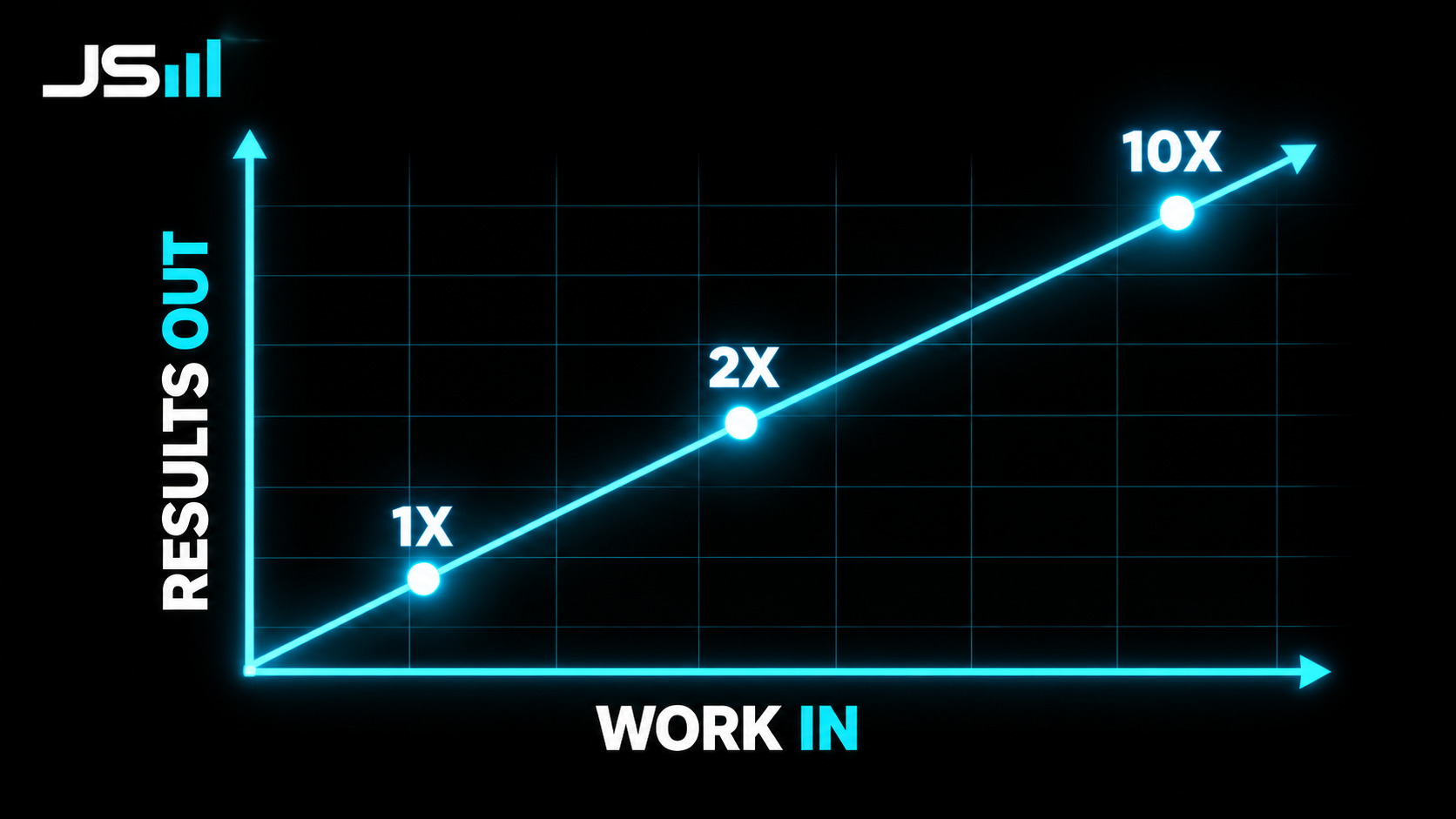
So this is not a "hustle culture is toxic" article. Hustle is required. What I'm arguing is that hustle is necessary and nowhere near sufficient, and the people who forget the second half start believing something about themselves that isn't true.
Look at what success actually is
Strip away the mythology and ask what a successful business actually consists of.
It's people who know you, like you, and trust you enough to hand you money. That's it. That's the whole thing. A business with no customers isn't a business, it's a hobby with a logo. And every single one of those customers is a person in your community who decided to believe in you.
You cannot bootstrap that. You can't will it into existence alone in a room. Success, by definition, is other people.
My receipts, since I keep saying I'm moderately successful
Let me get specific, because the abstract version of this argument is easy to nod at and ignore.
I run a company that's doing well now. It was not always doing well, and I've been very public about the month half my customers cancelled and I did $953 in revenue. I would not have come out the other side of that without a handful of specific people who had no obligation to help me and did anyway.

Start with a small one. When I was 19, I was 140 pounds at five foot eight, which is a polite way of saying I was a stick. I wanted to get in shape and I had no idea how. So I asked my uncle, who's in incredible shape, to teach me. He didn't have to. He did. He taught me how to train, how to eat, how to actually build a body instead of flailing at a machine. Long story short, 25 pounds of muscle.
Now, did I do the work? Every rep. Every meal. Years of it. Nobody lifted the bar for me. But if you asked me who's responsible for that result, the honest answer is "me, and also my uncle," and anyone who says just "me" is lying to make the story sound cooler.
Business was the exact same pattern at a bigger scale. My mentor and business partner, Brandon Gosselin, taught me pretty much everything I know about running a company. How to sell. How to think about a customer. What to build and, more importantly, what not to. He saw what I was good at before I had words for it and pointed me at it, which is the whole story of how a failed fitness guy ended up building software.
And it's not just mentorship. It's the opportunities people hand you. The introduction that leads to the client. The professor who mentions your name in the right room, which is most of what I think college is actually for. The friend who passed my study guide to a guy in Texas and got me my first sale ever. The chamber of commerce lady who lets you speak. None of those were things I earned by grinding harder. They were people choosing to open a door.
The web you're standing in

Draw it out and it's obvious. There's you, working like a dog, in the middle. And around you, a web: the mentor who taught you, the family that fed you before you could feed yourself, the friend who made the introduction, the customers who took a chance, the community that bought from you before anyone else would. Cut any one of those lines and the whole picture changes.
The "self-made" guy sees himself in the middle and edits out the lines. Not because he's evil. Because the lines are humbling, and it feels better to be the whole story.
And that's just the human side of it. There's God's provision under all of this too, but that's a bigger conversation. Stick to the people you can name and the case is already closed.
Why this matters practically, not just philosophically
Here's why I actually care, beyond it being true.
The self-made myth makes you a worse founder. If you think you did it alone, you stop asking for help. You stop looking for mentors. You get weird about giving credit. You treat your customers like a scoreboard instead of the people who are literally the reason you exist. And you become impossible to work with, because you think the company is you.
It makes you a worse mentor. The guys who think they bootstrapped it are the ones least likely to hold the door for the next person, because they've convinced themselves nobody held it for them. So the chain breaks.
And it makes the work lonelier than it needs to be. The valley of despair is bad enough on its own. Going through it while insisting you don't need anybody is how founders burn out.
So what do you actually do with this
- Work like a dog. Still true. Always true. 10X in, 10X out. Don't let anything in this article become an excuse.
- Find your mentor. Whatever you're trying to get good at, somebody already is. Ask. The worst they say is no, and almost nobody says no to a genuine ask.
- Say who helped. Out loud, by name, often. It costs nothing and it keeps you honest about how you got here.
- Be somebody's mentor. The only real way to pay back the people who opened doors for you is to open them for someone else.
- Treat your community like the asset it is. Your customers are not a number. They're the people who decided to trust you. Act like it.
Number two and number four deserve a lot more than a bullet point, so I'm going to write a full article on mentorship soon. How to find one, how to actually be worth mentoring, and how to be one yourself. It's probably the highest-leverage thing in this entire piece.
I worked for everything I have. I also didn't do any of it alone. Both of those are true at the same time, and the second one doesn't shrink the first. It just makes the story accurate.
Nobody is self-made. The sooner you stop pretending, the more people will want to help you build.
Want to talk about what you're building?
Get in touch