College Is a Scam (Unless You Use It Right)

As an education, what you get for the money is a bad trade, and I say that as a current MBA student. As a networking machine, it might be the best deal on the table. The trick is knowing which product you actually bought.
College is a scam.
Now let me add the part that keeps me from getting run out of the building, because I am, at this exact moment, an MBA student who is voluntarily paying for the thing I just called a scam.
College is a scam as an education. As a networking machine, it might be the single best deal available to a young person, and almost nobody uses it that way. Those two sentences are not in conflict. They're the whole article.
The part where I'm mean about it
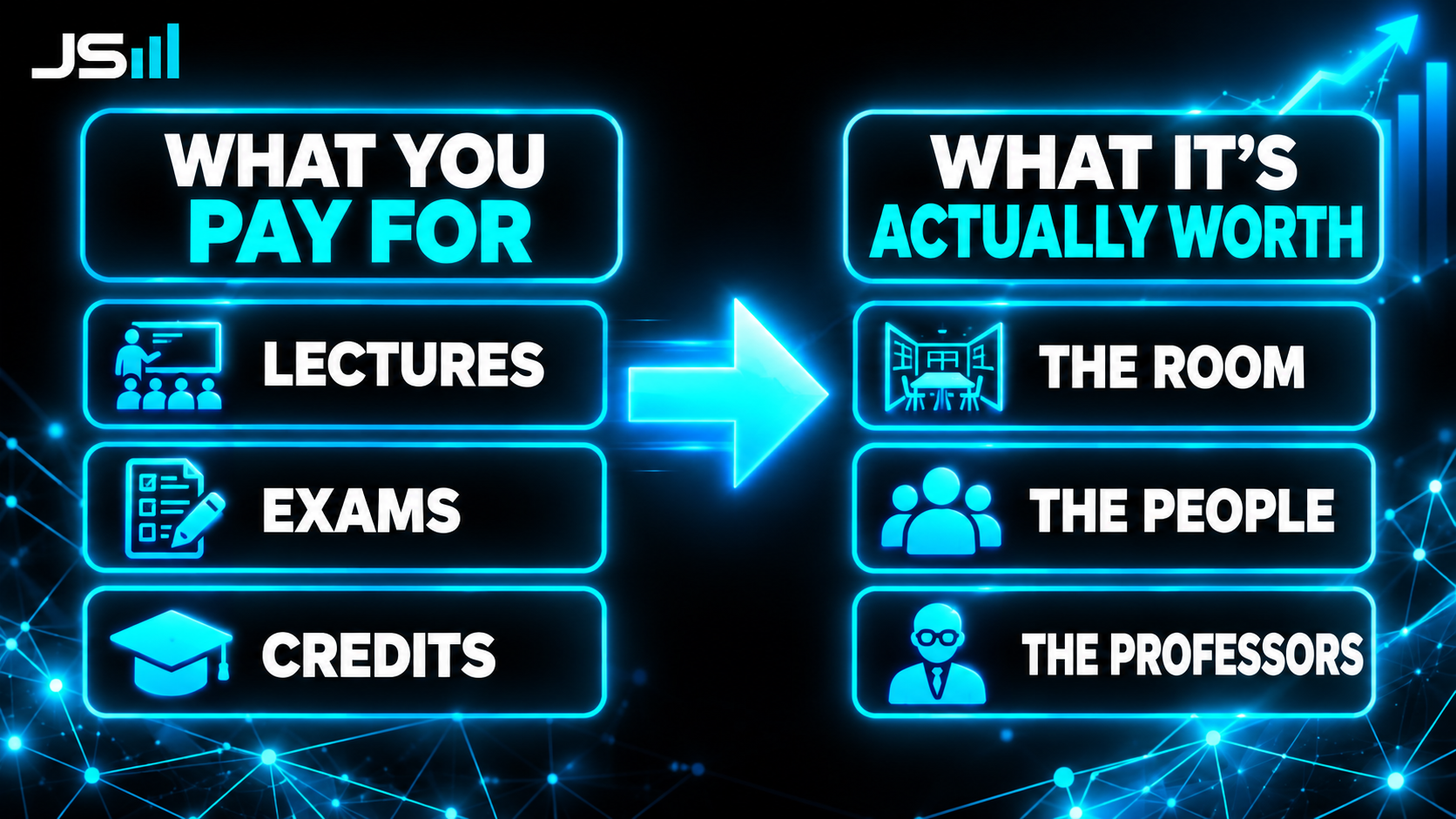
Let's talk about the trade. You hand over a truly stupid amount of money. In exchange you get lectures, exams, and credits. If you're going for a PhD in something genuinely specialized, or med school, or law school, fine, the credential is the product and it's a real one. You legally cannot do the job without it. No argument from me.
For everybody else? Look at what's actually in the box.
Half of a typical undergrad degree is courses you will never use. And I want to be careful here, because I'm a massive history nerd. Genuinely. Ask anyone who's had a beer with me and made the mistake of mentioning the Roman Republic. I think everyone should read history. I just don't think the average twenty year old should be charged four figures per semester to be lightly quizzed on it while trying to get a marketing degree.
And the price keeps climbing while the thing it buys keeps getting less rare. Competition for good jobs got fiercer, so the bachelor's stopped being a differentiator, so now people go get a master's, and soon that won't be a differentiator either. That's not education. That's an arms race with tuition attached.
My receipts
I majored in something completely unrelated to what I do now. Everything I actually earn a living with, writing code, designing systems, building AI agents that run a company, I taught myself. Not "took a bootcamp" taught myself. Sat down, broke things, read documentation at 2am, built it, taught myself.
I'll be honest about the asterisk on that: I'm wired a little strange. I can sit with a hard problem for nine hours and enjoy it. That is not a universal setting, and I'm not going to pretend it is. But the point stands. The knowledge was free and available. The thing I paid a fortune for was not the knowledge.
And now I'm in an MBA program, and there are absolutely moments in class where I look around and think, this is a very confident description of a world none of us are standing in.
Okay, but here's where everyone gets it wrong
Every one of those complaints has been made a thousand times on the internet. Student debt is a scam, degrees are worthless, learn to code on YouTube, the whole genre. That's not what I'm here for. That take is loud, half right, and useless, because it ends with "so don't go," and then a nineteen year old walks away from the single densest concentration of useful human beings they will ever have legal access to.
Here's the reframe. Stop buying the education. Buy the room.
A university is a building where hundreds of ambitious, smart, unformed people are stacked on top of each other with nothing to do but talk to each other, plus a staff of professors who have spent decades in the industry you're trying to enter and are, for four years, contractually obligated to answer your emails. You will never again in your life have that kind of access for free. Not at a conference. Not on LinkedIn. Not anywhere.

What I'm actually doing with my MBA
I wish I could go back and tell my undergrad self this. I can't, so I'm making it up in real time with the MBA.
I'm not there for the grade. I'm there to work the room, and it is working. A few things that have come out of it already:
- I've met several strong sales candidates who are sitting right next to me in class. Not from a job board. From a seat.
- I've been meeting with one of the directors, who is now helping me navigate the right channels to find software talent for my company.
- I've had genuinely great meetings with professors. Business school faculty are frequently very well connected. They've run companies, they've consulted, they know people, and a shocking number of them are delighted that a student asked them a real question instead of asking whether something's on the exam.
That last one matters more than people realize. The professor is not the vending machine for the content. The professor is the introduction.
And on the hiring point, this is exactly why I wrote about not chasing the mythical do-everything hire. I'm one man. I cannot personally fix every UI issue, write every line of backend, and run sales. I need real people. Turns out a graduate program is a pretty efficient place to find them.
And no, not every class is bunk
I want to be fair, because the lazy version of this take pretends every second in a classroom is wasted.
I sat in a class recently where the professor pulled up his actual live ad account on the projector. Real campaigns, real spend, real numbers, in front of the room. That's not theory. That's the thing itself. That was genuinely valuable, and I've written before about how much respect I have for people who can actually make ads work, so watching someone do it live was the opposite of a waste of my time.
So no, it's not all bunk. Some of it is excellent. The problem is that the excellent parts are priced identically to the filler, and nobody tells you which is which when you enroll.
The nuance nobody wants because nuance doesn't trend
I'm deliberately not touching the politics of higher education. Both directions. Not my lane, not my interest, and the second an article goes there it stops being about anything useful.
What I'll say is that our public conversation about this has exactly two settings: "college is a life-ruining debt trap" and "college is the only path to a respectable life." Both are dumb. The real answer is that college is a bundle, and the bundle contains one overpriced product and one underpriced one, and your entire return depends on which one you spend your four years consuming.

Squeeze it
If you're in school right now, or you're about to be, or you're paying for someone who is, this is the whole playbook:
- Go to office hours. Not to ask about the exam. Ask what they did before teaching and who they still know.
- Assume the person next to you is a future hire, cofounder, client, or referral. Act accordingly.
- Take the classes where someone shows you the real thing, not the model of the thing.
- Learn the actual skill on your own time, for free, because it is free.
- Leave with a contact list, not just a transcript.
This is just the Sawdust Principle pointed at your own education. You already paid for the sawmill. The tuition is sunk either way. So stop sweeping the most valuable byproduct into the trash because the brochure told you the diploma was the product.
College is a scam. Go anyway. Just be very clear about what you're actually there to take.
Want to talk about what you're building?
Get in touch