On Mentorship

Socrates taught Plato, Plato taught Aristotle, Aristotle taught Alexander, and Alexander carried Xenophon's field notes with him into Persia. Four generations of teachers and one guy who wrote it down. I would not be where I am without mine: my uncle taught me to lift, Brandon taught me to sell and spotted what I was actually built for, and Rich took my software and hardware game somewhere I couldn't reach alone. Here's what I've learned from the receiving end.
Socrates taught Plato. Plato taught Aristotle. Aristotle taught Alexander the Great, who then went out and conquered most of the known world before he was thirty.
Four links in a chain, and the last one reshaped the map. That is, I think, the single best argument for mentorship ever recorded, and nobody's really beaten it in 2,400 years.
Which brings me to why I'm writing this.
This blog is a lot of me. My ideas, my builds, my opinions about which tools are garbage. That's the nature of a blog with my name on it. But read enough of it and you could come away with the wrong picture, so let me correct it directly.
I would not be where I'm at today without the mentors I've had. Not as a humble thing to say. As a plain fact about how I got here. I wrote Nobody Is Self-Made and promised a full piece on mentorship. This is it.
Six things I've learned about it, all from the receiving end.
1. Different mentors for different areas of your life

Let me give you mine.
My uncle: fitness. During the pandemic, I was a skinny kid who'd wrestled in high school and had no idea how to actually lift weights. I wanted to go from skinny nerd to jacked, and I did not know how to get there. My uncle did. The man is pushing seventy with a six pack, and I still don't fully understand how. We had a weight set at my dad's house, and he taught me proper form, how to actually eat so I'd put on size, how to structure a week. Twenty-five pounds of muscle later, that was the whole reason.
Brandon: business. My business partner. He taught me how to sell. How to talk to people. How to work on the parts of myself I wasn't good at. He helped me think through questions about faith. And, maybe most importantly, he noticed something about me before I'd noticed it myself. He'd send me a Zapier automation or some workflow and I'd just build it, fast, without really thinking, and he saw that for what it was: a specific gift I'd been pointed away from for three failed businesses. He pointed me at it. That's how Hyppo started.
Rich: the craft itself. Brandon introduced me to Rich, which is its own lesson I'll come back to. Rich took my software and hardware game to a level I genuinely could not have reached on my own. Not encouragement, not vision, actual technical depth, the stuff that only comes from somebody who's been inside the machine a long time. And the relationship isn't a lecture. Rich and I bounce ideas off each other constantly. He's the one who put the number on how rare it is to actually be a power user of these tools, which turned into an entire article.

Three people, three completely different domains. Here's the principle, and Brandon's the one who taught it to me: nobody's good at everything, so don't look for one mentor. Look for a different one for each area of your life.
Think about it from the other side. If somebody asked me to mentor them on sales, I could teach them a thing or two, sure. But it would be a bad fit. I'm an average salesman on my best day. If somebody wanted mentorship on building software, or thinking in systems, that I'm genuinely great at, and I'd be a great mentor for it. The person you want in each area is the one who actually went down that specific road.
There's a line in Proverbs: plans fail for lack of counsel, but with many advisers they succeed. That's this. People from different walks of life see the world differently, and you want several of those lenses, not one.
And notice the thing hiding in the Rich story: Brandon introduced us. A good mentor doesn't just teach you, he hands you his network. One relationship became two. That's how the chain actually grows.
2. Good artists copy, great artists steal

Picasso said it, Jobs quoted it constantly: good artists copy, great artists steal. And I think the reason it's true is the part nobody says out loud.
Copying is taking one person's thing and reproducing it. You end up a worse version of them. Stealing is different. Stealing is taking a piece from here, a piece from there, from people who don't even know each other, and assembling something that didn't exist before you put it together.
That's exactly what having multiple mentors does to you.
If I'd only learned from Brandon, I'd be a worse Brandon. If I'd only learned from Rich, I'd be a worse Rich. But I took sales instinct from one, technical depth from another, discipline and how to build a body from my uncle, and dropped all of it into whatever my own weird wiring already was. What came out is a combination none of them have and none of them could have given me on purpose.
And here's the practical part: that combination is extremely hard to replicate. Anybody can read the same books. Nobody else has your specific set of thefts. I've written about how judgment is the real moat, and this is where judgment actually comes from. Not one source. A pile of borrowed instincts from people who disagreed with each other, filtered through a thousand of your own mistakes.
So steal. From everybody. Different domains especially. The weirder the mix, the harder you are to copy.
3. A mentor compresses the learning curve
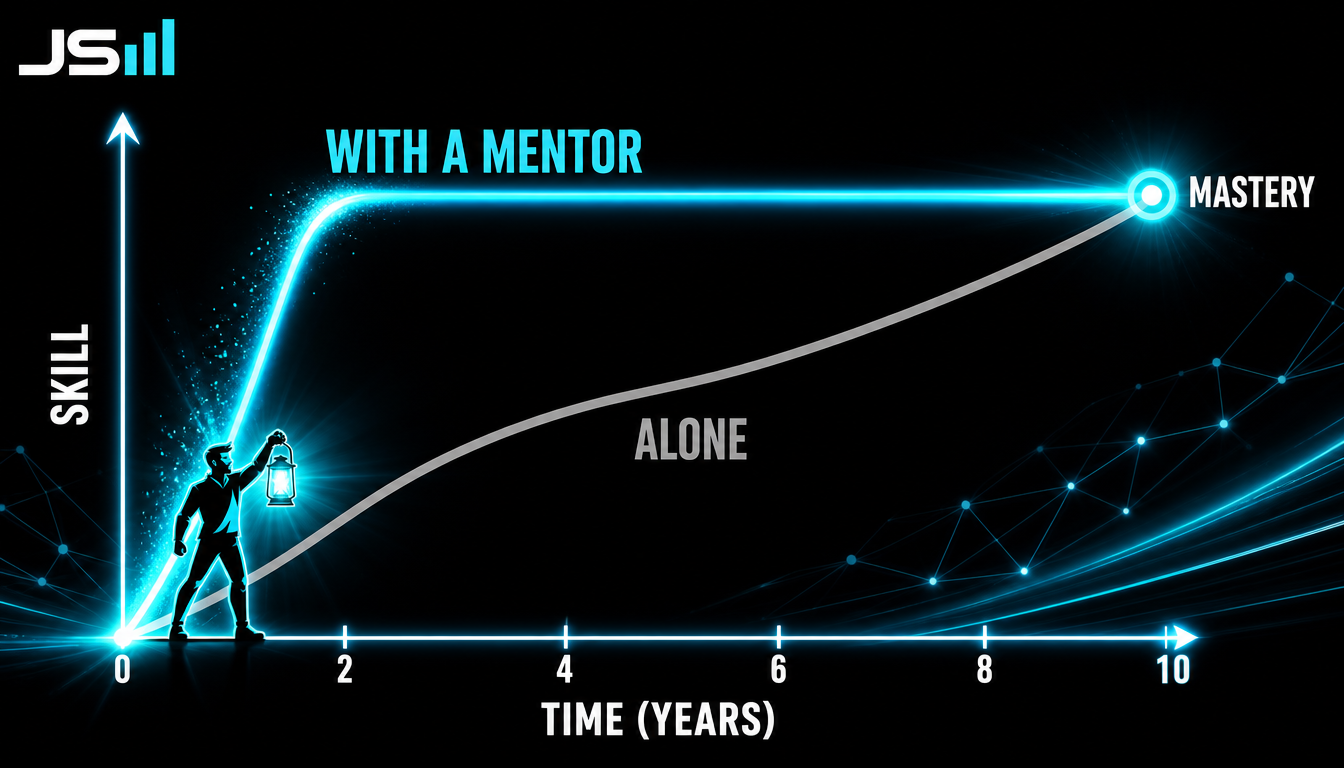
This is the actual mechanism, and it's worth being precise about.
What makes someone worth learning from is that they failed, repeatedly, in a specific domain, and kept going until they understood it. That knowledge cost them years. A good mentor hands it to you at a fraction of that cost. Not for free, you still have to do the work, but you skip the part where you make the same dumb mistakes they already made.
When Brandon and I started working together, he'd founded tech companies before. He wasn't the one writing the code, but he knew how they ran, how they died, what killed them. And he said something to me that I've never forgotten: "Joe, my goal is to get you where you should be in ten years in about two."
I'm sitting here now as a CTO with a platform I built and a client who just broke a million. I'd say that worked out.
Robert Greene's book Mastery opens on exactly this. Find a mentor, study under them, let them compress the curve. And I want to be honest about the catch: it compresses the curve, it doesn't delete it. You still have to put in the ten thousand hours. I spent about two years where building software products was my entire existence, and no mentor could have done those hours for me. What they did was make sure the hours were pointed at the right things.
4. The best mentors write it down

Indulge me, I'm a history nerd and this one is my favorite story in the whole article.
About seventy years before Alexander, a Greek named Xenophon signed on as a mercenary with a Persian prince who was trying to take the throne from his brother. The prince lost. He died at the battle, and suddenly ten thousand Greek soldiers were stranded deep inside the Persian Empire with no employer, no allies, and no way home.
Xenophon ended up leading them out. They fought and marched their way back to the sea, and he wrote the whole thing down in a book called the Anabasis.
Now here's the part that matters. Xenophon did not conquer Persia. He failed at the mission he went out to do. What he accomplished was getting ten thousand men home alive and then documenting every single thing he'd seen on the way: the terrain, the logistics, how the Persian army actually fought, and above all the realization that the whole enormous empire was softer on the inside than anybody in Greece believed.
Alexander is said to have carried that book with him. He studied it. And he took the weaknesses a failed mercenary had noticed and written down, and used them to take the entire Persian Empire in an absurdly short span of years.
Think about that chain for a second. A guy loses, survives, writes it down. Decades later somebody who never met him reads the notes and conquers the known world with them.
That's mentorship without the mentor ever being in the room. It's also the purest version of stealing from point two: Alexander never met Xenophon, he just took what was useful.
And it's a big part of why I write this blog. I'm not conquering anything, and I've failed at three businesses before this one worked. But I can write down exactly what I saw on the way: the terrain, the logistics, which walls are softer than they look. For free, for whoever picks it up.
Somebody's going to read these and go do something I couldn't. Good. That's the point of writing it down.
5. A good mentor builds you an environment, not a lecture

This is the one I underrated for a long time, and it might be the most important thing on the list.
The best mentors I've had didn't primarily hand me information. They built, or arranged, an environment where I could actually succeed. For me that environment was software. Brandon didn't teach me to code. He put me in a position where building was the job, where my weird wiring was the asset instead of the quirk, and then got out of the way. Rich did the hardware and systems version of the same thing: handed me problems that were just past my ability and let me go fight them.
Which connects to something I wrote about separately: you don't fix behavior with willpower, you fix it by changing the environment. A mentor is somebody doing that for you, from the outside, with more information than you have.
And the other half of it: they challenge you in a specific way. Not generic "push harder." Specific. The right problem, slightly too hard, at the right moment. That's how skill actually gets built, and it's also exactly what hardening against an edge case feels like from the inside. You get hit with something you can't handle, you adapt, and now you permanently can.

Which, now that I've described it, is just the training montage from every movie ever made. The little green guy in the swamp making the kid carry him around on his back while doing handstands. I genuinely cannot remember that character's name right now and I refuse to look it up, because the point stands either way: the mentor's job in that scene is not to explain the Force. It's to make the kid lift the rock.
6. It's not a one-way street

Here's the part people miss. The mentor gets something out of it too, and not just the warm feeling.
I've taught a few people a thing or two about software. And every time, I learned something, because explaining a thing forces you to actually articulate it. You can't hand-wave to a person who's asking why. You find the gaps in your own understanding. You see your field from an angle you don't get just by doing it. It's the difference between knowing how to ride a bike and being able to teach someone, and the second one makes you better at the first.
That's not a nice side effect. That's how a whole field advances. Figuring everything out yourself from scratch is brutal, and almost nobody at the top did it that way. Zuckerberg had Jobs taking his calls. Every elite athlete you can name has a coach in the corner who sees what they can't see from inside the fight. Justin Gaethje has Trevor Wittman. The people at the highest level are the ones with the most coaching, not the least.
I wrote about being wrong out loud recently, and that whole story was a mentor telling me something I didn't want to hear, me going and checking, and finding out he was right. He got something out of that too. He got to watch his read on a situation get confirmed by somebody who pushed back. Good mentorship is two people sharpening each other, not a lecture.
You were handed it. Hand it on.

Back to the chain.
The reason it matters isn't that any one of them was a genius. It's that each one passed it forward. Socrates didn't write anything down, Plato did. Plato taught Aristotle, who disagreed with him about almost everything and was a better teacher for it. Aristotle got handed a teenage prince. Xenophon, who never met any of them, left notes that the prince used to redraw the world.
None of them kept it.
I was handed this, by my uncle, by Brandon, by Rich, by people I haven't named here and people I probably don't even fully recognize as having shaped me. So the only honest response is to hand it on. Not someday, in a vague way. Specifically.
There's a whole generation of people wired like me. Technical, a little odd, good at building systems, and completely unaware that it's a gift, because they've been told their whole lives to be better at the stuff they're bad at. I spent three businesses pointed at the wrong things before somebody told me what I was actually for. I'd like to be that person for a few of them. God opens the right doors and I'll walk through the ones He opens, but the intent is set. The next generation of tech founders, especially the ones who don't know yet that they are one.
Thank you
I'm not an expressive person. Anybody who knows me knows that. So I'll say this plainly, which is the only way I know how to say anything.
To the people who taught me what I know, who told me the truth when I didn't want it, who saw what I was good at before I did, who built the room I was allowed to grow in, and who forged me into whatever I am now: thank you. Iron sharpens iron. That's what you did for me, and it means more than I'll ever be able to say out loud.
And if you're reading this and you don't have a mentor: go find one. Pick the area of your life you most want to grow in, find somebody who's already been down that road, and ask. Almost nobody says no to a genuine ask. It's the highest-leverage move I know of, and the people who skip it spend years learning things somebody would have told them in an afternoon.
Then steal everything they'll let you take, and go be somebody's link.
Want to talk about what you're building?
Get in touch