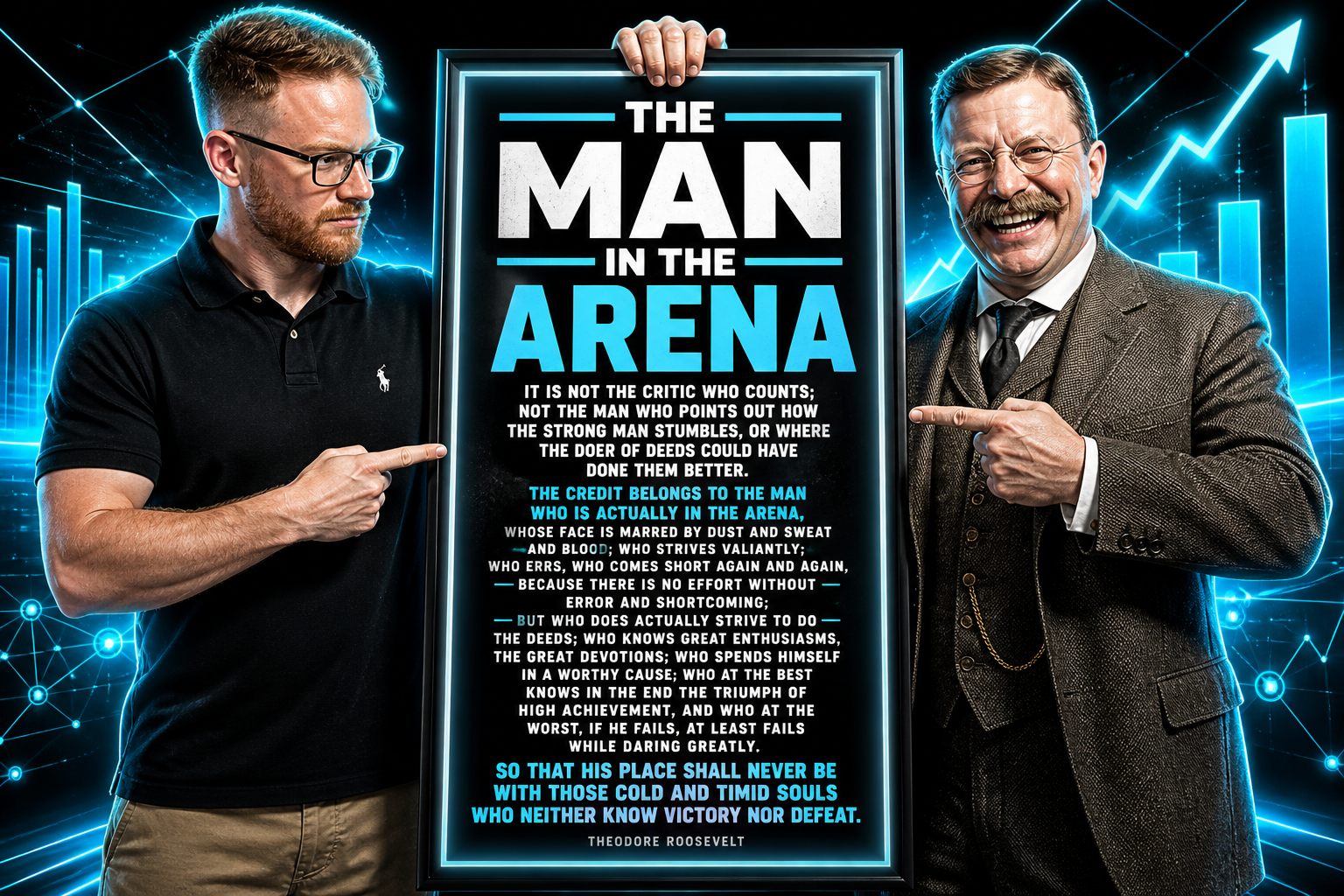
Career Advice From a Guy Who Failed at Three Businesses

I've killed three companies and I could barely hold down a campus gym job. So naturally, here's my career advice: figure out how you're wired, and stop fighting it. Then go work on your weaknesses anyway.
Let me establish my credentials before I hand out career advice.
I have failed at three separate businesses. Not "pivoted." Failed. And before that, I could barely hold down a regular job. I was a personal trainer at the campus rec at FAU, and I got in trouble constantly. I'm fairly sure the only reason they kept me around is that I kept dragging in new clients, and it's hard to fire the guy who's filling the schedule.
So, obviously, I'm the person you should listen to about careers. Grab a coffee.
First, a disclaimer from a die-hard
I'm an entrepreneur to the bone. I'd rather be caffeinated and writing code at 2am on a problem nobody asked me to solve than do almost anything else. But I've been around long enough to know that path is not for everybody, and that's completely fine. There's nothing noble about suffering through a startup if you'd be happier with a steady paycheck and weekends.
This article isn't "quit your job." It's about what to do if you're picking a more normal career. Because most people will. And most people pick wrong.
The whole thesis in one blunt sentence
If you don't want to hate your life, pick something that lines up with your temperament and your natural abilities.
That's it. That's the advice. Everything below is me showing my work, because I learned this one the expensive way.
I was a decent personal trainer. That was the problem.
Here's how I ended up at the rec center. In college I went from 140 pounds to about 165. Twenty-five pounds of muscle. I got jacked, I got obsessed with fitness (still am, for the record), and I wanted to help other people do the same thing. So I became a trainer.
And I want to be clear: I was good at it. My first client, Nico, was six foot four and 180 pounds soaking wet. I got him to put on 30 pounds of real muscle. Another client came to me wanting to get leaner and dropped 15 pounds with me. I got people results. I even spun up my own LLC for private clients when I couldn't take the rec anymore, and that little business is where I made one of my first real sales. Training taught me how to talk to people, how to read a room, how to sell something I believed in.

But if you've read anything else on this blog, you already know the punchline. Being good at something is not the same as being built for it.
My natural wiring, let's be generous and call it a "particular skill set," is taking things apart, seeing exactly where they break, and putting the pieces back together in a different arrangement. That's how I learn. That's how I have fun. I'm a kid with a pile of Legos, I just got older and the Legos got more expensive.
Personal training doesn't use that muscle. Yes, you tailor programs to the client. But the day to day is not "here's a broken system, figure out why." If I'd stayed in that lane, I'd have been competent, useful, and quietly unfulfilled for forty years. Which describes a scary number of people.
How I found out (spoiler: someone else noticed first)
My business partner and mentor, Brandon Gosselin, spotted it before I had words for it.
When we first started the company, he said he wanted to learn about AI. So he'd send me Instagram videos. "Hey, I saw AI can do this thing," and it'd be some n8n flow or a Zapier automation somebody built for views. And instead of us sitting around going "huh, neat," he'd have me actually build it.
That was the unlock. Because most of that Instagram content was, let's be honest, optimized for engagement rather than for working. And when you build the thing instead of theorizing about it, you see exactly where it falls apart. I could see the breakage in a way nobody watching the video could, because I had my hands inside it. Then, being me, I'd put my own touches on it and make it actually hold up.

Brandon will tell you: I love that stuff. Rather than fighting the way I'm wired, I pointed it at getting results for real people. And that's how a guy with a degree in something completely unrelated ended up building software.
Were the early automations good? No. Some of them were genuinely horrible under the hood. But that's the same philosophy I preach about everything: build it, watch it fail, iterate. A lot of people don't know what they're naturally good at, and sometimes the only way to find out is to break a bunch of stuff and notice which kind of breaking you enjoyed.
Picking your own seat
Here's the clearest example I've got. In an earlier company I was the CEO. Which in practice meant I was the glue trying to hold every moving piece together, which is a fantastic job for a certain kind of person and an absolutely miserable one for me. I learned something expensive there: I am a bad CEO, and I don't want to be a good one.
So at Hyppo I'm not the CEO. I'm the CTO, the technical co-founder. Same person, same brain, completely different seat, and it is so much better for me and for the company.
That's the move most people never make. They assume the title at the top is the goal. It isn't. The goal is the seat where your specific wiring turns into output. Sometimes that's the corner office. Often it isn't, and pretending otherwise costs you years.
Now the part where I contradict myself on purpose
None of this means "only do what comes easy." That's how you end up a talented person nobody ever hears about.
I built and scaled this company to around $20K a month, and I did a lot of that by knocking on doors. Me. A guy with zero sales experience who would rather sit alone with a hard technical problem than talk to a stranger about their marketing budget. It was uncomfortable. I did it anyway, because the alternative was building beautiful software nobody bought.

And here's the funny part: working on that weakness made me better at my strength. Once you've stood in enough lobbies watching a business owner's face, you stop building tech for tech's sake. You build the thing people actually care about. That's a whole other article. But the point stands: lean into your wiring, and then deliberately go get the skills your wiring doesn't hand you for free.
Why this matters more now, because of AI
I'll make a prediction. AI is going to make specialists more valuable, not less.
People complain that AI gives them generic slop. Yeah. Because they prompted it like a generalist. "Make me an app." Cool, here's an app-shaped blob.

I've watched these models make some truly stupid mistakes in software engineering. But when I say "architect it this way, eliminate this single point of failure, here are the specs, now build it," the output is dramatically better. The model didn't get smarter. I brought the specialized judgment, and the model brought the hands.
That's the future for anyone with a real skill. The groundwork gets stripped off your plate, and what's left is the part only you can do. My own executive assistant, Joe 3.5, tells me when an invoice gets paid so I don't chase it. I don't even look at my email anymore. All of that time goes back into the thing I'm actually built for.
So if you're a specialist, or you're about to become one, this is the best time in history to be you. If you're a generalist hoping the robot does the thinking, it's going to be a rough decade.
The actual advice
If you're just starting out, fresh out of school, or still picking a major, here it is from a guy who's failed enough to be qualified:
- Figure out what you naturally enjoy and what you're naturally good at. Not what's impressive. What you'd do on a Saturday with nobody watching.
- If you don't know yet, go break things. Try stuff, fail at it, and pay attention to which failures you were happy to go back to.
- Pick the career that uses that wiring, then run with it. Don't spend forty years being competent at the wrong thing.
- Then go work on your weaknesses anyway. Especially the ones that stand between your talent and other people finding out about it.
- And if you're going to be a specialist, go deep. AI is about to reward that harder than anything has.
For me, that wiring was systems thinking, hard technical problems, and taking things apart to see how they work. For you it might be something completely different. Doesn't matter. Find it, and stop fighting it.
Advice from a three-time failure. Take it for exactly what it's worth.
Want to talk about what you're building?
Get in touch