
Sales Is a System

I've written that sales is the most important skill a founder can have, and that systems thinking is the one that beats everything else. This is where they meet. Here's how I went from knocking on doors with a product nobody needed to a repeatable process I just handed to fourteen sales reps.
I've made two arguments on this blog that look like they contradict each other.
One: sales is the single most important skill a founder can have. Two: systems thinking is the only skill that matters. Both true. And the thing that ties them together is the whole point of this article.
Sales is a system. If you're a first-time founder, or you've never built a sales process before, you're not looking for a magic pitch. You're looking for the thing that works, that you can repeat, that you can eventually hand to someone else. That's a systems problem. It just happens to involve talking to people.
Here's how I found mine, mostly by getting it wrong first.
Mistake one: I was good at selling the wrong thing
When we started, our flagship was the ASP form. Simple tool: a business owner uploads a photo of a finished job, our AI writes a caption in their brand voice, and it posts to all their social accounts. Quick, convenient, genuinely useful.
And I was good at selling it. I knocked on doors and closed it. That was the trap.
Because it wasn't sticky. Let me define that, since it's the most important word in this article. A product is sticky when cancelling it hurts. Not annoys. Hurts. Something in the business stops working, or leads stop coming, or the phone stops ringing. A non-sticky product is a nice-to-have. When the customer has a slow month, it's the first line item they cut, and they don't feel a thing.
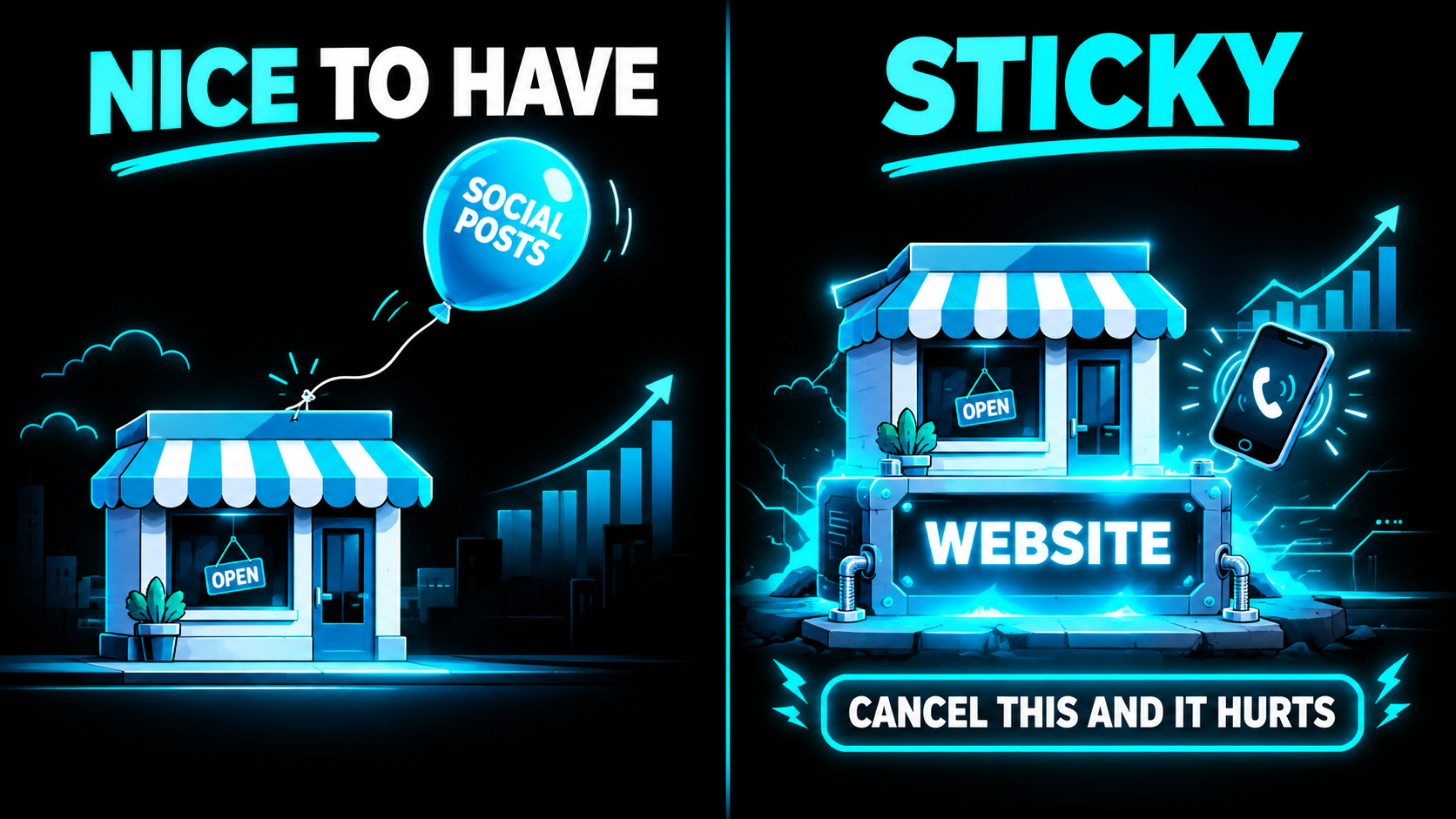
Social posts are a balloon. Let go of the string and nothing falls down. I learned that the hard way in August of 2025, when half my customers cancelled in the same month and I did $953 in revenue. Being good at selling something is worthless if the something doesn't stick.
The pivot: sell the thing bolted to the foundation
So I looked at who wasn't cancelling. By a mile, it was our website clients.
Obvious in hindsight. A business needs a website. It's where the leads come from, where the phone number lives, where Google sends people. Cancel that and you don't lose a nice-to-have, you lose the front door of your business. That's sticky.
So I started selling websites. Same doors, same me, different product. And that's when I made mistake two.
Mistake two: the pressure close (I regret this one)

Early on, I tried the thing every sales course tells you to do. On the call: "If you don't decide tonight, the price doubles."
I'll be honest about this. It felt gross while I was saying it. Since then people have tried it on me, and I hung up on them. And here's the kicker: it didn't work. I didn't close a single deal with that line. Not one. So I was being the guy I hate, for zero return.
The fix came from flipping the logic. Pressure makes the yes more painful. What if I made the yes easier instead?
So now, if they don't decide on the call, I say something like: "Look, if we get this handled tonight, I'll throw in Rank." Rank is our AI blogging agent. It writes blog posts in the business owner's voice, on autopilot, and when we analyzed our own portfolio, the sites running it got 78% more views. Normally it's $197 a month. For a same-night decision, it's free.
Same urgency, completely different feeling. Nobody's being threatened. They're being handed something real for deciding now. That's the difference between a pressure sale and a good deal, and it turns out people can tell.
The sales sheet: because people don't all listen the same way

My mentor gave me a note that fixed a problem I didn't know I had: people take in information differently. Some listen. Some need to see it. I'd been doing the whole pitch out loud and losing the visual people.
So I made a one-page sales sheet. Three packages, side by side:
- E-commerce. The big one. Full online store.
- Multi-page. Our most popular. Home, services, about, contact, the works.
- Single page. The minimum. One clean page that converts.
Now the owner can see the whole menu at once. They anchor on the big one, they feel smart picking the popular one, and the single page is there so nobody walks away with nothing. It's not manipulation, it's just not making them hold three options in their head while I talk.
Then you iterate, because it's a system
None of those pieces was the answer on its own. The sticky product, the bonus instead of the threat, the sales sheet, the script that got a little tighter every week because I was paying attention to which lines landed and which ones got a blank stare. Each one was a small fix to a process, and the process kept getting better.
That's the systems-thinking part. You don't need to be a natural closer. I'm not. I'm a guy who would rather be alone with a hard technical problem. What I did was treat sales like any other system: find what works, cut what doesn't, make it repeatable, measure it, tighten it. Over and over.
The payoff: you can hand it to someone else

Here's why any of this matters. Once sales is a repeatable system instead of a founder's personality, you can take the founder out.
I just hired fourteen sales reps. (Yes, fourteen. And if you're reading this thinking you'd be good at it, we're still hiring, reach out.) They're not selling on charisma. They're running the process: sticky product, clear sheet, easy yes. It works without me because it was never really about me.
My goal is to take myself completely out of sales. Not entirely, to be fair. If there's a wild AI build that needs serious custom engineering, I want to be in that room, because that's a conversation only I can have. But a website sale? Everybody understands what a website is. It's simple, it's repeatable, it's a system. And a system is something you can hand off.
If you're building your first sales process
- Sell something sticky. If cancelling doesn't hurt the customer, you'll be good at selling something that leaks. Look at who never cancels and sell more of that.
- Make the yes easier, not the no scarier. Bonuses beat threats. The threat didn't even work for me, and it made me the guy I hang up on.
- Put it on paper. One page, three options, most popular in the middle. Some people need to see it.
- Treat the pitch like code. Ship it, watch what breaks, fix it, ship again. Your script at month six should be embarrassing compared to month twelve.
- Build it to hand off. If it only works when you're in the room, it's not a system yet. Keep tightening until a new rep can run it on week one.
Sales and systems thinking aren't two skills. They're one skill, pointed at people instead of code. Learn to sell, then build the machine so you don't have to.
Want a sales system you can hand off?
We build the product that sticks and the process that sells it. That's what we do at HyppoAI.
Want to talk about what you're building?
Get in touch