
The Valley of Despair

In August 2025 half my customers cancelled in the same month and we did $953 in revenue. In August 2026 we did $21,091.66. I'm not going to pretend there was a clever trick in between. There's just a stretch where it sucks, and the only way out is through.
Most of what I write here has a joke in it somewhere. This one doesn't, much. I want to talk about the worst month I've had in business, because I think the honest version of it is more useful to somebody than another growth post.
There's a stretch every founder hits that people call the valley of despair. Sam Altman has talked about it. Paul Graham drew it on his startup curve and labeled it the trough of sorrow. Different names, same hole.
I was in it in August of 2025.
The setup
When my business partner and I first started Hyppo, I somehow landed a couple of real deals. A $1,000 and a $2,500. For a guy who had failed at three businesses already, that felt enormous.
Our flagship at the time was something we called the ASP form. Genuinely simple tool: a business owner uploads a photo of a finished job, and the AI writes a caption in their voice and pushes it out to all their social accounts. We charged a setup fee plus a monthly. (We don't do setups on it anymore, it's just a clean software subscription now.)
Here's what I didn't understand yet: the ASP form had no stickiness. None. If you cancel it, nothing in your business breaks. Your phone still rings, your customers still show up, your website still works. You just post less. That is a very comfortable thing for a customer to cancel on a slow month.
And underneath it, a machine made of duct tape

I'm going to be honest about this part because I've written about it before and I'm not going to suddenly get shy.
Our company ran on GoHighLevel, Zapier, n8n, and hope. Middleware calling middleware. A Zapier endpoint firing into another Zapier endpoint. Duct tape and chewing gum all the way down. It worked, in the sense that a car with a coat hanger holding the muffler on works.
If you want the longer version of my feelings about renting your entire company from someone else's platform, I wrote a whole review of HighLevel about it. Short version: I built my business on top of software I didn't own and couldn't control, sold a product that nobody needed badly enough to keep, and I did not yet know that those were the two problems.
August 2025
Then, in one month, half my customers called and cancelled.
Not one. Not a rough patch. Half. One after another, same conversation, "hey man, I just can't do it right now." And every one of them was right to. I had sold them something that was nice to have, built on a stack that could break in five places, and when money got tight for them I was the easy line item to cut.
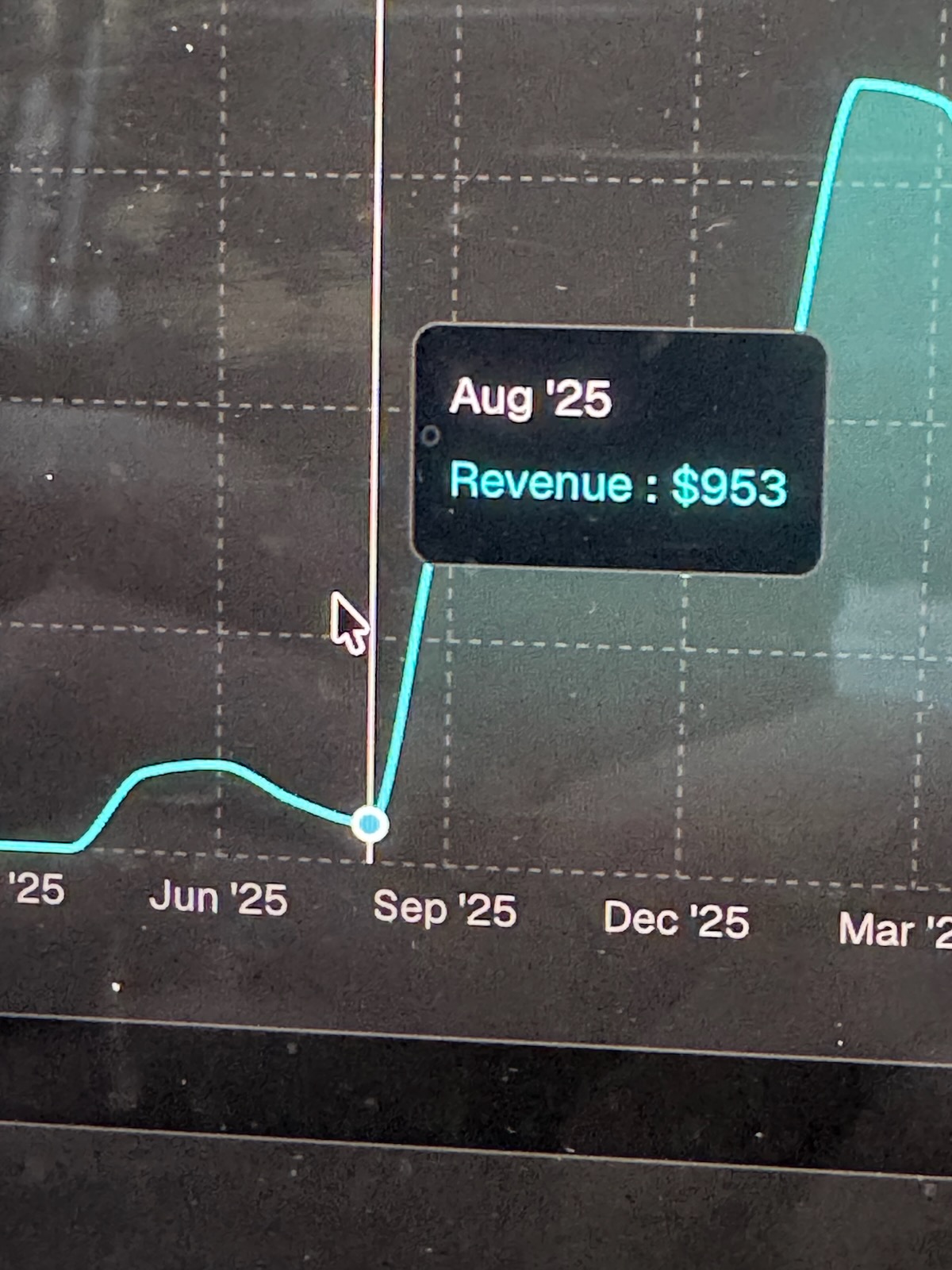
That's the real number. $953 for the month. And here's what makes it worse: this is a software business with genuinely healthy margins, near zero cost of goods. And I still don't think we were profitable that month. You have to work fairly hard to lose money in a business like this. I managed it.
It was brutal. Just bloody brutal. I don't have a better word.
What that phase actually feels like
I wish I could give you the optimistic version. Here's the real one.
You have no momentum. Nothing you push moves. Everything is breaking at once and you're the only one who can fix any of it. People tell you your product isn't good enough. And the part nobody says out loud: they're right. Your product actually does suck. Mine did.
Around the same stretch I ran a big offer I was sure would land and it struck out completely. So add that to the pile.
Elon Musk described starting a company as staring into the abyss while chewing on glass, and honestly, that's the most accurate sentence anyone has written about it. Everybody glamorizes the founder life. The laptop, the freedom, the posts about building in public. The actual experience, in that phase, is sitting alone with a broken thing you made, knowing it's your fault, with no evidence that it's ever going to work.
There's no hack. That's the part I refuse to lie about. The typical advice is "push through," and I hate how useless that sounds, but I don't have better advice because it happens to be the only thing that works.
What I actually did
Not much that was clever, if I'm honest.
I landed a $5K a month client after that, which felt like rescue, and then we went flat for about three months anyway. Then down again through December. The graph does not go up right after the bad part. That's the thing the founder content never shows you. The recovery isn't a hockey stick, it's a long flat stretch where you keep working and nothing visibly changes.
What I changed in that flat stretch mattered more than the deals. I stopped selling nice-to-haves and started selling things that break a business when you cancel them: websites that produce leads, the receptionist that answers the phone, the infrastructure their operation actually sits on. And I stopped renting my company from other people's platforms and spent the better part of two years building our own, so the duct tape wasn't load-bearing anymore.
And I kept my head down. I prayed a lot. I'm a believer, so that's where I went with it, and if you're not, keep whatever your version of that is. I'm not going to pretend that part wasn't a big piece of how I got through it.
August 2026
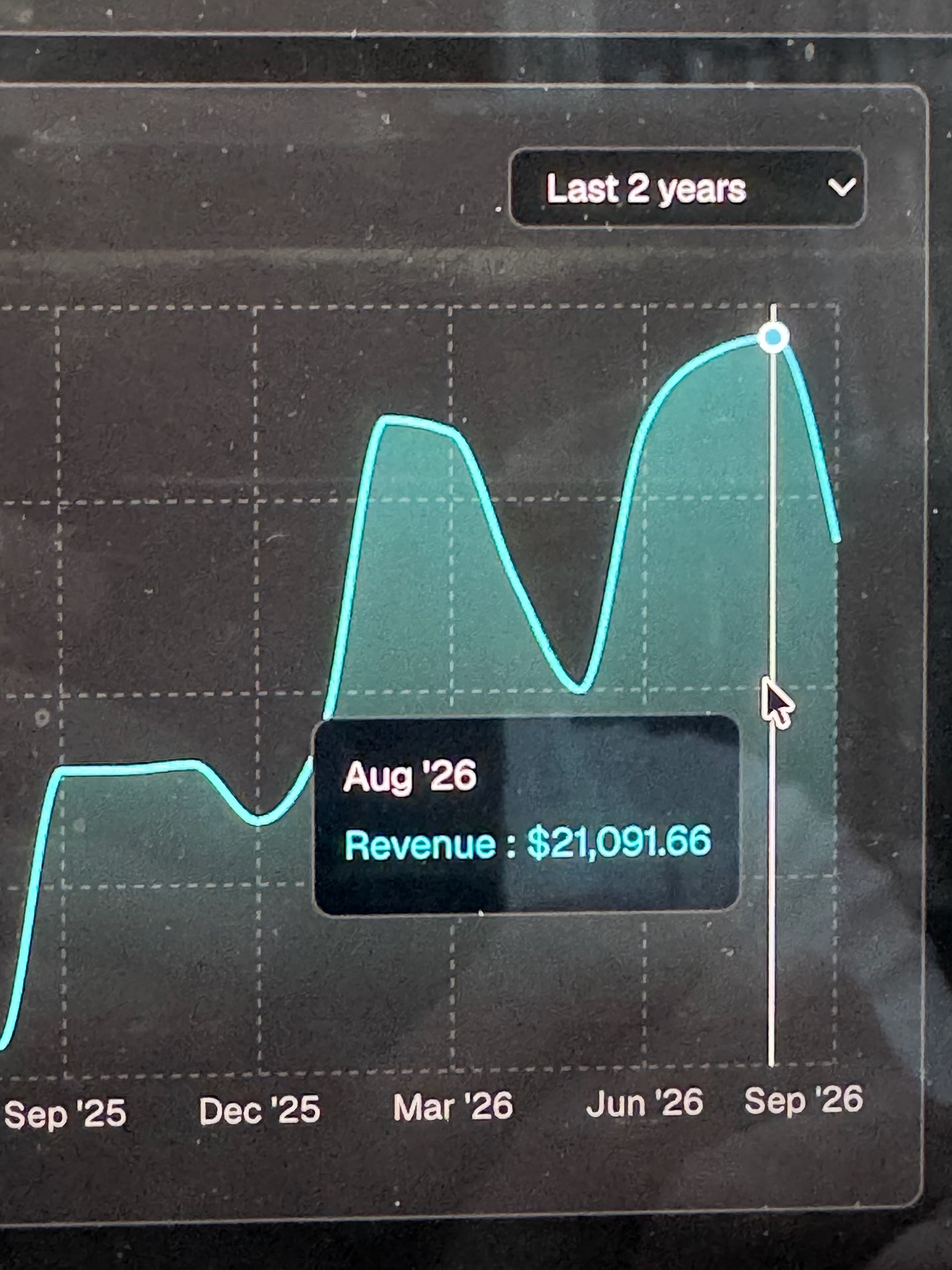
Twelve months later, same month on the calendar: $21,091.66.

I'm not posting that to flex. I'm posting it next to the $953 because the two numbers only mean something together. Nothing magical happened between them. I didn't find a growth hack. I built a better product, sold things people couldn't cancel without consequences, owned my own infrastructure, and refused to stop showing up.
And I'll say the obvious: I'm glad we're out of that phase. I still have big goals for this company and growing brings its own set of problems, different ones, but real ones. The valley isn't the last hard thing. It's just the first one that makes you consider quitting.
If you're in it right now
Here's everything I've got, and it's less than I wish it was:
- It sucks. You're not doing it wrong because it sucks. It sucks for everyone.
- Your product probably does need to be better. That criticism is data, not an insult.
- Sell things that hurt to cancel. Nice-to-have is the first line item cut when your customer has a bad month.
- Own your foundation. If your whole company runs on somebody else's platform and a pile of glue, you don't have a company, you have a rental.
- The recovery is flatter and slower than the story you've been told. Expect flat. Keep going anyway.
- Keep your head down and pray. That's not a metaphor for me.
Everybody goes through it. I'm convinced of that now. The ones who come out the other side aren't smarter, they're just still standing there when the light finally hits.
Chew the glass. It ends.
Want to talk about what you're building?
Get in touch