
I Love Failing

I love failing, and not in the motivational-poster way. Before my first kickboxing fight my coach handed me Teddy Roosevelt's "The Man in the Arena" (still on my wall), and it rewired how I think about losing. Failure and success are on the same road, failure's just the earlier off-ramp. Hyppo is my fourth business, and the graveyard behind it taught me everything. The trick is to fail at your edge, and a great mentor's job is to keep you there.
Here's a sentence that'll make most people uncomfortable: I love failing.
Not in the cutesy, motivational-poster, "failure is just feedback" way that gets printed over a sunset. I mean it. Failing, over and over, as fast as possible, is one of the best things that ever happened to me. Let me explain, and I promise it lands somewhere optimistic.
The poster my coach gave me
Before my first amateur kickboxing fight, my coach handed me a poster. It was Teddy Roosevelt's "The Man in the Arena." (Side note: Teddy is one of my favorite presidents, but that's a whole other article.)
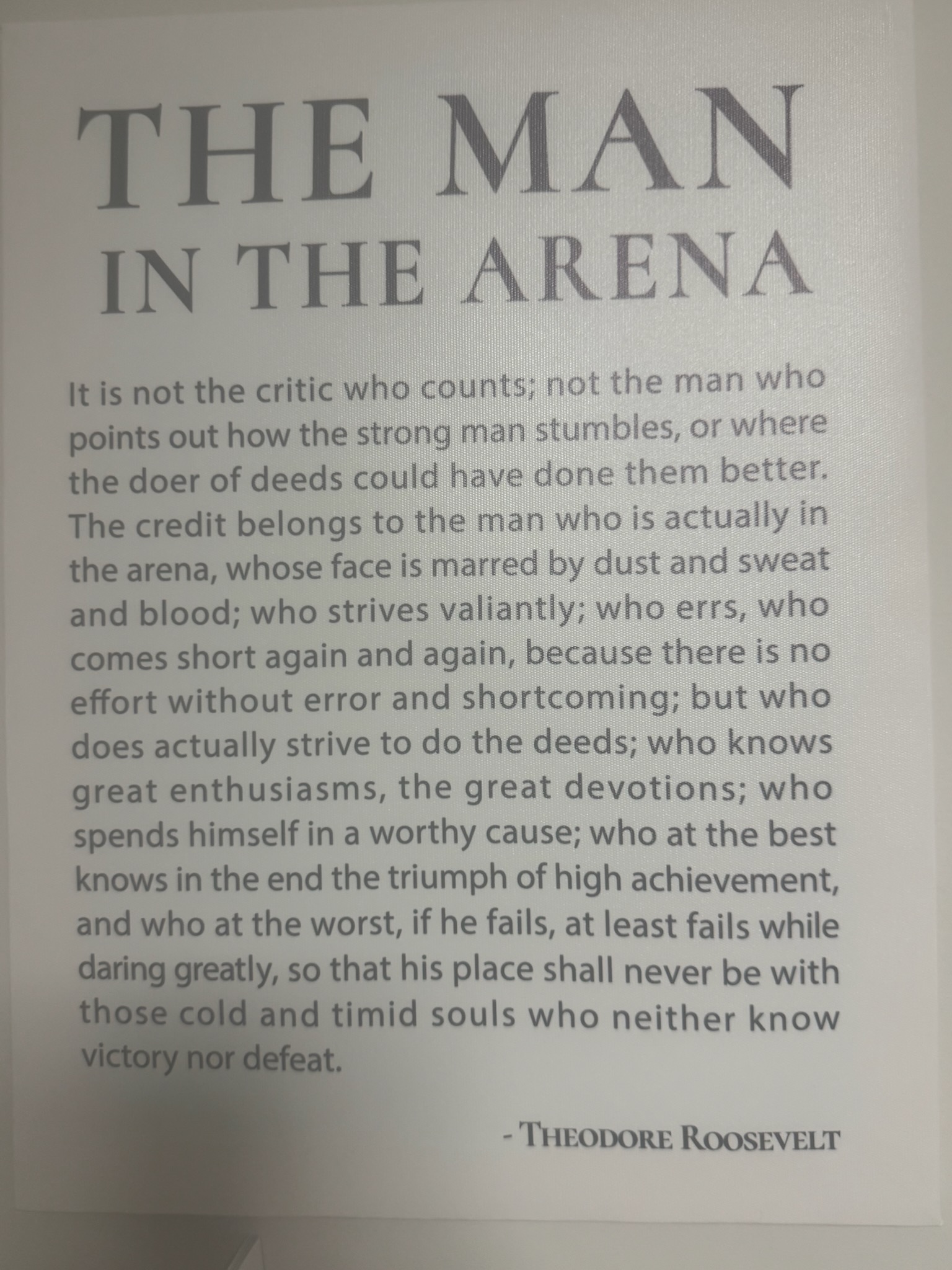
If you've never read it, the gist is this: the credit doesn't go to the critic, or the guy on the sidelines pointing out how you could've done it better. It goes to the person actually in the arena, face covered in dust and sweat and blood, who strives, who errs, who comes up short again and again, but who is in there daring greatly.
I was nervous, obviously. First fight. And my coach said something I've never forgotten. He told me: even if you go out there and lose brutally, you'll have already done more than most people ever do in their whole lives. Give it everything. Leave it all in the ring. If you do that, I can't fault you, win or lose, because you'll have done everything in your control. So go have fun.
(For the record, I did not lose brutally. But that's not the point.)
The point is that framing changes everything. When the only real failure is not trying, the fear kind of evaporates. That poster is still hanging on my wall today, and I still read it.
Failure and success are on the same road
Alex Hormozi has a line I love: failure and success are on the same road, failure is just the earlier off-ramp. Most people take that exit. They hit the first stretch of "this is hard and I look stupid" and pull off. The people who win just keep driving.
Here's the mechanism nobody wants to hear: the speed at which you mess up and learn is the speed at which you become successful. That's the whole cheat code. Every founder I admire, Sam Altman, Elon Musk, all of them, is obsessed with iteration speed for exactly this reason. Fail fast, learn fast, adjust fast, repeat. Success is just failure that kept going.
My actual resume of failures
Let me put my money where my mouth is. Hyppo is my fourth business. Here's the graveyard behind it.
Business one: I sold study guides for a personal trainer certification exam. Business two: I ran a little private training company as an undergrad, mostly because I had nothing better to do. Business three: a fitness-industry tech startup called FindMeATrainer.
That third one is the one that actually hurt. It fell apart. I was out there knocking on doors trying to talk to the market, and picture this: a reserved, technically-minded guy who'd much rather be writing code, cold-pitching strangers face to face. You can imagine how smoothly that went. Eventually the whole thing came apart, four co-founders and all.
I was genuinely depressed for a while after that. I'm not going to pretend otherwise. But what I walked away with was priceless. I learned how to build a product, badly at first, then less badly. I learned how to manage a team, badly at first, then less badly. Every one of those "less badly" upgrades was paid for in failure. The sheer speed at which I failed is exactly what turned me into the person who could build what I'm building now.
Even if it all blows up tomorrow
Let me say something that sounds crazy coming from a founder. Hyppo could disappear tomorrow. I don't think it will, but hypothetically, sure, it could all go to zero.
And I'd be okay. Because I'd know I did everything in my control. That's the whole Roosevelt thing again. The pain of trying and failing, even failing spectacularly, even failing four times over, is so much smaller than the slow ache of never having stepped in the arena at all. That second pain never goes away. The first one turns into skills.
This is literally how software works too
None of this is just motivational fluff, by the way. It's how I build every single day. You write code, you test it, it breaks, you learn why, you fix it, it breaks somewhere else, you fix that too. Test, iterate, break, repeat. Software is basically failure management with extra steps. The best products on earth are the ones that got to fail the most times before you ever touched them.
So if you want to start something, start
Here's my advice to anyone sitting on a business idea, waiting for the fear to go away: it won't. So just start. Go knock on the doors.
The first 99 people might slam the door in your face. The next 99 might tell you no. And then one says yes. If you keep showing up and doing that, over and over, you will do very well in life. Not because you're special, but because almost nobody else is willing to eat that many no's.
But start where you can afford to lose
Now, one big caveat, because "just go fail!" is terrible advice on its own. The key isn't to run out and fail at the biggest, riskiest thing you can find. It's to start with something you can actually handle, in a low-risk, low-stress environment, get your reps there, and then slowly take on bigger and bigger failures as you get stronger.
There's a sweet spot to all of this, and it looks like this:

If the challenge is too easy, you're bored and nothing grows. If it's too hard, it crushes you and you quit, or worse. The magic is right at your edge: hard enough that you might genuinely fail, not so hard that it destroys you. You want to fail at your edge, then move the edge a little further out.
This, by the way, is exactly what a great mentor is for. I'll write a whole separate piece on finding good mentors, because it deserves one, but here's the short version: a great mentor's real job is to keep you failing right at your edge. Not to hand you easy wins, and not to throw you off a cliff, but to keep dialing the challenge into that growth zone, over and over, as you get stronger. My business partner Brandon is phenomenal at this. He builds people for a living, and this is exactly why. (I happen to be the first scholar of the Be Good House, but that's a story for another day.)
I learned this in the most literal way possible: at the gym. Failing is how you get stronger, you push a muscle until it physically cannot do another rep, and that failure is the exact signal that tells your body to grow back tougher. But you do it in a controlled way.
Back in high school, I failed to bench 95 pounds. Couldn't do it. So I didn't march over, load up two plates, and pray. I dropped down to 85, where I could actually handle it, and started there. Then I built up, rep by rep, week by week. (And yeah, for the record, I eventually hit two plates. Lol.)
That's the whole model. I went from a 135-pound skinny nerd at 19 to, well, let's just say considerably less skinny, not by succeeding at every lift, but by failing right at the edge of what I could handle, on purpose, and then moving the edge. Same exact thing in business. Don't bet the house on your first swing. Start small, fail cheap, learn, then raise the stakes.
So push yourself to failure, in the gym, in your business, in the arena, wherever your fight is, but start where a fall won't kill you. Keep your head down, keep failing, keep learning. That's all any of us can really do. The rest is in God's hands.
Now if you'll excuse me, I'm pulling into the gym to go fail at some bench press.
Building something? Let's build it right.
We've failed enough times to know how to do this well. That's what we do at HyppoAI.
Want to talk about what you're building?
Get in touch