AI Won't Replace Your Experts. It'll Replace Everyone Under Them.

Everybody's got the AI story backwards. It isn't replacing expertise. It's making expertise the most valuable thing in the building, and quietly deleting every job that used to feed it. Walk through a twenty-person marketing agency with me and watch it become five. Then ask the question nobody wants to: where does the next CTO come from?
Everybody has this backwards.
The loud take is that AI replaces expertise. Fire your developer, prompt ChatGPT. Fire your marketer, prompt ChatGPT. Fire everybody, prompt ChatGPT.
The quiet reality is the opposite. AI doesn't replace expertise. It makes expertise the single most valuable asset in a business. And then it deletes every job underneath the expert.
Let me show you with a real org chart.
First, remember what this thing actually is
I've said it a dozen ways on this blog, so here's the short version. An AI model is fancy autocomplete. It was trained on something close to the entire internet, and it predicts the next word based on everything it read.
Now think about what that means. The internet is enormous and mostly generic. So when you ask it a generic question, you get a generic answer. "You're a marketing expert, give me a strategy" produces the average of every marketing blog ever written. Which is to say, nothing.


Picture it as a cloud of a trillion words. Swing a big vague net through it and you pull out a gray blob. Point a laser at exactly the right spot and you pull out a gem. The model is the same in both cases. The person is the difference.
And what's an expert? Strip the title off and an expert is simply somebody who knows which question to ask. They either know the answer or they know exactly what to ask to get it. That's the entire job description. Junior people push buttons. Experts know what to point the laser at.
Case in point: this article
I'll prove it with the thing you're reading.
I did not type "write a blog post about the latest developments in AI" into a chat box. That's the net. That produces a gray blob with a stock photo on top, and you'd have closed the tab four paragraphs ago.

What actually happened is I walked out to grab a cup of coffee and rambled into my phone for about ten minutes. A voice memo, to my own agent, Joe 3.5. Not a prompt, a brain dump: the org chart of a specific agency, which seats get cut and why, the HVAC detail, the trillion-word cloud, the part about sawing off the ladder rungs. My actual opinions, from actually doing this. Then it came back with this article, the structure, and every image on this page.
That's the laser. The output is good because the input was specific, and the input was specific because I've spent years being wrong about this stuff in public. Hand the same tool a vague question and you get vague garbage. The leverage isn't in the model. It's in knowing what to point it at.
A twenty-person marketing agency
Let's build one. Nothing fancy, just a normal shop.
There's a founder. Under him a COO who runs the day to day, and an executive assistant. There's a CMO who runs paid ads to acquire clients, with a few people under him who build the creative, run the campaigns, and put up landing pages. There's a CTO with a handful of junior developers. And there's a sales side: one closer and a few setters making calls and booking appointments.
Call it twenty people. Say this agency serves HVAC companies specifically. That detail matters, you'll see why.
Now they decide to actually implement AI. Not "we bought ChatGPT Teams," actually implement it. What happens to the chart?
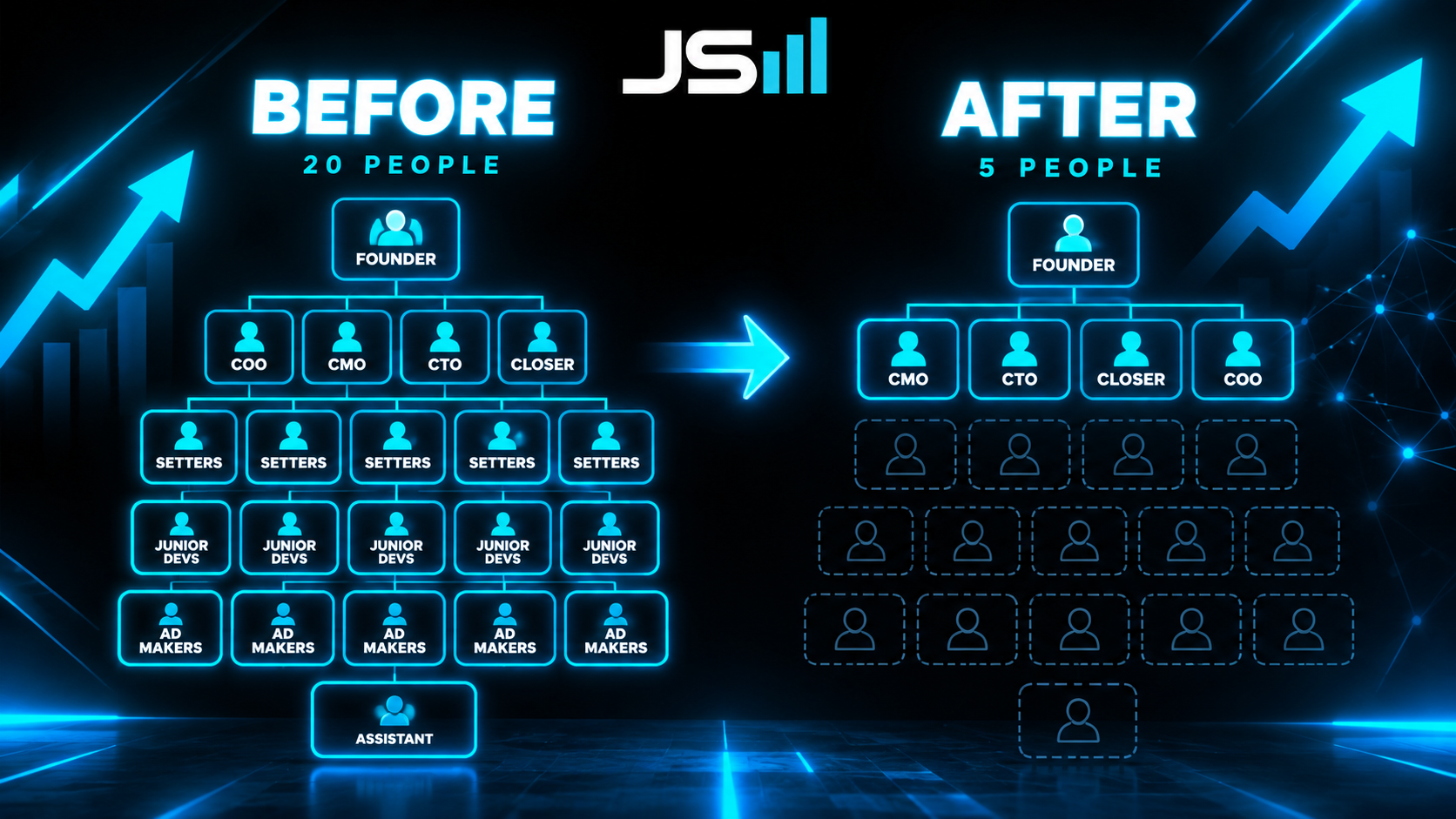
The CTO is fine. His juniors are not.
Start on the tech side. AI is a leverage monster for a senior engineer. A CTO who knows architecture, knows where things break, knows what "done" looks like, can now build at a rate that used to need a whole team. I know because I'm doing it. I built our entire platform largely by myself with a tireless AI junior developer at my side.

So what does he need five junior devs for? He doesn't. He might keep one for UI polish and QA. If he had five, four of them are gone, maybe all five, and he becomes the technology department.
Why him and not them? Because a junior developer who knows how to push buttons but doesn't understand architecture has no idea what to ask the machine. He'll get a generic app back, with generic security holes. The CTO, just by being a CTO, sees the failure points before they exist. I wrote about mine trying to leak customer data between tenants. The AI didn't catch that. I did. That's the job now.
The CMO is fine. His team is not.
Same story on marketing, and it's worth going slow because this is the one people miss.
Prompt ChatGPT as "a marketing expert" and you get the gray blob. But this CMO has spent years learning exactly which hooks make an HVAC owner stop scrolling, which creative gets them to book a call, which follow-up sequence closes them. That's not on the internet. That's in his head, from doing it. It's the laser.

So what does he do with it? He walks over to the CTO and says: build me a system that spins up landing pages with this headline structure. Build me something that generates and tests ad creative against these hooks. I saw this automation sequence work, make your thing do it.
And the CTO builds it in a week. Now the CMO's domain knowledge is running at machine speed, and the three people who used to make the ads and build the pages by hand are doing nothing. This isn't theory, by the way. An AI system that iterates ad creative at absurd speed is how we took a cabinet shop from $700K to a $1.3 million pace, with click-to-calls at about a quarter of the industry rate.
The CMO just got more valuable. His team just got deleted.
The closer is probably fine. The setters are in trouble.
Sales is the one I'll hedge on, and I'll tell you why honestly. I'm working on automating the closing process right now. If that experiment pays off, it's a very big deal. But it's an asymmetric bet, and my actual opinion is that AI closing a real sale with a real human is further away than the hype suggests. So the closer keeps his chair.

The setters are a different story. Outbound AI agents aren't magic, and built wrong they're a lawsuit. But built right, they can carry a big chunk of the dialing and booking that a setting team does. I'd wager most of the setters go. Maybe you keep one.
Twenty becomes five
Run the math. Founder. CMO. CTO. Closer. COO, who's now mostly overseeing automations instead of people. Five.
Same revenue. Same clients. A payroll that's a quarter of what it was. And every one of the five is a person who knows which question to ask.
That's what AI actually does to a business. It doesn't replace the experts. It turns each expert into a department and makes the department unnecessary.
Now here's the part that should scare you
I said expertise is knowing which question to ask. So how do you learn which question to ask?
You screw up. Repeatedly. In the weeds. Over a long time.
I didn't start out knowing where my competitors fail or where a business owner actually needs AI plugged in. I started out selling duct tape and chewing gum prototypes. I lived up north for eighteen months building this company and got my teeth kicked in more times than I'd like to put in writing. If Hyppo disappeared tomorrow, the judgment I built in those eighteen months is the one thing I'd walk away with, and it's worth more than anything we've built. I got it by failing in a controlled environment where failing was survivable.
That's what junior roles are. They're not just cheap labor. They're the controlled environment where a person gets to be wrong a few hundred times before anything important depends on them being right. That's how a junior dev becomes a CTO. That's how the kid running ads becomes the CMO who knows what HVAC owners click on.

So go back to our five-person agency. The CMO and CTO are fine, today. What happens when the CTO retires? Exits? Steps away for a family thing? There's no replacement, because the four people who would have grown into the job got cut three years ago. Nobody under him was ever allowed to fail. Nobody built the judgment. You kept the expert and sawed off every rung that makes the next one.
That's the company-sized version. Zoom out and I'll say it plainly: we have some pretty nasty social ramifications coming. An entire generation locked out of the apprenticeship that turns people into experts is not a small thing, and it doesn't resolve itself quietly.

I'd have a little more faith that somebody's on top of it if the people in charge weren't literally asleep at the wheel. And I don't mean that as a figure of speech. Go pull up footage of a congressional hearing on technology sometime. Half of them are dozing, and the ones who are awake are asking the witness to explain what an app is. That's the oversight. Sleep well.
Anyway, that's a whole other article, and probably one I won't write. The company version is enough to chew on.
What this means for the "fire your developer" crowd
This is why the viral stuff doesn't impress me. "Have ChatGPT replace your dev team." "Seven prompts that replace your marketing agency." "Let the AI be your CTO."
No. The whole point is the opposite. AI doesn't replace the person with the domain knowledge. It leverages the hell out of them. If you have very specific expertise, this technology makes you something close to unstoppable. If you don't, it makes you unnecessary. And it does that at the cost of every entry-level seat that used to turn people into experts.
So the honest advice, if you're early in your career, is uncomfortable: get specific, fast. Get in the weeds. Pick a domain and be wrong in it until you're right. Find somebody who's already got the judgment and learn under them while that's still a thing you can do. Because the rung you're standing on is being sawed off, and the only way through is to climb before it goes.
And if you run a company: by all means, cut to five. The math is real and your competitors will. Just know what you're cutting. Then ask yourself, out loud, where your next CTO is coming from.
If you want AI plugged into your business by somebody who's already made the mistakes, that's what we do.
Want to talk about what you're building?
Get in touch