
Squeeze Everything: How I'm Attacking the Distribution Bottleneck

Yesterday I said distribution is the constraint. Today, on the drive to church with my dad, I figured out where the leverage is hiding. The voice memo you're reading. The opt-in list I already have. The cold calls I'm about to make anyway. Sawdust, all of it, and I'm sweeping it up.
I'm dictating this on the way to church with my dad and my grandma, which is going to matter in about four paragraphs.
Quick recap if you missed yesterday's article: building software stopped being the hard part. AI collapsed the two-to-three-year SaaS build into a couple of months. So the bottleneck moved, and now it's distribution. Getting the thing in front of people. I'm a Theory of Constraints guy, you find the one constraint and you dog it until it goes away, and as of this weekend that's the one.
I also said I'd rather be sitting in a dark room writing code than doing any of this. Still true. But everybody wants to start a trillion dollar company and nobody wants to do the annoying part, so here we are.
Here's the plan, or at least the first chunk of it. And the whole thing runs on one idea.
First, what leverage actually means
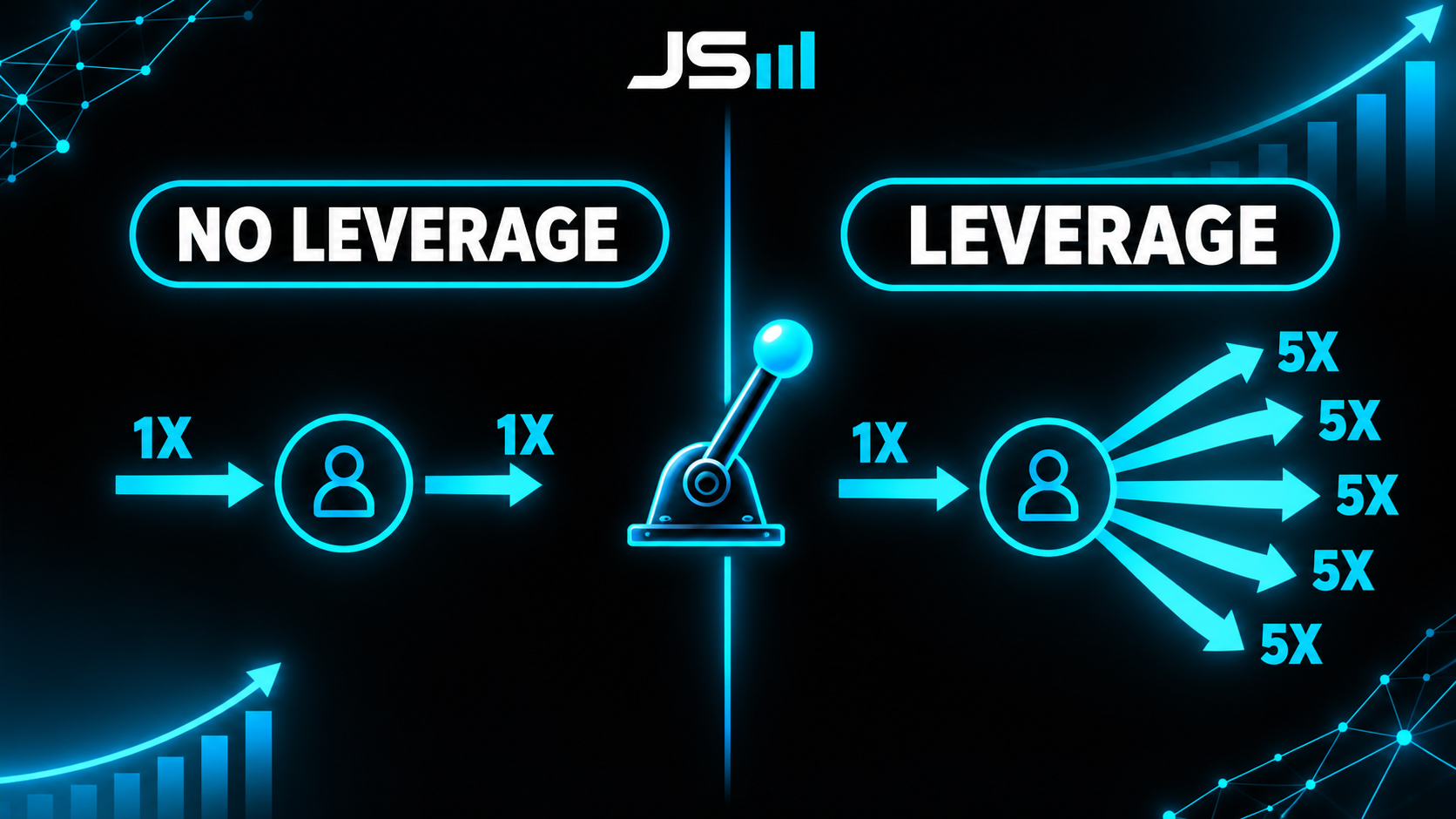
Leverage is the simplest idea in business and almost nobody uses it on purpose.
No leverage: you put in one unit of effort, you get one unit of result. You make a phone call, you get one conversation. You write a post, one platform sees it. One in, one out. That's how most people run their whole lives.
Leverage: you put in one unit of effort and the system turns it into five. Same phone call, but it's also a piece of content. Same post, but it hits six channels. One in, five out. The effort didn't change. The machine around the effort did.
I'm a systems thinker. So the way I'm attacking distribution isn't "work harder at marketing." It's "take the inputs I'm already producing and build a machine that multiplies them." Which brings me to the sawdust.
Sweeping up the sawdust

I wrote about the Sawdust Principle a while back. A sawmill's business is planks, but every log through the saw also produces sawdust, and the smart owner bags and sells that too instead of sweeping it into the trash. Before you go start a brand new business, look at the byproducts of the one you've got.
Distribution is full of sawdust. Here's what I've started bagging.
Sawdust #1: the ramble you're reading right now
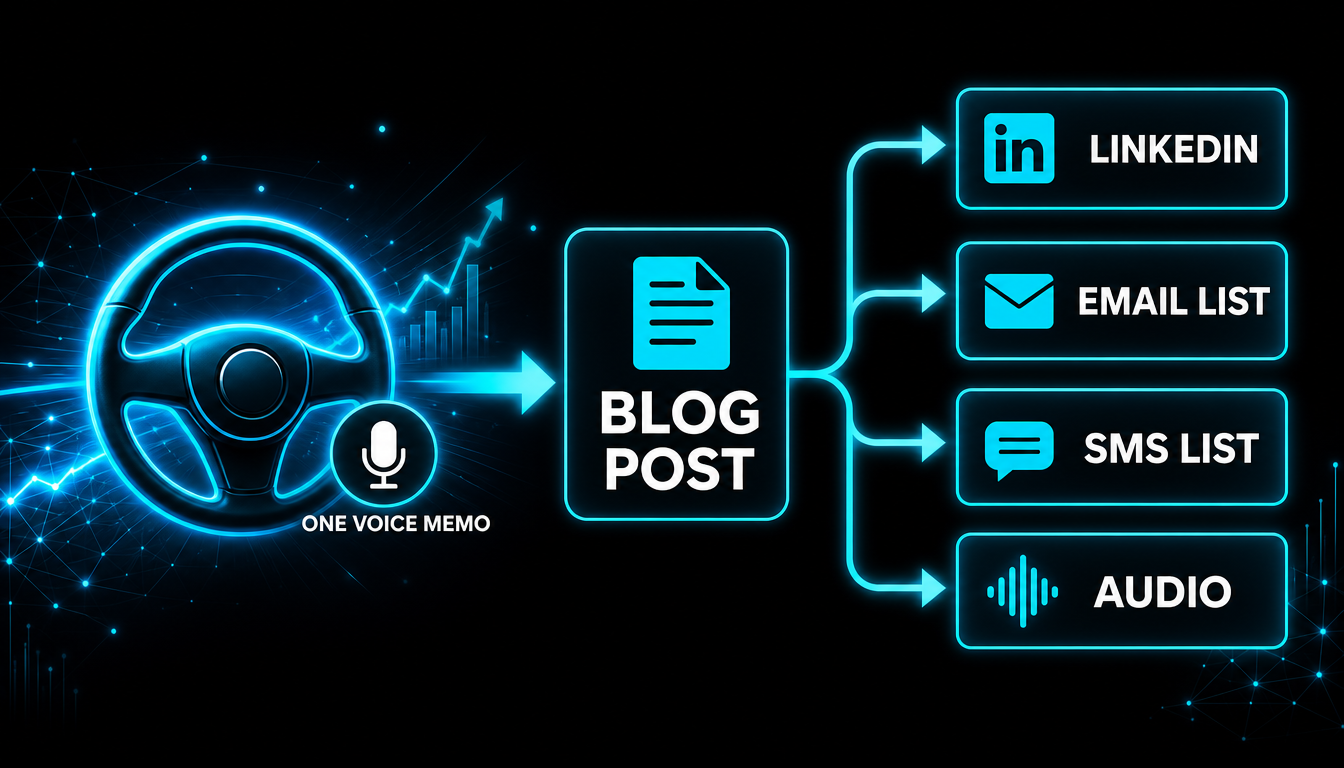
If you've gotten a text or an email lately saying "Joe wrote a new post," this is why.
I'm already talking. I ramble at my phone while I drive to get coffee, or on the way to the gym, or right now on the way to church. That time was going to be spent anyway. So Joe 3.5, my AI assistant, turns the ramble into an article, generates the images, narrates it, posts it to the blog, cross-posts it to LinkedIn, and then, here's the part that matters, sends it out to my list.
The blog going to LinkedIn and Facebook is fine, but let's be honest, nobody cares. Those platforms decide who sees what and it's usually nobody. What I actually have is a list of people who opted in. People I cold called, who said "yeah, you can reach out to me," with the consent logs to prove it. That list is mine. No algorithm sits between me and it. So every article now goes to that list by email and by text, automatically, the moment it's live.
One input, a voice memo. Five outputs. That's leverage stacked on leverage, and it's also why I keep telling business owners that building a list is the single most important distribution asset you can own. Everything else is rented.
Sawdust #2: the cold calls I have to make anyway

I'm going to be dogging the phones again. Cold calling business owners, the thing that built this company in the first place. That's not new.
What's new is that I'm not just going to make the calls. I'm going to live stream them. Real cold calls, real business owners, real objections, in public. That alone is distribution, because people watch that stuff.
Then, and this is the leverage part, I point my AI systems at the recording and have them cut it into short clips. The awkward pause. The objection I fumbled. The one that turned into a booked demo. Each of those is a piece of content that goes out on every short-form channel there is.
So the same hour of cold calling produces: the sales conversations themselves, a live stream, and a week's worth of clips. One in, three out, before I've done anything extra. I was going to make the calls regardless. The only change is I stopped throwing away the byproduct.
There's more, but I'm at church
My business partner and I have a few other distribution systems in the works that I'm not going to get into yet, partly because they're not built and partly because I'd like to see if they work before I brag about them. When they do, I'll write it up with real numbers. When they don't, I'll write that up too.
But the principle is the whole thing, and it's the same principle from every other article on this blog: use systems thinking to get the maximum possible output from the inputs you already have. Don't go find a new log. Bag the sawdust from the one you're already cutting.
Five loaves and two fish
Since I'm on my way to church anyway, let me close with something that hit me in the car and genuinely made me laugh.
There's the story where a crowd of thousands needs feeding and the disciples take inventory and come back with basically nothing. Five loaves and two fish. One kid's lunch. The obvious move is to say we don't have enough, go find more. That's not what happens. He takes what's already there, the small thing in front of him, and multiplies it until there are twelve baskets left over.
I have never once thought of the Bible as a business book, and I'm not about to start writing "biblical growth hacks." But sitting in the car it struck me that this is the cleanest picture of leverage I've ever seen. Nobody went looking for a new input. They multiplied the input they already had.
That's the whole article. I've got a phone, a list, a voice, and a drive to church. That's my five loaves and two fish. Be a good steward of what's in front of you and you get entrusted with more. I take that pretty literally, and apparently it also happens to be excellent distribution advice.
If you're staring at your own distribution problem
- List what you already produce. Calls, conversations, drives, meetings, rambles. That's your raw material. You don't need more of it, you need a machine around it.
- Find the byproduct of each one. A call is also a recording. A ramble is also an article. A meeting is also a post. Stop deleting it.
- Build one pipe from input to every channel. Once. Then it runs without you.
- Own your list. Everything on a platform is rented. Email and text to people who opted in is the only channel nobody can take away.
- Measure it and report back. Which I will, including the parts that flop.
Alright. Church. More soon.
Want to talk about what you're building?
Get in touch