The People Who Win With AI Are Going to Be Boring
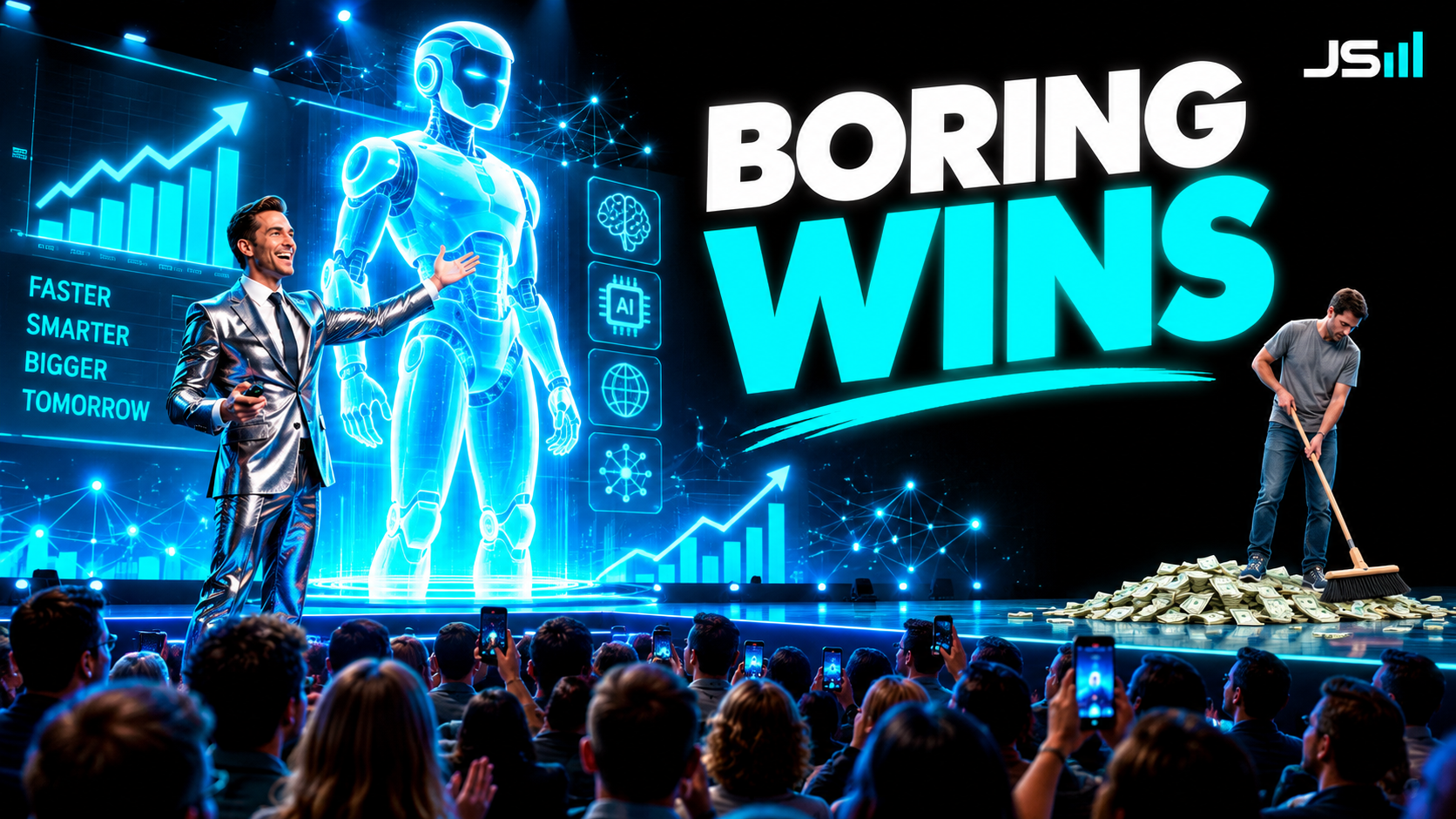
Nobody is going to get rich off the humanoid robot demo. The money in AI is in answering the phone, refreshing ad creative, and handling the FAQ for the nine hundredth time. The flashiest product in the room is almost never the one making anybody money.
Here's my prediction, and I'd like it on the record so you can laugh at me later if I'm wrong.
The people who actually win with AI, the ones who make real money with it, are going to be the most boring people in the room. Not the ones with the humanoid robot on stage. Not the ones with the pulsing orb and the gamified dashboard. The ones quietly using it to answer the phone.
That's it. That's the article. But I'm going to take a few thousand words to be obnoxious about it, because the alternative is you spending $30,000 on a demo.
The demo is not the product
Go to any AI conference, scroll any feed, sit through any pitch. The vision is enormous. Autonomous agents running your entire company. AI that replaces your whole cold-calling team. A swarm of digital employees that never sleep, never complain, never ask for equity.
It demos beautifully. Of course it does. A demo is a controlled environment where the happy path is the only path and nobody asks what happens on call four thousand.
I wrote a whole piece on the legal end of one of these pitches, Your AI SDR Is a TCPA Nightmare, because "our AI will replace your sales reps" happens to be illegal in the way most people are selling it. The FCC ruled AI voices are robocalls. $500 to $1,500 per call, uncapped, and it lands on you, not the vendor. The compliant version of that product announces itself as a robot and gets hung up on. The non-compliant version is a class action with a countdown timer.
But the legal problem is a symptom. The disease is broader, and I've said it before: this industry has a snake oil problem. Enormous. Historic. We're going to look back on this period the way we look back on people selling radium toothpaste.
Why the flashy stuff loses
There's a specific mechanic here and I want to name it.
Flashy AI products optimize for the moment of purchase. Boring AI products optimize for month eleven. Those are completely different engineering problems and they are funded by completely different incentives.
If your job is to close the deal, you build a beautiful interface, a slick onboarding, some satisfying animation, and a demo script that never deviates. If your job is to still be useful in a year, you build consent ledgers, retry logic, error handling, an audit trail, fallbacks for when the model says something insane, and a human escape hatch on every path. None of that second list shows up in a thirty second video. All of it takes months.
Guess which one gets built when the market rewards funding rounds over renewals.
And I'm not sneering from the sidelines. I build this stuff for a living. I integrate AI into real businesses that have payroll and a phone that rings, and I'm telling you: every single dollar I have ever seen AI generate for a client came from something that would put you to sleep if I described it at a party.
Boring thing #1: ad creative, at a speed no human can match

Paid ads work on one mechanic: your creative goes stale, and you have to replace it before performance craters. That's the whole game. Volume of tested creative over time.
Your agency charges you five grand a month and ships you, what, four new creatives? Maybe eight? Because a human has to design each one, and humans are slow and get attached to their work.
AI doesn't get attached. We generate and test creative dramatically faster than any human doing it by hand, which means we find the winner faster, which means the cost per lead drops. I've written before about how I am personally terrible at making ads and built a machine instead. It's not a glamorous story. It's just cheaper leads, permanently.
Nobody is putting "iterates on ad creative faster" on a conference keynote slide. It's also the single highest-ROI use of AI I've deployed.
Boring thing #2: actually answering the phone

I did this for a law firm, and it's the clearest example I have of the whole thesis.
Law firms live and die on intake. Somebody has an accident, they are scared, they pick up the phone, and they call three firms. Whoever picks up first gets the case. Whoever sends them to voicemail loses it, permanently, to the guy down the street. That's not a marketing problem, that's a revenue problem measured in cases.
The old fix was an answering service. And I'm going to say the thing everyone thinks and nobody writes down: those services are frequently a bad experience. Not because of who's on the other end, but because they're the cheapest possible option bolted onto the most important moment in your funnel. The caller strains to understand, the operator is reading a script for eleven different companies, nobody sounds like they work there, and the details come through garbled or not at all. You're handing the single highest-stakes conversation your business has to the lowest bidder.
We replaced it with an AI receptionist. It picks up on the first ring, at 2am, on a Sunday. It's clear, it's calm, it sounds like it works there, and it captures the details correctly every time. Then it hands the human the case.
Notice what it doesn't do. It doesn't argue the case. It doesn't give legal advice. It doesn't try to be the attorney. It takes the message and gets out of the way so an actual person can call back and be a human being to somebody having the worst week of their life. That's the entire design.
Boring? Extremely. It's a receptionist. It is also the difference between catching a case and losing it.
Boring thing #3: the FAQ you've answered nine hundred times
Somebody emails your support inbox asking a question that is answered verbatim on your own website. Again. For the nine hundredth time this year.
Let the AI answer that. Instantly, correctly, at 3am, forever, without a human ever seeing it. Nobody's life is made worse. Your support person gets their afternoon back.
Now the same inbox, different email: somebody wants to cancel. That one goes to a human, always, no exceptions. There's a reason they're leaving, that reason is worth more than the ticket, and a person who cares might save the relationship. Automate the cancellation and you've deleted the most informative conversation you'll have all month.
Tedious, automate it. The relationship, never. I laid the whole framework out in Where to Plug AI Into Your Business (and Where Not To), and it hasn't changed.
Boring thing #4: the content nobody wants to write
Social media and blogging are pure grind. Nobody running a cabinet shop wants to write a post about kitchen island trends on a Tuesday night. So it doesn't get written, and the business stays invisible.
That's a perfect AI job. Our clients upload a photo of a finished job and a quick note, and the content builds itself in their voice. Their blog runs on autopilot. When we analyzed our portfolio, the sites with blogs pulled 78% more views than the ones without. That's not a vanity metric, that's more people finding the business.
Again: deeply unsexy. Just traffic that wasn't there before.
Boring thing #5: websites, if you do it right
And here's the nuance, because I don't want to be quoted as "AI can build your website, go nuts."
AI can absolutely help build a website. It can also produce the most beautiful useless object you've ever seen. I've written about this at length in AI Websites Suck: a client once sent me a gorgeous ChatGPT-generated site where the contact form went nowhere, the call button dialed a fake 888 number, and there wasn't a single piece of SEO plumbing underneath.
It looked incredible. It would have generated exactly zero customers.
Which, honestly, is this entire article in one example. The pretty part is the easy 10%. The boring part, wiring the form to a real CRM, making the phone button dial the actual phone, putting tracking in so you can prove the thing works, is the 90% that determines whether it makes money. AI helps enormously with both. Only one of them shows up in the screenshot.
The trophy nobody wants

Here's the uncomfortable part for the hype crowd. Every use case I just listed has the same shape:
- It's a task a human already does.
- Doing it is tedious, repetitive, and slightly demoralizing.
- It has a clear right answer, so the AI being weird is caught immediately.
- A human stays in the loop for anything that matters.
- You can put a dollar figure on the result in under a minute.
That last one is the tell. If somebody pitches you an AI product and you can't do the arithmetic on what it saves or earns within sixty seconds, you are being sold a vision, not a tool. Visions are expensive and they don't renew.
So what do you actually do
If you run a business and you want in on AI without getting taken:
- Write down the five most repetitive things your team does every week. That list is your roadmap. Not a vendor's deck.
- For each one, ask: does it have a clear right answer, and would a human still review anything that matters? If yes, automate it.
- Draw the line at the relationship. The close, the complaint, the cancellation, the apology. Human, always.
- Judge every tool by its plumbing, not its interface. Ask what happens when it fails. If they haven't thought about that, they haven't built it.
- Demand a number. Leads, hours, dollars. If nobody can give you one, walk.
The bet
The flashy demos are going to keep coming. They'll get flashier. Somebody will put a face on it and it'll go viral, and a lot of business owners are going to spend real money on a thing that never makes them a dollar.
Meanwhile some guy with a cabinet shop will have an AI answering his phone at 8pm, and a law firm down the street will stop losing cases to voicemail, and neither of them will tweet about it.
That's who wins. It was never going to be the demo.
Want AI pointed at the boring stuff that actually pays?
That's the whole job. That's what we do at HyppoAI.
Want to talk about what you're building?
Get in touch