
Everybody Can Smell a Mass Text
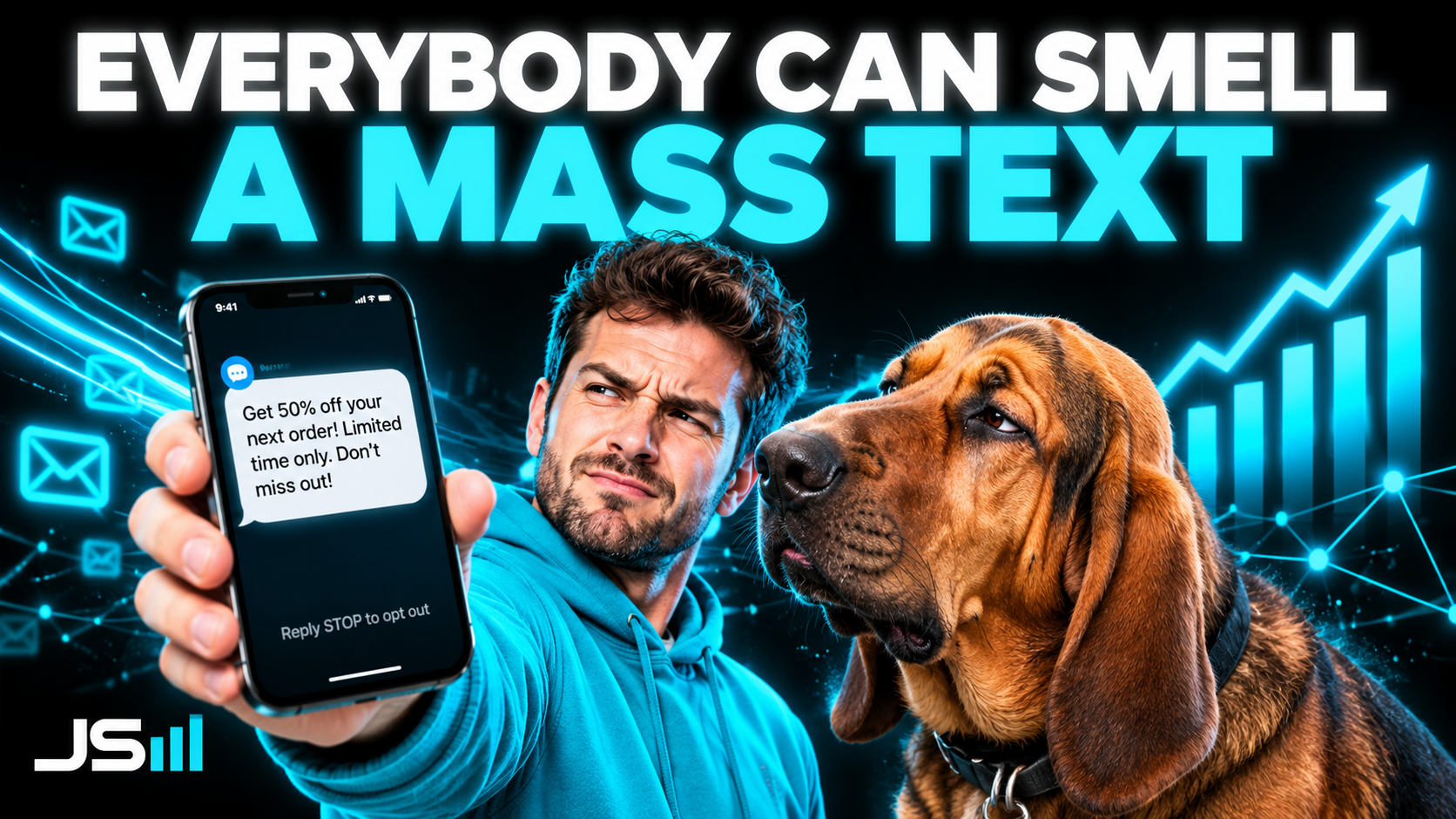
SMS still books appointments. But "Reply STOP to opt out" is a confession, business owners clock the tactic instantly, and the compliance tax keeps climbing. Here's what text marketing is actually good for now.
Text marketing still works. I'll say that first, because the rest of this reads like a eulogy and it isn't one. We run SMS. It books appointments, it gets replies, it makes money. But it is not the channel it was three years ago, and anyone still calling it a core growth engine is about to sell you a sequencer.
The era when it felt like cheating
For a few years SMS was the best deal in marketing. The pitch was always the same number, 98% open rate, and it was technically true because a text is open the second it lands on a lock screen. You could send a blast on a Tuesday and watch the phone ring. No algorithm in the middle, no inbox tab, no ad auction. Just straight into the one device nobody puts down.
That worked because of a condition, not a feature. The condition was that a text from an unknown number was probably a person. Everything since has been the slow destruction of that assumption.
The tell
Here's the problem in one line: "Reply STOP to opt out."
Those five words are legally required and they are a confession. The instant a human reads them they know the message came out of a system, which means it went to a list, which means they are on a list, which means this is not a person reaching out. Conversion doesn't drop because people are offended. It drops because the message stopped being personal, and personal was the entire advantage of the channel.

And it isn't just the footer. It's the shape of the whole thing. The too-friendly first name. The emoji doing emotional labor. The question that's engineered to get a reply instead of an answer. People have been trained on thousands of these, and pattern recognition is cheap. They clock it in under a second and the thumb is already moving.
The AI responder is not saving it
The pitch now is that AI fixes this. You don't blast, you converse. The bot handles the back and forth, qualifies, books.
I build these. They're useful. They are also, in the actual conversation, still a little bit unimpressive, and the reason is the medium. Text is intimate. It's where your mom and your best friend live. The bar for sounding human in that thread is brutally high, much higher than a chat widget on a website where everyone already assumes a bot. So the AI gets to "competent" and competent reads as hollow. Two exchanges in, people tend to know, and the ones who know get more annoyed than they would have if you'd just sent a plain message and signed your name.
That gap will close. It's closing fast. But today, an AI responder in SMS is a good tool having a hard time in the toughest possible room.
B2C survives, B2B is over
This is the split that actually matters, and it's not close.

Consumers still respond. A reminder about your dentist appointment, a 20% off code from a store you actually shop at, a text back from the roofer you just called. That's alive and it will stay alive, because the text is expected, timely, and about something the person already wanted.
B2B is a different story. You are texting someone who runs marketing for a living. They have an A2P campaign of their own. They know what your tool costs, they know what your list cost, and they know the message was scheduled. You cannot run a tactic on somebody who sells the same tactic. Every cold B2B text I've seen in the last year got read as spam by the exact people who could afford to buy.
The compliance tax
Then there's the paperwork, which is nobody's favorite section and the one that quietly decides the math.

A2P 10DLC registration, brand vetting, campaign approval, per-segment carrier fees, opt-in language the carrier has to like, and a rejection process that can bounce you for a sample message that reads too promotional. None of that is unreasonable. I'd rather live in a world where you have to prove consent. But be honest about what it is: friction and cost layered onto a channel whose conversion rate is going down. You're paying more per message to reach people who trust the message less. That's the whole story of a declining channel in one sentence.
The gray market is not a foundation
Which brings us to the workaround industry. iMessage senders running off racks of Mac minis to get the blue bubble, device farms, consumer SIMs doing business volume, anything that skips registration. It exists, it works for a while, and it is a terrible place to build a company.
I say this as the guy with a Mac mini running his whole operation, so I'm not squeamish about owning hardware. The problem isn't the hardware. The problem is that your entire acquisition channel sits on something Apple or a carrier can turn off on a Tuesday afternoon with no warning and no appeal. You're not building a business, you're renting a loophole, and loopholes have worse terms than vendors do. If a policy update can zero your pipeline, it was never your pipeline.
What I'd actually do
- Keep SMS for the stuff it's still great at: confirmations, reminders, the instant reply after someone fills out a form. Expected and timely beats clever every time.
- Stop cold texting businesses. It converts near zero and it burns the number you need for the real conversations.
- Stop reporting delivery and open rates. They were never the point. Count replies from humans and count booked appointments.
- Use AI to respond fast, not to pretend. Let it answer in seconds and hand to a person the moment it matters. Speed is the advantage, not the illusion.
- Register properly, own the consent records, keep the list clean. If the channel is going to cost more, at least make it durable.
- Don't build on a loophole. If your plan breaks when a platform changes a rule, it's a tactic, not a channel.
SMS isn't dying tomorrow. It's just been demoted. It used to be the engine. Now it's the follow-through, and it's very good at that. Treat it like what it is and it'll keep earning. Treat it like 2022 and you'll spend a year paying carrier fees to annoy people who already know your playbook.
Want to talk about what you're building?
Get in touch