
AI Sucks on a Blank Page
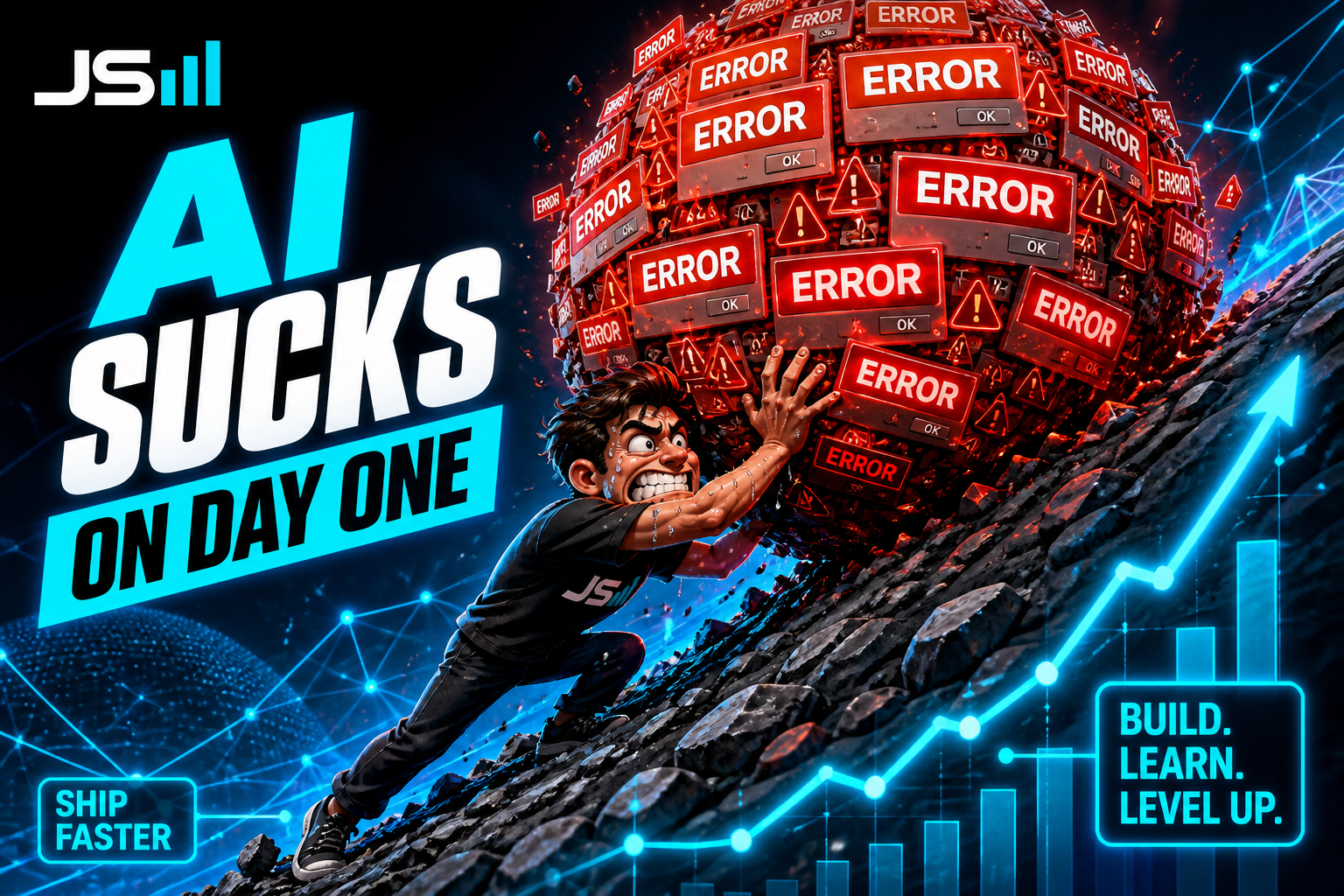
A take the hype crowd skips: when you start something brand new, AI kind of sucks. Building HyppoCRM early, I got an error every three seconds. Here's why: AI is fancy autocomplete, a prediction machine, and a fresh codebase gives it almost nothing to predict from. No architecture, no patterns, so it makes stuff up. But as the codebase grows and hardens, the errors fall off a cliff. It's the SaaS boulder: brutal uphill, then you're chasing it downhill. Push through the start.
Here's a take the AI hype crowd won't hand you: when you're starting something brand new, AI kind of sucks. And I mean that with love, because I use it every single day. But if you're a fresh vibe coder spinning up your first project expecting instant magic, brace yourself.
The error-every-three-seconds phase
When I started building HyppoCRM, I'm not exaggerating, I was getting an error roughly every three seconds. It felt less like coding with a genius and more like babysitting a very confident toddler. And there's a clean reason for it, one that comes straight from what AI actually is.
AI is fancy autocomplete
I've said this before and I'll keep saying it: at its core, AI is fancy autocomplete. (Full breakdown here: it's just autocomplete.) It's a prediction machine. It looks at what came before and guesses the thing that comes next.
"The weather outside is ___." It fills in gray, or overcast, or chilly, based on the patterns it's seen. That's the whole trick, scaled up to billions of parameters. Predict the next thing.
Now think about what that means for a brand-new project
A prediction machine is only as good as what it has to predict from. And when you start a fresh codebase, there's almost nothing to predict from.
Sure, it has general training data. But it has no idea how YOUR project is built, because your project isn't built yet. There's no architecture to lean on, because there isn't one. You can hand it a spec, but a spec isn't code, and it doesn't actually know how your code is going to look and feel until the code exists. So it does the only thing a predictor can do with nothing to go on: it makes stuff up. And a lot of what it makes up is wrong.
That's why we actually slowed way down early on. The AI had too much to invent. It didn't know "here's how we do migrations," or "here's how we structure our code," or "here's how we abstract our providers so there's no single point of failure." No established patterns meant constant guessing, and constant guessing meant constant errors.
Then something flips
Here's the good news, and it's a big one. As the codebase grew and I corrected all those early mistakes, the errors started dropping off a cliff.
Because now the predictor has something to predict from. When the codebase is big and, crucially, hardened, cleaned up and battle-tested against the weird edge cases, the AI can look at the parts it needs, see exactly how you've done things before, and match it. It's not guessing in a vacuum anymore. It's pattern-matching against real, working, approved code you already shipped. More context, more to go on, better predictions. That's the entire game.
Now, don't misread me. It's still not perfect. It'll still make mistakes, and you still have to watch it like a hawk (human in the loop, always). But the difference between day one and month six is night and day.
It's the SaaS boulder, basically
Alex Hormozi has this great line about building a SaaS company: before you hit product-market fit, it's like pushing a boulder up a hill. Grueling, slow, every inch is a fight. But once you crest that hill, it flips, and suddenly you're chasing the boulder down the other side. For a software company, adding one more customer barely costs a thing, so the momentum just compounds. (And yes, before anyone asks: SaaS is not dead. It's getting more exciting.)
Building with AI on a codebase works exactly the same way. The start is the uphill grind. You're forcing the architecture, the specs, and the patterns into existence, and AI fights you the whole way. But get that foundation right, and it flips. Now AI is chasing the boulder downhill with you, iterating at a speed that feels almost unfair. It becomes the leverage monster everyone promised.
The takeaway
So if you're new and your AI-built project is throwing errors every three seconds, relax. That's not you failing. That's the uphill part. Push through it, build the structure, harden it, and the same tool that felt useless on day one becomes ridiculous leverage by month three.
One last thing, because it always bears repeating: AI is a leverage monster, but it is not an oracle. If it tells you to break up with your boyfriend, it's almost certainly being dumb and definitely doesn't have the full context. Use it for the boulder. Not for your life decisions.
Want the downhill without the uphill?
We've already pushed the boulder. We build on a hardened foundation so you get the leverage, not the error spiral. That's what we do at HyppoAI.
Want to talk about what you're building?
Get in touch