
Your AI Receptionist Startup Just Lost Its Moat

Bold claim: the AI receptionist companies, Vapi, Retell, Synthflow, just lost their moat overnight. And Vapi's no joke, reportedly valued near $500M and working with Amazon's Ring. So let me prove it. An AI receptionist isn't one brain, it's five layers duct-taped together: telephony, speech-to-text, the LLM brain with its tools, text-to-speech, and telephony back out. The moat was never the parts, it was making the seams play nice, and that was brutally hard. Then OpenAI's Realtime API collapsed the middle three layers into one speech-to-speech model. I built my own copy in a day. When your moat is "this is hard to build," and AI makes it easy, that's a problem.
I'm going to make a bold claim, and then I'm going to spend most of this article arguing against myself before I prove it. The AI receptionist companies, your Vapi, your Retell, your Synthflow, just lost their moat overnight.
That's a big swing. Vapi in particular is genuinely promising, reportedly valued around $500 million and working closely with Amazon's Ring. These are not toy companies. So when I say their biggest technical moat just evaporated, I don't say it lightly. Let me show you exactly why, and I'll build it up so both the engineers and the business owners reading this walk away understanding it.
First, an AI receptionist isn't one thing
When people picture an AI phone agent, they imagine Jarvis, one magic brain that just talks. That's not how it works. Under the hood it's a chain of separate systems duct-taped together, and getting them to cooperate is the whole game. (This is really a story about architecture, which I've written about before.)
Here's the old way, the way Vapi, Retell, and Synthflow are built. Five layers.
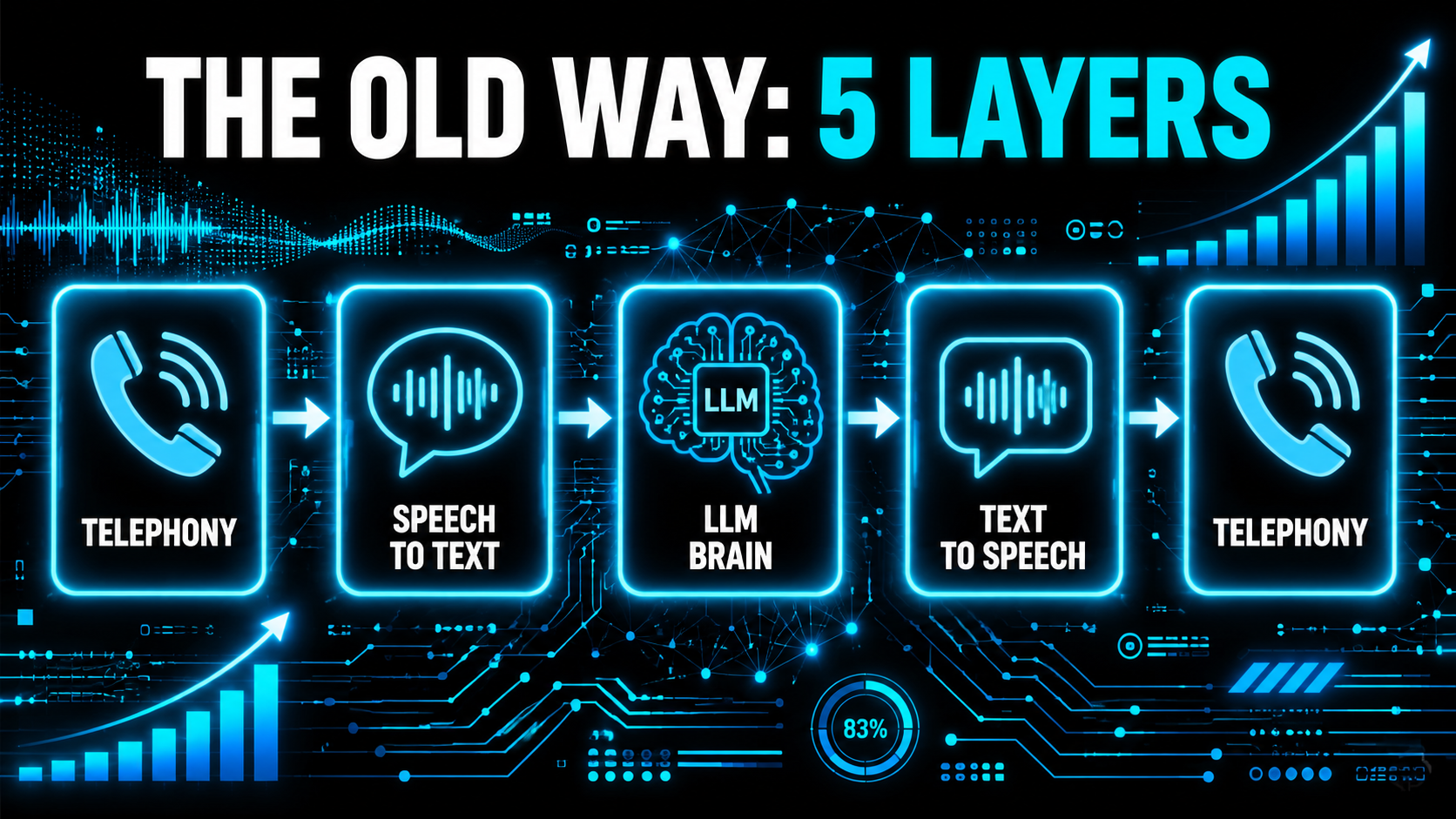
Layer 1, telephony. This is just the phone part. The carrier that connects the actual call, think Twilio or Telnyx, pick your poison. Me dialing a number and it ringing through. This layer isn't going anywhere.
Layer 2, speech-to-text. The caller is talking, which is just audio. A computer can't reason about audio, so this layer takes the sound and turns it into written words. Fun fact: this is exactly how Joe 3.5 handles my voice memos, he transcribes what I say into text before he does anything with it.
Layer 3, the LLM. The brain. This is the large language model, your Claude, Gemini, Grok, ChatGPT, DeepSeek, there are a million now. It takes the text from layer 2 and follows a "system prompt," which is just its standing set of instructions. Something like: "You are the receptionist for HyppoAI. You answer inbound questions and help people take the next step toward a high-converting website or a CRM they love." That prompt shapes its whole personality and job.
And here's the part that makes it actually useful: the brain can call tools. A receptionist that can only chat is useless. It needs to do things. Hooked into a CRM with API access, the LLM can look someone up by phone number, pull their info if they exist, create a new contact if they don't, book an appointment, fire off a text, or escalate to a human. Chat plus action. That's the difference between a demo and a product.
Layer 4, text-to-speech. The brain's answer comes out as text ("I'm good, how are you, Joe?"). But you can't play text down a phone line, so this layer turns those words back into natural spoken audio. This is your ElevenLabs, Deepgram, Cartesia. It's why these platforms have you plug in your own ElevenLabs API key.
Layer 5, telephony again. That freshly generated audio gets played back down the phone line, and the caller finally hears the reply.
The magic was never the parts. It was the seams.
Here's the thing. None of those five layers is the hard part on its own. The hard part is making them fit together so it feels like one smooth human conversation instead of five robots passing notes.
There's a whole art to it, things like "endpointing," which is just the system figuring out when you've actually finished talking versus when you're mid-sentence taking a breath. Get that wrong and the thing either interrupts you constantly or sits there in awkward silence. Multiply that by five layers, all needing to run in a fraction of a second so there's no weird lag, and you start to see the problem.
This is why building one of these properly took a real team, serious money, and a lot of time. And I'll be honest with you: even for me, and I'm genuinely good at architecture, building this cleanly from scratch was brutal. I tried. It's hard. That difficulty was the moat. It's the entire reason these companies could raise hundreds of millions.
It took me six minutes just to explain this out loud driving home from dinner with my dad. That's how many moving parts we're talking about.
Now here's what changed
You've talked to ChatGPT's voice mode, right? You speak, it speaks back, in a natural voice, in real time. OpenAI recently opened that up as something called the Realtime API. (Quick translation: an API is just a way for two pieces of software to talk to each other directly.)
What that API does is collapse the middle of the stack. Instead of speech-to-text, then LLM, then text-to-speech as three separate hops, it does speech straight to speech in one shot. You feed it audio, it gives you back audio. And it still keeps a system prompt, and it can still call your tools.
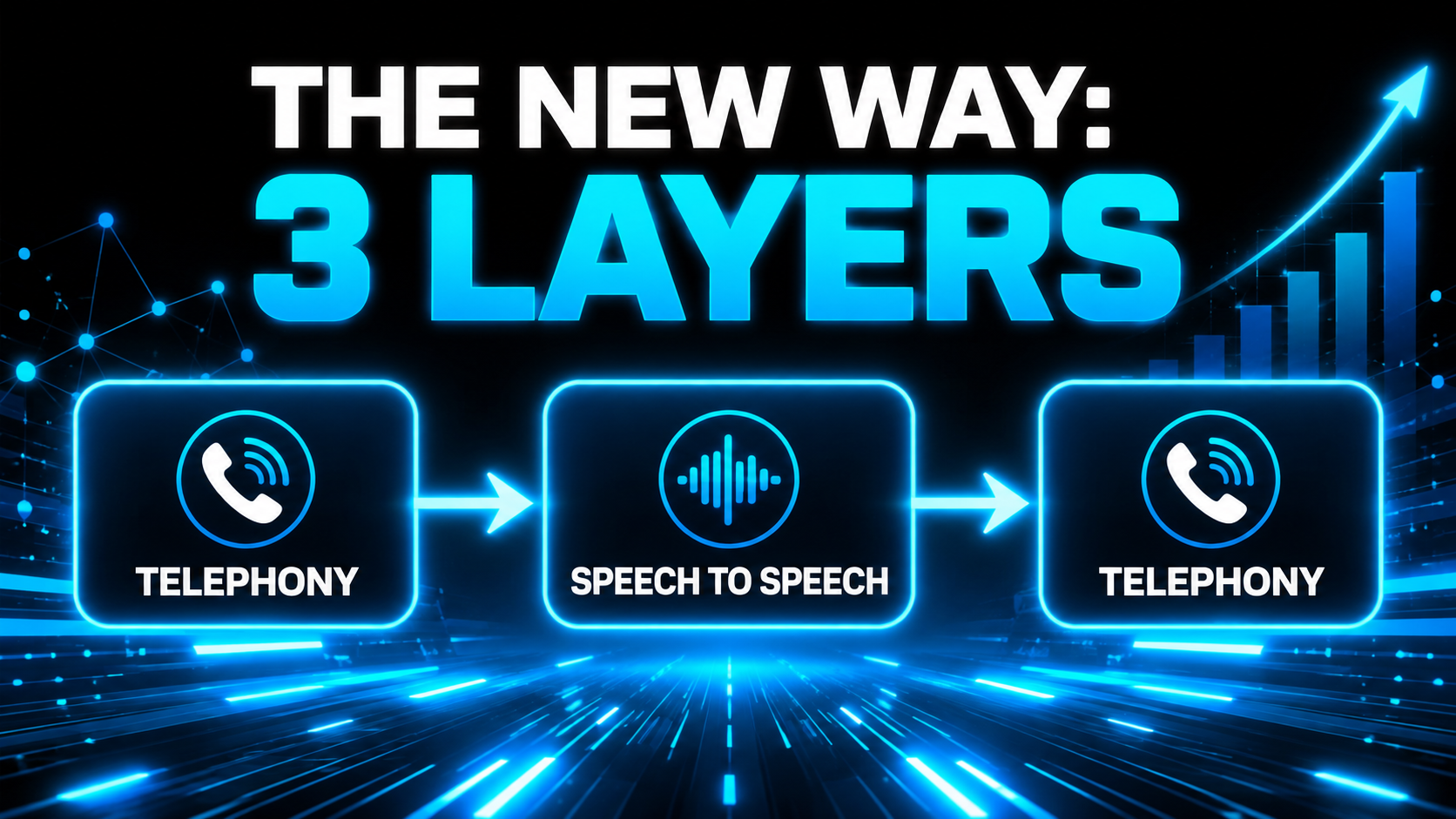
Look at what just happened to the architecture. Five layers became three: telephony in, speech-to-speech model in the middle (with its prompt and its tools), telephony back out. The three trickiest layers, and more importantly the fragile seams between them, got swallowed by a single model. The hardest, most expensive part of the entire build, making all the pieces play nicely, just got handed to you for free.
So I built one. In a day.
That's not a hypothetical. That's literally what I did today. I stood up my own speech-to-speech receptionist copy and it's already pretty good. We'll likely have it running in production next week and drop our third-party provider entirely, plugging it straight into our own CRM instead.
A day. For a thing that used to need a team of twenty and still fought you the whole way. That's the leverage AI gives you, and it's exactly why I keep calling it a cheat code. It doesn't make hard things a little easier. It vaporizes what used to be the hard part.
To be fair, they're not dead
Let me be clear so nobody misreads this. Vapi, Retell, and Synthflow are not going away tomorrow. They still have real advantages: distribution, brand awareness, polished products, existing customers, integrations. Those matter, and a valuation doesn't vanish because one layer got easier.
But make no mistake about what happened. The thing that made this genuinely hard to build, the reason you'd pay someone else to do it, got dramatically easier basically overnight because the underlying technology took a leap. When the moat was "this is really hard to build," and the difficulty drains out from under you, that's a moat problem. Full stop.
The takeaway
This is the pattern to internalize, whether you're a founder or just trying to stay ahead. AI doesn't only build products faster. It periodically reaches down and erases the exact difficulty that some company's entire valuation was resting on. If your moat is "this is technically hard," keep one eye over your shoulder, because hard is a moving target now.
Anyway, I've got a voice AI to go finish building. The AI world keeps getting more interesting.
Want voice AI that plugs straight into your business?
We build it native, into your own CRM, no third-party middleman renting you your own front desk. That's what we do at HyppoAI.
Want to talk about what you're building?
Get in touch