
Product Review: Airtable Is a Toy Pretending to Be a Database
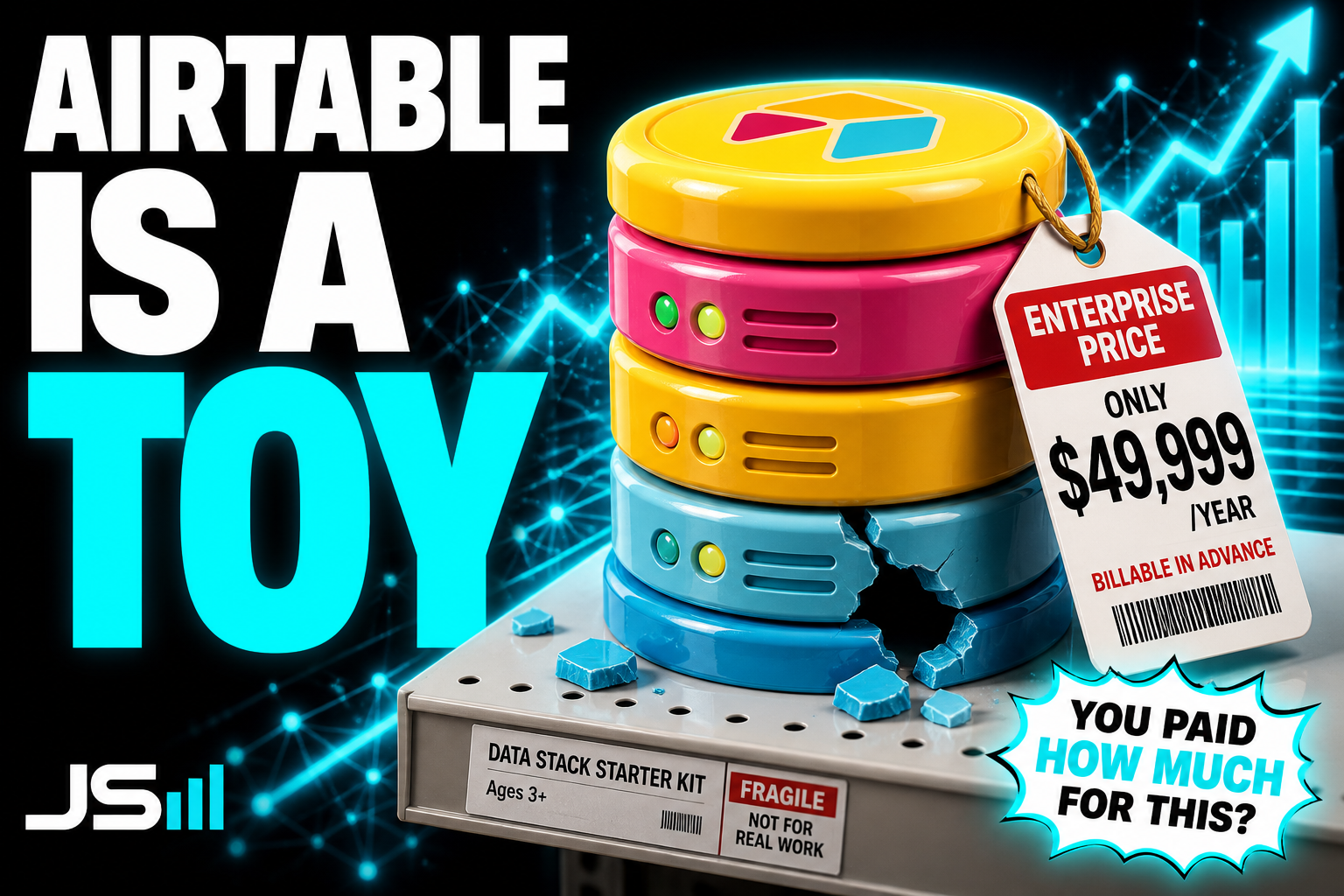
Next up in the review series, and you know I don't pull punches: Airtable is garbage. One out of ten. Google Sheets is simple and cheap; Supabase is a real Postgres database that scales. Airtable sits in the awkward middle, priced like enterprise software while refusing to be a real database. No SQL, no foreign keys, no row-level security, and an API so crippled (5 requests a second, 10 records each) it would take 40 minutes just to read 125k records. It's a toy pretending to be a database.
Welcome back to the part of the blog where I review software and pull no punches. Last time I put Microsoft Power Automate in the ground. Today's victim: Airtable. And I'll be honest right up front, because you know I'm a provocateur: Airtable is garbage. One out of ten. Let me explain exactly why, and I'll keep the technical stuff in plain English.
First, a spectrum
To understand why Airtable fails, you need two reference points on opposite ends of a spectrum.
On one end: Google Sheets. Look, as a database, it's bad. Bad API, brutal rate limits, not built for anything serious. But here's the thing, it's dirt simple, it's genuinely free, and everybody already knows how to use it. If you're doing beginner data entry, some manual tracking, a quick MVP, or light accounting where you don't need a real database, Sheets is completely fine. It knows exactly what it is.
On the other end: Supabase, which is a real Postgres database. It's more technical, but it's the real deal, built to scale, and it even generates your own API for you automatically, which is genuinely great. When you're building something serious, this is what you reach for.
Two tools, two very different markets, both honest about who they serve. Good.
Airtable lives in no-man's-land
Now here's Airtable. It planted itself right in the awkward middle, trying to appeal to everyone, and in doing so it appeals to basically no one.
It looks like a spreadsheet. It behaves sort of like a database, if you squint. But it charges you like enterprise software while refusing to give you actual database capabilities. It's the worst of both worlds: too fiddly for the Google Sheets crowd, and nowhere near powerful enough for the Supabase crowd.
Under the hood, it's not a real database
Let me translate the technical problems for the non-engineers, because this is where it gets ugly.
It doesn't use SQL. SQL is the standard language every serious database speaks, the thing that lets you ask powerful, precise questions of your data. Supabase speaks it fluently. Airtable doesn't, which quietly caps what you can actually do.
It doesn't enforce foreign keys. A "foreign key" is just a rule that keeps related data honest, for example, making sure an order actually belongs to a real customer and can't point to a customer who doesn't exist. Real databases enforce that automatically. Airtable shrugs.
It doesn't give you row-level security. That's the feature that controls which specific records each user is allowed to see. If you're building an app where many customers share one system, this is non-negotiable. It's what stops Customer A from ever seeing Customer B's data. Airtable doesn't offer it. Let that one sink in.
But the API is the real crime scene
Here's the most atrocious part, and I'm not exaggerating. Airtable's API, the doorway your software uses to read and write data, is crippled.
- It allows about 5 requests per second, per base. Supabase is dramatically higher.
- You can only read or write 10 records per request. Supabase handles thousands at a time.
- And you're billed per seat, per person, rather than by how much you actually use it, the way Supabase does.
Let me make that concrete. 5 requests a second, times 10 records each, is 50 records per second, at absolute full throttle. So just to move 125,000 records one time, you're looking at over 40 minutes of maxed-out API hammering. For anything running a real backend, that's a non-starter. It's like trying to drain a swimming pool through a coffee straw.
The record ceiling that kills you
And about that 125,000: that's the cap on Airtable's Business plan. The Team plan? 50,000 records. Per base.
For a personal to-do list, sure, whatever. But for a real software product, especially a multi-tenant one (meaning one app serving many customers out of the same system), that number is comically low. Do the math: if you've got 100 customers sharing a 125,000-record base, that's about 1,250 records each, total, spread across every contact, order, note, and log combined. One active client can burn through that alone. You will slam into that wall shockingly fast, and when you do, there's nowhere to go.
It's an architecture nightmare
Because Airtable can't do the real work itself, you end up bolting on a mess of external tools, Zapier, Make, n8n, just to force it to behave. Before long, your actual business logic is scattered across four different services and nobody on your team can tell you where any given rule actually lives. That's not architecture, that's a scavenger hunt. (I wrote a whole piece on why architecture is the thing that actually matters.)
And I'm not the only one
Since I'm just one guy with strong opinions, let me zoom out. The common complaints are remarkably consistent: the per-seat pricing balloons fast as your team grows, the automation runs are capped, large bases get sluggish, and migrating your data out later is a genuine pain because you're locked into their world. It's a pattern, not just my bad mood.
The one nice thing
In fairness: the UI is pretty. It's approachable, it looks clean, and that's a real reason it caught on. But "pretty" is table stakes now. Supabase and plenty of others look great too, and they're actually databases. A nice paint job doesn't make up for the engine being missing.
The scorecard
- Real database capabilities: 1/10
- API and developer-friendliness: 1/10
- Scale and record limits: 1/10
- Data integrity (relations, keys): 2/10
- Pricing and value: 2/10
- UI and first impression: 6/10
- Overall: 1/10
The verdict
Airtable is a toy pretending to be a database, sold at enterprise prices. It's brittle, it breaks, it can't scale, it can't do real relational work, and its API will strangle any serious backend you try to build on it. One out of ten. Honestly, don't even use it. If you need simple and cheap, use Google Sheets. If you need real and scalable, use Supabase. Airtable is the answer to a question nobody should be asking.
Building on the wrong foundation?
We build on real databases that actually scale, no toys, no duct tape. That's what we do at HyppoAI.
Want to talk about what you're building?
Get in touch