Failing Silently vs. Failing Loudly

A loud failure hands you the bug report for free. A silent one compounds for as long as nobody notices. Elon's rockets, the summer my AI assistant quietly stopped texting me, and the two-part pattern, a heartbeat plus a checker, that turns silent failures into loud ones, in software and in your business.
There are two ways for something to break. It can blow up in front of everyone, or it can quietly stop working and tell nobody. One of those is embarrassing. The other one is dangerous. Most people have them backwards.
I want to make the case that the loud failure is the good one, and then show you how I force the quiet ones to get loud, because that second part is where the engineering actually lives.
Elon and the rockets
SpaceX blew up a lot of rockets. On the pad, in the air, on landing. The early Falcon tests, the Starship prototypes. For a while it felt like every launch ended in a fireball and a clip going viral. People laughed. Then the same company started landing boosters on their tails like it was nothing, and the laughing stopped.

Here's what people missed about those explosions. Every one of them was loud. Not just visually, in the engineering sense. The rocket failed, everyone knew it failed, they knew the exact second it failed, and they had a few hundred sensors telling them why. The failure announced itself. That's the entire reason they could fix it so fast. A loud failure hands you the bug report for free.
Compare that to the alternative, which is the one most companies actually live with. Nothing explodes. The rocket just never leaves the pad, nobody notices, and six months later someone asks why we haven't launched anything.
The silent one is the killer
I've written before that being wrong out loud is an underrated skill. This is the systems version of the same idea. A failure you can see is a problem. A failure you can't see is a trap.

Let me tell on myself. Joe 3.5, my AI assistant, used to text me a morning brief every day at 7am. Calendar, tasks due, what to expect. This summer it stopped. Not with an error. Not with a crash. The cron job that fired it simply stopped firing, and the only symptom was that my phone was a little quieter in the morning.
A quiet phone does not feel like a bug. It feels like a nice morning. So I didn't notice for weeks. Meanwhile, tasks were getting created that I was never shown, follow-ups were going stale, and the whole point of having an assistant, that he nudges me so I don't have to remember, was silently gone. The system was "running." It just wasn't doing anything.
That's the trap. When a button on your website breaks, a customer tells you within the hour. When a background job breaks, nothing happens, and nothing happening is indistinguishable from everything being fine. The failure mode is silence, and silence is the one thing a human brain is worst at detecting.
What a heartbeat is
So here's the fix, and it's one of the most useful patterns in this whole field. It's called a heartbeat.
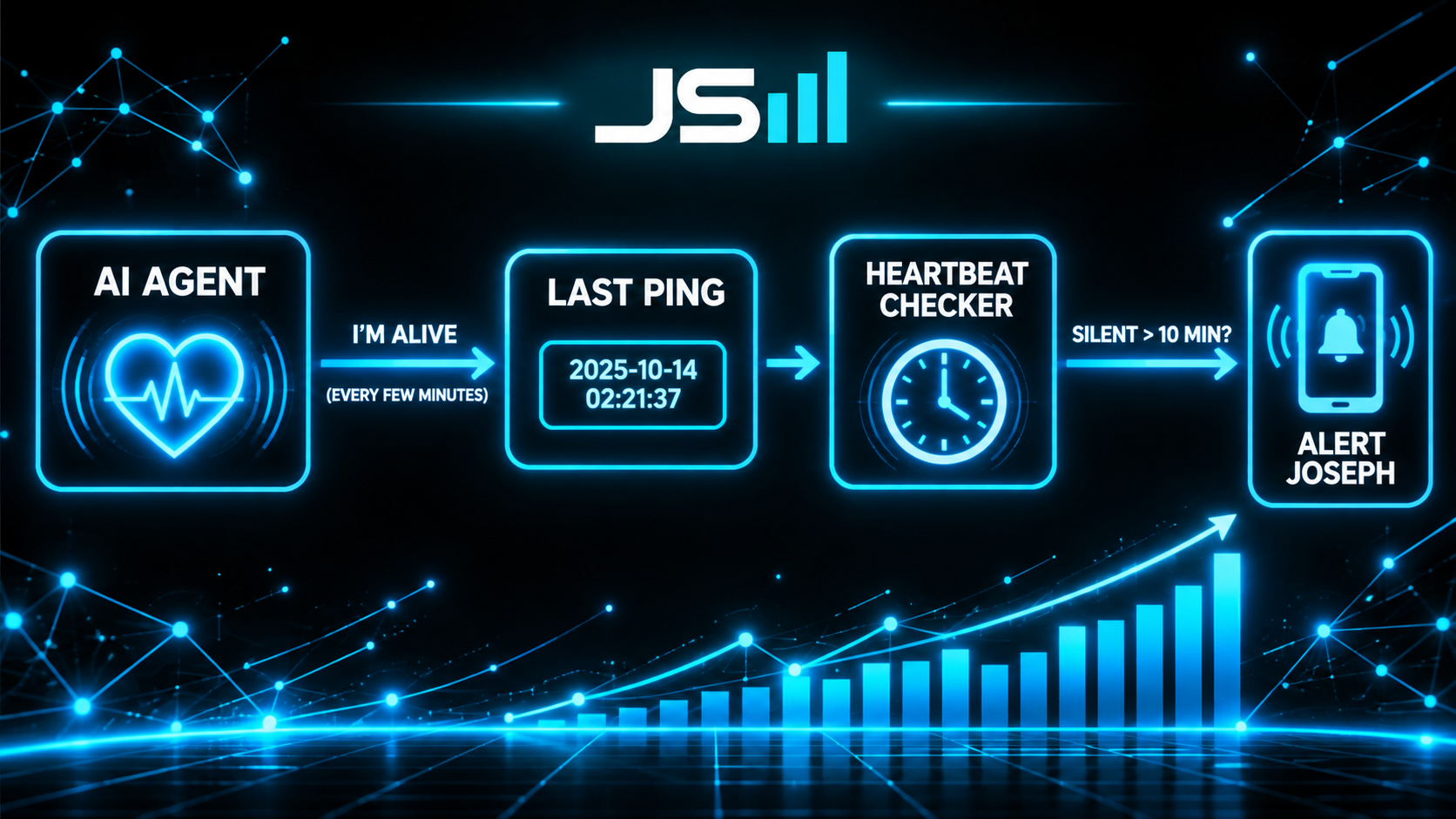
The idea is simple. Your system, whether it's an AI agent, a cron job, or a whole server, sends a tiny signal on a regular schedule that says "I'm alive." A ping. Every minute, every five minutes, whatever makes sense. It writes a timestamp somewhere: last seen at 7:04am.
Then there's a second, completely separate job whose only purpose is to watch that timestamp. It runs on its own clock, and it asks one question: "when was the last ping?" If the answer is recent, it does nothing. If the answer is "ten minutes ago" and the pings are supposed to be every minute, it screams. It texts me. It sends an alert. It makes the silent failure loud.
That's the whole thing. Two pieces:
- The heartbeat. The system reporting in. "Still here." Cheap, tiny, runs constantly.
- The checker. A separate watcher that notices when the heartbeat stops and alerts a human.
The important word is separate. If the checker runs inside the same process as the thing it's watching, it dies with it, and you're back to silence. The watcher has to live somewhere else. Programmers sometimes call this a dead man's switch, after the handle a train operator has to keep holding down. Let go, the train stops. Stop pinging, the alarm goes off.
How Joe 3.5 does it now
After the morning brief incident, every scheduled job he runs reports in when it finishes. A checker runs on its own schedule and compares what should have happened to what did. If the brief was due and nothing reported, I get a text that says, in plain words, the brief didn't fire. If the inbox watcher goes quiet, same thing.
I also built the other direction in. If a tool he depends on breaks, an auth error, a service that won't respond, he doesn't swallow it and tell me "all set." He tells me it failed and that he'll retry. That's a rule I had to write down explicitly, because the default behavior of a system that wants to be helpful is to paper over the error and sound confident. Confident and wrong is the quietest failure of all. If you've read about my Upwork bot trying to expose my Mac mini to the internet, you know why I care about agents that announce what they're doing.
The principle for any AI assistant you build: it should be loud about two things. When it did something, and when it couldn't. "I sent it" and "I could not send it" are both fine. Silence is the only unacceptable answer.
Your business has silent failures too
This isn't just a software thing. It's a business thing, and once you see it you can't unsee it.

The contact form on your website that stopped sending emails in March. The lead that came in on a Friday and never got a reply because it landed in the one inbox nobody checks. The client who stopped opening your emails three months before they stopped paying you. The ad campaign that's been running to a dead landing page. None of these announce themselves. They all look like "a slow month."
Every one of them is fixable the same way. Put a heartbeat on it. A weekly job that submits a test lead through your own form and yells if it doesn't show up. A check that flags any lead older than a day with no reply. A report that lists clients who've gone quiet. You don't need to watch everything. You need something that watches for you and makes noise when the signal stops. I wrote about engineering the consequence instead of relying on discipline, and this is the same muscle. Don't rely on noticing. Build the thing that notices.
The takeaway
Loud failures are a gift. They tell you what broke, when, and usually why. Blow up the rocket, take the notes, fly again. Silent failures are the ones that actually hurt, because the damage compounds for as long as nobody knows.
So design for noise. Make every important thing in your business report in, and build a separate watcher that screams when it stops. A heartbeat and a checker. It's one of the simplest patterns in software and it's the difference between finding out in ten minutes and finding out in ten weeks.
My phone was quiet for a month this summer. It'll never be that quiet again.
Want systems that tell you when they break?
That's a baseline at HyppoAI. Everything we build reports in, and something is always watching.
Want to talk about what you're building?
Get in touch