
Your No-Code Automation Tools Just Lost Their Moats
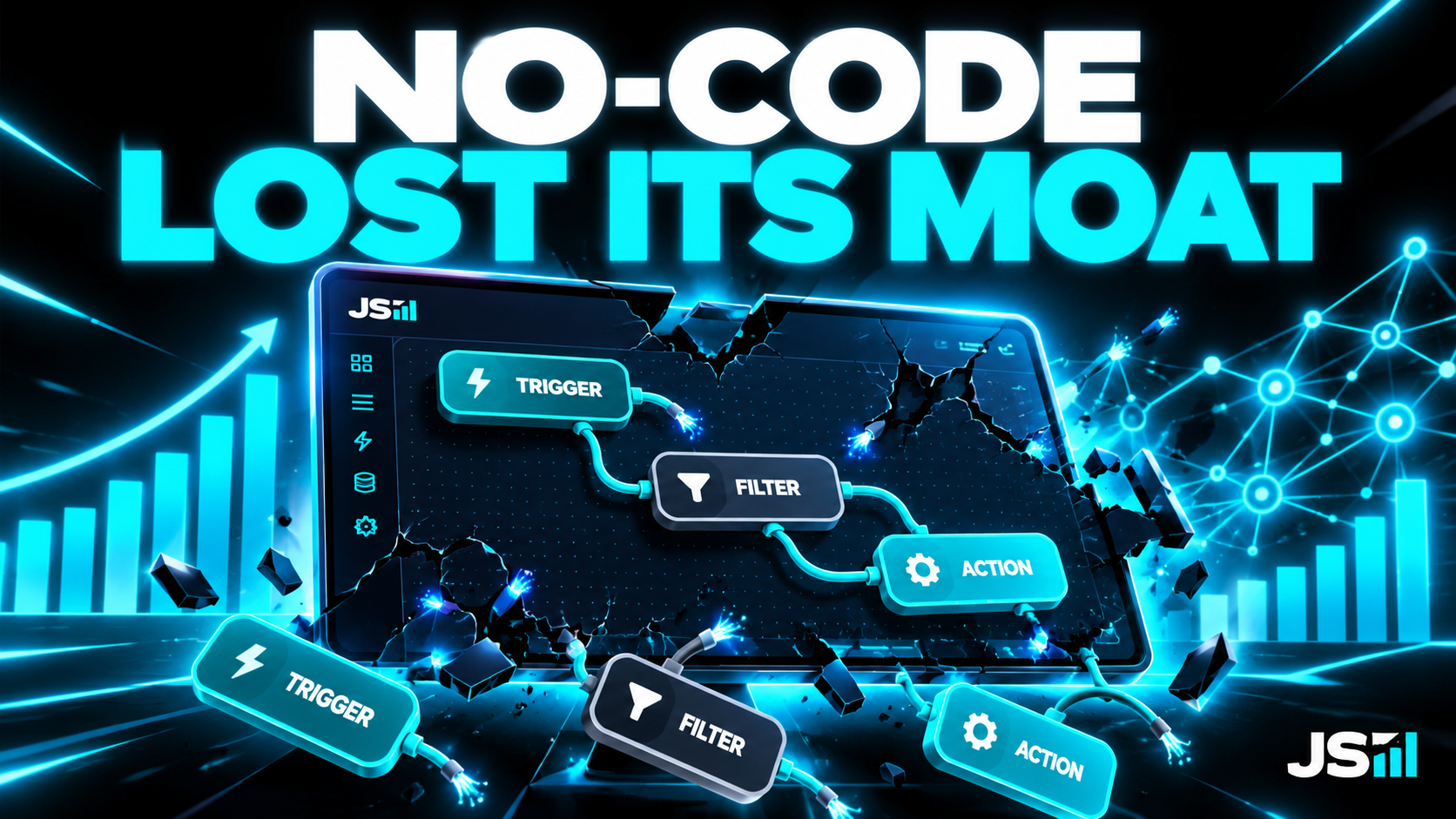
The moat was never the software. It was that wiring two APIs together used to be annoying enough to pay for. That annoyance is gone, so here's what happens to Zapier, Make and n8n over the next three to five years.
The moat was never the software. The moat was that wiring two APIs together used to be annoying enough that people would pay a monthly fee to avoid it. That annoyance is what Zapier sold. It's what Make sold. It's what n8n sold a better version of.
The annoyance is gone. So the moat is gone. Let me go tool by tool, because each one is losing it for a slightly different reason.
Zapier: a great product for a problem that shrank
I want to be fair here. Pre-AI, Zapier was genuinely useful. Form fills to a spreadsheet, new customer to a Slack ping, receipt to a folder. For a small business with no developer, that was real value and it worked.

Two things always bit, though. The pricing scales against you, because you pay per task, which means the better your business does the more you pay for the privilege of your own volume. And the logic is brittle. Anything past a simple trigger and action becomes a branching flowchart you're debugging through a web form, with no version control, no real tests, and no way to see why last Tuesday's run died.
Now the floor fell out. The simple zap, the one that moved a record from A to B, is forty lines in a cloud function that costs effectively nothing and that you can actually read. You don't need a platform for it anymore. You need an afternoon, and AI gives you the afternoon in twenty minutes.
What's left for Zapier is the long tail of legacy integrations. The thousands of connectors to software nobody wants to write an API client for, including some ancient systems with authentication flows that are genuinely miserable. That's real value and I'd use it for exactly that. But notice what it is. It's a library, not a moat. Libraries get replicated.
Make: stuck in the middle with nobody
Make sits awkwardly between Zapier's simplicity and n8n's power, and that was survivable when the visual canvas itself was the differentiator. Being able to see the workflow, drag it around, prototype something in an hour, that was the pitch.
AI took the prototyping advantage outright. I can describe a workflow and have a working version in code faster than I can lay it out on a canvas, and mine comes with tests. Strip that away and you have to ask who Make is specifically for. Not the owner who wants two steps and no thinking. Not the engineer who wants real control. Serving the middle works right up until the middle has better options on both sides.
n8n: the best of them, and still exposed
Credit where it's due. n8n is the most versatile of the three and it's the only one that actually teaches you something. Build in n8n for six months and you'll learn retries, error branches, idempotency, webhook auth, rate limits. Those are software fundamentals, and they transfer. I'd rather hire someone who learned them in n8n than someone who learned nothing in Zapier.

But its core value proposition is now in the blast radius. Two reasons.
First, self-healing. The whole reason you built a careful node graph with explicit error branches was that software fails in boring predictable ways and someone had to handle each one by hand. Agents handle a lot of that themselves now. They catch the failure, read the error, retry differently, and tell you what happened. That erases a big chunk of why the graph existed.
Second, natural language. The node graph is a way for a human to express intent precisely to a machine. It's a pretty good one. It is not better than saying what you want in a sentence and getting code that does it, which is where we now are.
Here's my favorite leading indicator, and it's not a technical one. Watch the YouTubers. Eighteen months ago every automation channel was pumping out n8n tutorials, because that's where the views were. That wave is cooling and the creators are drifting toward agents and code. Creators chase attention with no sentimentality whatsoever, which makes them a better demand signal than any analyst report.
The RAG example, because it's the clearest one
Retrieval augmented generation, in plain terms: letting an AI answer questions using your own documents instead of just what it was trained on.
A year ago this was the flagship no-code build. Forty nodes, a document loader, a chunker, an embeddings call, a vector database, a retrieval step, glued together on a canvas, and a tutorial with 200,000 views explaining the wiring.

Today you ask for a Supabase connector, a chunking strategy, an embeddings pipeline, and a retrieval function, and you have working code in an afternoon. In your repo. With types. That you can debug with a stack trace instead of by clicking individual nodes and squinting at their output panels. The forty node version isn't impressive anymore. It's just forty places for something to break.
Bolting on an AI builder doesn't fix it
Every one of these companies has shipped or is shipping an AI workflow builder. Describe what you want, it assembles the nodes. I understand why. It's also an admission.
If an AI can build the workflow, the interesting question is why the workflow still has to live inside your canvas, on your runtime, at your per-task price. The AI builder makes the easy part easier and leaves every structural problem exactly where it was: you still don't own the logic, you still can't test it properly, you still pay by the execution, and you still can't move it.
And yes, I built one anyway
Full disclosure, because leaving it out of a piece like this would be weird. HyppoCRM has a no-code automation builder in it. Canvas, nodes, drag the thing to the other thing. I built it on purpose.
Two reasons. First, people genuinely like canvases. There's something satisfying about seeing your own logic laid out in front of you, and plenty of owners are never going to write a line of code and shouldn't have to. Second, ours is free, like most of the platform, because I don't think you should pay by the task to move your own data around your own system.
That's the distinction I'd draw. A canvas as a nice interface on top of software you already own is a feature. A canvas as the entire product, with your business logic held hostage inside it and a meter running, is the thing that's losing its moat.
What actually replaces it
Not a better canvas. One system.

Most automation work exists because the data is scattered across nine products that don't know about each other. The CRM doesn't know what the invoicing tool did, so you build a zap to tell it. Every connector in your stack is a tax you pay for having split the business across tools in the first place.
We went the other way with Hyppo. The CRM, the phone system, the books, the email, one codebase and one database. When the invoice and the contact live in the same place, there's nothing to integrate. The automation isn't automated, it's just how the software works.
Where this lands in three to five years
- Zapier survives on legacy connectors and brand, serving the non-technical end. Smaller, still real.
- Make has the hardest road, because the middle is the first thing to go.
- n8n stays the engineer's choice and probably becomes an agent orchestration layer, which is a different company than the one it is now.
- The per-task pricing model is the first casualty, because AI collapsed the cost of a task to roughly nothing and customers will notice.
- If you're building now, write the logic in code you own and reach for a connector library only when the integration is genuinely painful.
I'm not dancing on anyone's grave. These tools were the right answer to a real problem and I learned things from all three. The problem just got smaller, and a moat that depended on something being annoying doesn't survive the annoyance going away.
Want to talk about what you're building?
Get in touch