The Cost of Changing Your Mind Just Got Cut in Half
Every owner tolerates a pile of broken things because fixing them costs more than living with them. AI just cut the cost of fixing in half, and most people haven't re-run the math.
Every business owner tolerates a list of things they know are broken. The CRM nobody likes. The invoicing process with three manual steps. The vendor who's fine, not good. You tolerate them because fixing them costs more than living with them. That math just changed, and most people haven't re-run it.
Two lines, one decision
Every inefficiency in your business has a pain level. And every fix has a switching cost: time, money, risk, the week of chaos while the new thing settles in. You only act when the pain crosses the switching cost. Below that line you tolerate. Above it you move.
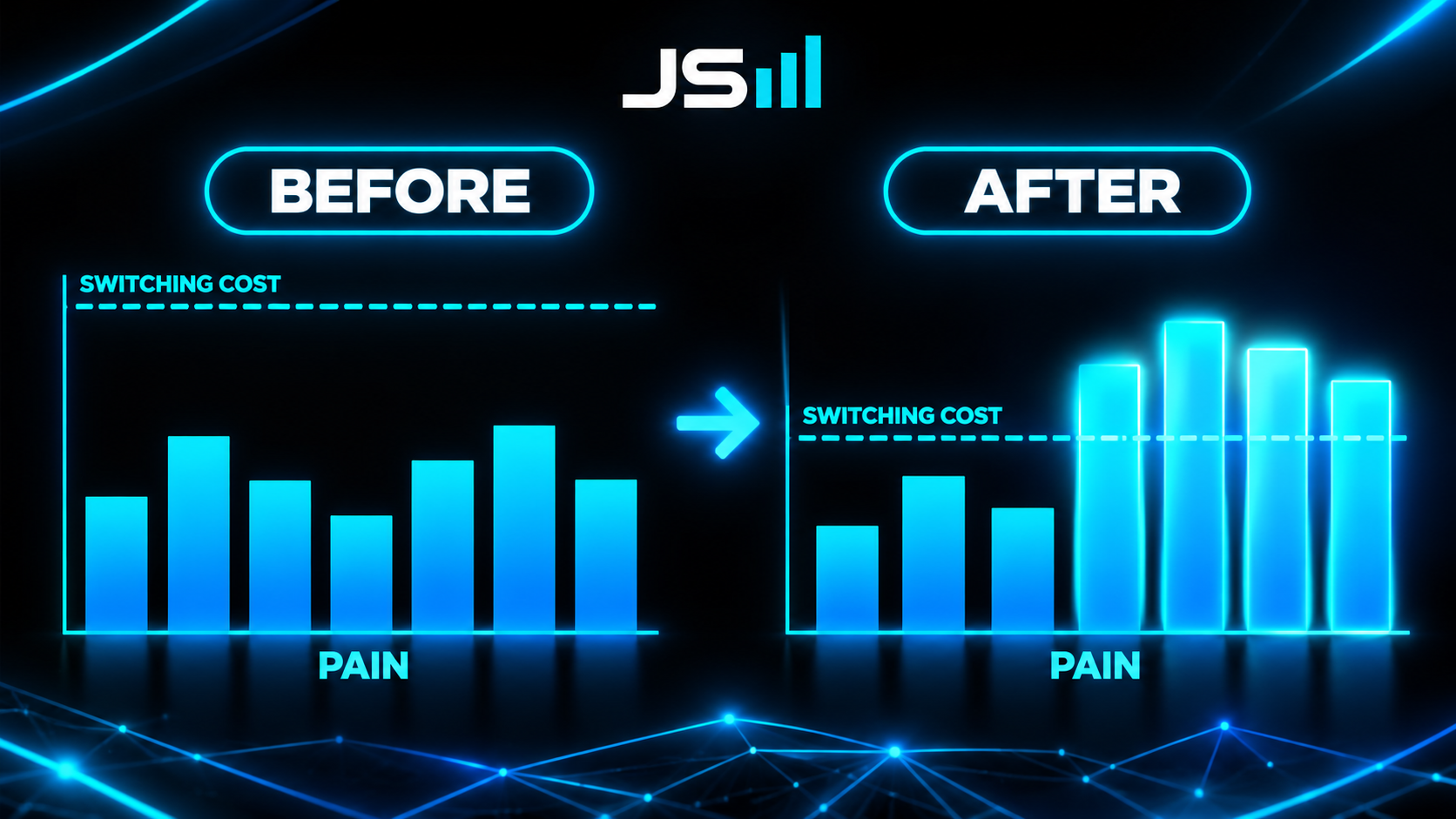
For most of business history the switching line sat high. Replacing a system meant a consultant, a migration, retraining, and a real chance the new thing would be worse. So the line sat up near the ceiling and a huge pile of inefficiency lived comfortably underneath it. Not because owners were lazy. Because the math said leave it.
AI didn't touch the pain. It dropped the line. A migration that was a quarter is a weekend. A process rewrite that needed a developer is an afternoon with one. The second the line drops, everything that was sitting just under it is suddenly above it, and the right move is to go fix all of it.
The loop is the whole game
Here's the part that matters more than any single fix. Once switching is cheap, the thing that decides who wins is how fast you can go around the loop: try something, see what happens, adjust, try again.

My rough number for a startup: the switching tax used to eat something like twenty percent of your capacity. Every pivot, every tool swap, every "let's redo onboarding" cost you a fifth of your momentum. I think it's closer to ten now, and falling. That's not a small improvement. Halve the cost of changing your mind and you change your mind twice as often, and the company that iterates twice as fast doesn't win by a little.
Bigger companies get the same gift, they just have to want it. The excuse for tolerating a bad internal process used to be real. Now it's a choice.
What this looked like for us
Hyppo is an all-in-one platform. Accounting, CRM, phone system, email marketing, one login, one database. Three years ago, a team my size building that by hand would have been a bad idea, and I say that as the guy who'd have tried anyway. Too many surfaces, too much to maintain, every customer request a month of work.

What AI changed wasn't the ambition. It was the cost of adapting. A customer tells us the invoicing flow doesn't match how they bill, and that's a fix that ships the same week instead of landing on a roadmap nobody reads. We stopped tolerating "that's just how the product works" because we no longer had to. The product bends to the customer now, fast enough that bending is the default.
The two kinds of companies
I see two groups and the gap is widening.
The first group bought a ChatGPT subscription, uses it to write emails, and calls that an AI strategy. Their business runs the exact same way it did in 2023. Same tolerated inefficiencies, same high switching line in their heads, because they never pointed the tool at the thing that actually costs them. For them AI is a gimmick, and gimmicks don't move the line.
The second group pointed it at friction. They asked what they'd fix if fixing were cheap, and then noticed it was. They're re-running the math on every tolerated thing, and they're pivoting in weeks on decisions that used to take a year of dread.
Same tools. Same subscription price. Completely different companies in eighteen months.
Re-run the math
- Write down everything you tolerate. Be honest. The list is longer than you think.
- Next to each one, write what fixing it would have cost two years ago, and what it costs now with AI doing the heavy lift. Most entries just moved above the line.
- Pick the ugliest one and fix it this month. Not to be bold. Because it's cheap now.
- Measure your loop. How long from "this is wrong" to "it's fixed"? That number is your real competitive advantage. Shrink it.
- Stop letting the subscription be the strategy. The tool is only worth what you point it at.
The pain didn't go anywhere. The cost of doing something about it did. Act like it.
Want to talk about what you're building?
Get in touch