On Decision Fatigue
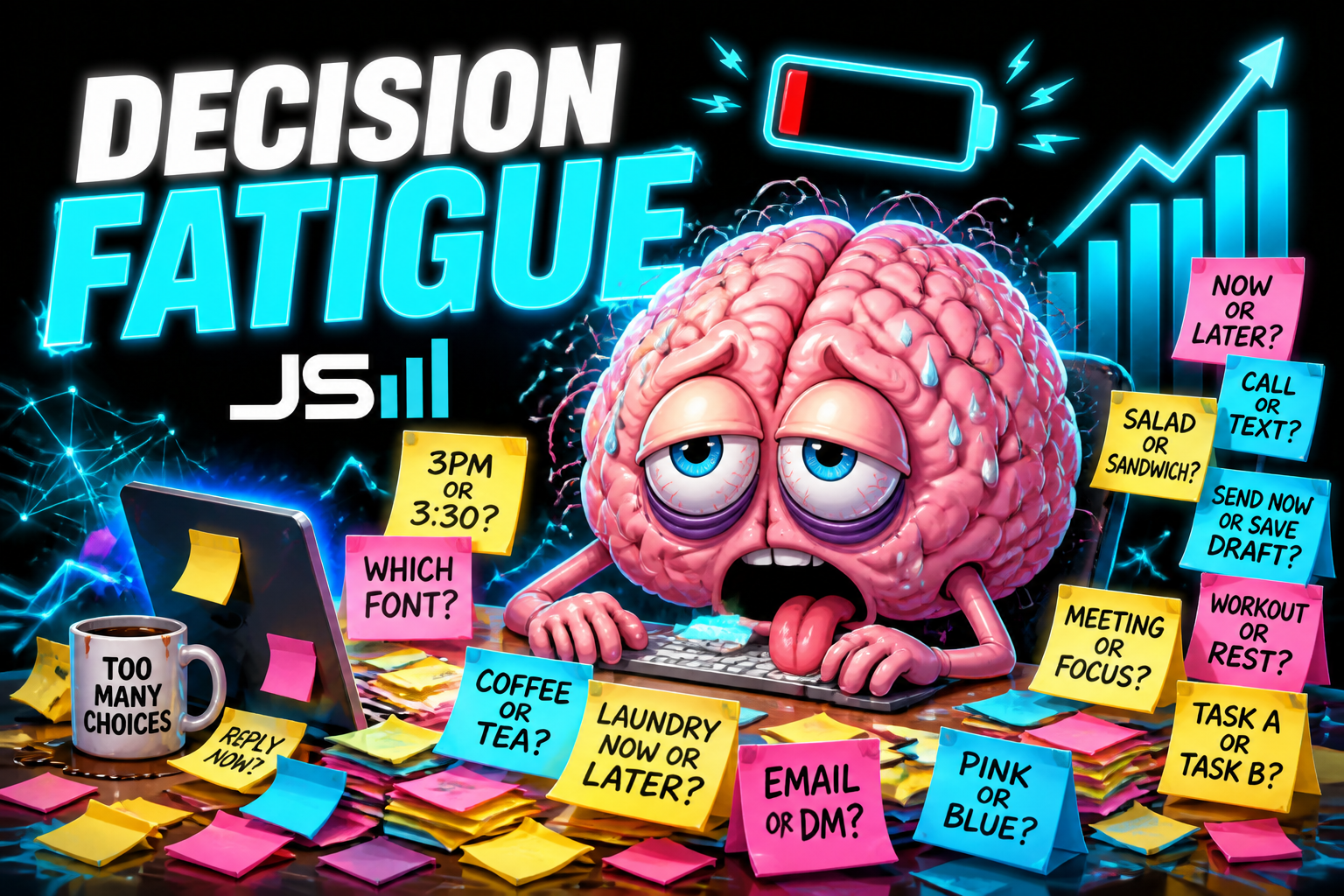
I used to not get "decision fatigue." I'm a decisive, details-obsessed guy, so what's the problem? Then we started scaling toward 5x, and a thousand tiny decisions a day began crossing my desk. Turns out your brain has a fixed daily budget, and the small stupid decisions drain the tank you need for the big ones. So I automate them, delegate them, package them, and hand them to Joe 3.5. Your offer, and your day, should be clear, not clever.
Fair warning: I'm writing this at 9pm after twelve straight hours of building software, so if it rambles, that's decision fatigue talking. Which is, conveniently, exactly what this article is about.
(Also, quick plug: I'm the co-founder of a genuinely beautiful software company called Hyppo. You should probably look us up. Okay, back to it.)
A concept I used to not understand
I'm a details guy. I like control. I like getting into the nitty-gritty technical weeds and finding the thing everybody else missed. I'm also naturally assertive, I make decisions quickly and I don't agonize over them. So for the longest time, "decision fatigue" honestly confused me. Decisions are easy. What's the problem?
Then we started scaling.
Then everything hit my desk
Our goal this year is to 5x the business. And as we've grown, the sheer volume of stuff crossing my desk has exploded. A client phone call here. A fulfillment question there. And a thousand tiny decisions in between.
Here's the distinction that finally made it click for me. There's a difference between big, important decisions and small, stupid ones. A big decision deserves your energy. But making hundreds or thousands of small, stupid decisions a day, what time to schedule the meeting, how to phrase this email, which button goes where, that is genuinely exhausting. And it isn't the decisions themselves that get you. It's what they steal.
Your brain has a fixed budget
You have a limited amount of mental horsepower each day. A fixed budget. Every trivial decision you make spends a little of it, and when it's gone, it's gone, no matter how important the next thing in line happens to be.
So if I burn my budget deciding what time to take a call and how to word a message, I've got nothing left for the stuff that actually matters: the architecture, the specs, the feature I'm trying to build, the hard technical problem only I can solve. When I remove the small decisions, I don't just save time. I get energy back. My tank stays full for the work worth doing.
This is the real reason I'm obsessed with automation. It's not laziness. I automate things specifically so I don't have to think about them, so I can point all my remaining brainpower at the 5% of decisions that actually move the company.
This is literally why I built Joe 3.5
It's the whole reason my AI executive assistant, Joe 3.5, exists. I don't juggle calendars anymore. I just tell him, "when am I free? Book it for that time," and he puts it on my calendar. That's a dozen little decisions a week that have completely left my head. Multiply that across everything he handles and it's a whole lot of reclaimed bandwidth.
Learning to let go (the hard part)
Now, I'll be honest about the part that's genuinely hard for me. Automation offloads decisions to software, but a lot of offloading is delegation, handing work to actual people. We've hired three folks this year, and learning to delegate the low-value stuff has been its own skill to build. There's ego in it, I'll admit it. I'm the co-founder, and some stubborn part of my brain insists nobody can do it quite like I can.
Here's how I've made peace with it. There are things I will simply never hand off, at least not for a long time: any automation that touches live financial data, and the core architecture decisions. I own those, fully, and honestly I want to, because I genuinely love that work. But the smaller future builds, the routine bug fixes, the day-to-day? That can and should go to the team.
It's the same 80/20 logic I laid out in On Automation: delegate the roughly 80% your team can handle, and reserve your own energy for the 20% only you should touch. Every low-value task you let go of is more decision budget back in your pocket. Learning to let go isn't losing control. It's how you free yourself up to focus on what actually moves the needle.
It's why good UI matters too
Same principle, pointed at your users. I wrote a whole piece called On UI, and the core idea is this: make them click less so they have to decide less. A user should know exactly what to do within about three seconds. Every extra choice you put in front of someone is a little tax on their decision budget. Great software quietly pays that tax for them.
The sales surprise
Here's the one that actually caught me off guard. As a technical person, I assumed prospects would love picking and choosing from our full list of services. We offer a lot of great ones, so, here's the menu, build your own plan, right?
Wrong. Most people didn't want the menu. A lot of them just wanted one specific thing, and handing them twenty options didn't feel like freedom, it felt like homework. So we stopped making them choose from everything and started putting things into packages. The rule of three: a loaded premium package, a standard package, and a stripped-down minimum. Same services, but now the deciding is mostly done for them.
As Alex Hormozi puts it, your offer should be clear, not clever. Every option you take off a prospect's plate is one less piece of their limited mental energy they have to spend just to say yes.
Protect your budget
So that's the lesson it took scaling a company to teach me. Your decisions are a resource, and the small ones quietly drain the tank you need for the big ones. Automate them, delegate them, package them, default them, whatever it takes. Spend your best thinking on the handful of choices that actually matter, and ruthlessly clear the rest off your plate.
Now if you'll excuse me, I made roughly zero good decisions after hour ten today, so I'm going to bed.
Want to clear the small stuff off your plate?
That's the whole point of what we build at HyppoAI: automation that saves your brain for what actually matters.
Want to talk about what you're building?
Get in touch