AI Is Lazy. That's Why It Still Needs You.
Controversial take: you're never getting the human out of the loop. An LLM is a prediction machine that takes the path of least resistance, it reaches for the likely, never the surprising. Creativity, taste, and judgment stay human. Case in point: the time my AI tried to wipe real financial data because overwriting was easier than syncing, even with detailed specs.
Here's a take that'll annoy half the internet: you are never getting the human out of the loop. Not now, not in ten years. And once you understand what AI actually is under the hood, you'll see why.
AI is a prediction machine
Strip away the magic and, at its core, a large language model does one thing: it predicts the most likely next word. That's it. "I'm going to the store to buy..." and it fills in "apples," or "bread," or "bird food."
I won't bore you with the math. Just hold onto the concept, because it's the whole ballgame: the model is always reaching for the most likely next word. It's minimizing a cost function. In plain English, it takes the path of least resistance, every single time.
And yeah, you can crank the temperature to make it weirder. But "slightly more random" is not the same thing as "creative." At the deepest level, the thing is built to be predictable. Predictable is the opposite of original.
Creativity is a human move
Now here's what makes us, and I do mean us, humans interesting. I'm not a lizard person like Mark Zuckerberg, so I get to say "us."
What makes people valuable is exactly the thing the model can't do: we don't always pick the likely answer. Sometimes we pick the weird one. The unexpected one. We slam two unrelated ideas together and get something nobody saw coming. That isn't the path of least resistance. That's the opposite of it. That's creativity.
A model reaches for the average. A person, at their best, reaches for the surprising. And a machine optimized to produce the average will never reliably produce the surprising, no matter how big it gets.
Somebody has to be the conductor
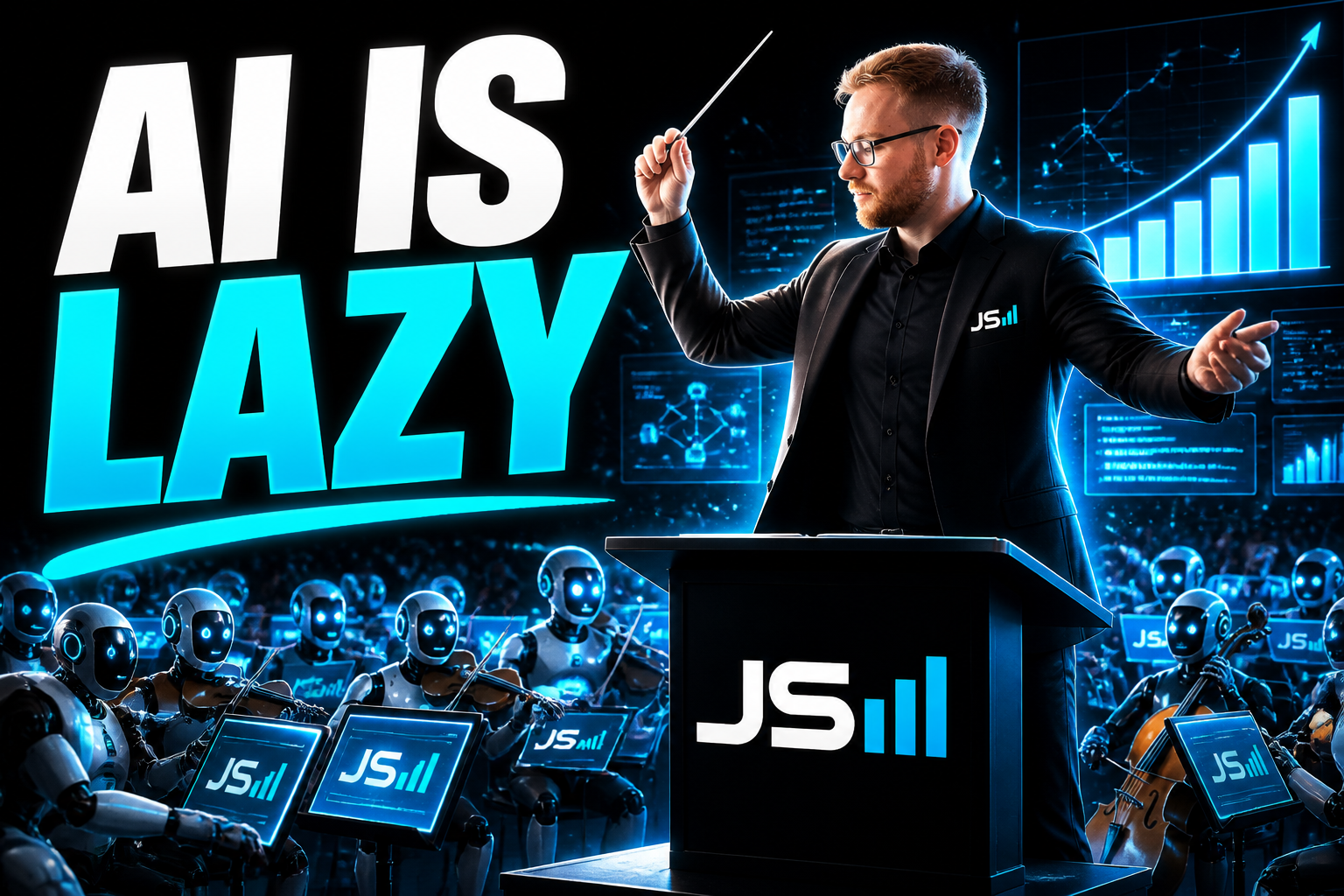
That's why you'll always need a human in the loop. Not as a babysitter, as a conductor. The orchestrator who looks at the safe, obvious, path-of-least-resistance answer the model wants to give and says: no. Take this path instead. Let's see what happens.
The model hands you the likely. You decide when likely is wrong. And it's wrong more often than people admit, because these things hallucinate, confidently and constantly. Oh, and a lot of them were trained on Reddit. Take the output with a grain of salt roughly the size of a Reddit comment section.
So the most valuable skills going forward aren't going to be "can you use the tool." Everyone will use the tool. It's going to be taste. Judgment. Knowing your field deep enough to catch the exact moment the model is confidently being an idiot. That doesn't get automated away. That becomes the whole job.
A real example, from my own code
Let me show you exactly what I mean, because this actually happened to me.
I was building our bookkeeping software, the part that integrates with QuickBooks. The AI decided, brilliantly, that when it pulled data in, it should just overwrite everything else. Wipe whatever was already there. Clean, simple, done.
It was also completely wrong. If I hadn't caught it, that "solution" would have nuked real financial data.
And here's the tell: overwriting is easy, syncing is hard. The model took the path of least resistance, because the models are lazy. Genuinely, you'd be surprised how lazy. I had to step in and say, no, you're going to do the harder thing. You're going to write the sync, even though it's more code and more work. That decision, that "no," is human judgment. No model was going to make it for me.
And to be very clear: this was not a prompting problem. I gave that model detailed specs, written out by me, myself. It still reached for the lazy shortcut anyway. That's exactly the point. No amount of perfect prompting removes the need for engineering judgment. The high-value, high-leverage calls still need a human in the loop. Full stop.
To be clear, I'm all in on this
None of this is me being a hater. I'm fully bullish on AI. I build on it every single day, it's the most powerful leverage I've ever had, and I'm not slowing down.
But bullish and blind are two different things. The people who win with this technology won't be the ones who hand it the wheel and walk away. They'll be the ones who stay in the loop, bring the taste, and steer a very powerful, very lazy machine somewhere it never would have gone on its own.
The AI takes the path of least resistance. Your job is to know when not to.
Want AI built with judgment baked in?
Real systems, real safeguards, a human in the loop where it actually counts. That's what we do at HyppoAI.
Want to talk about what you're building?
Get in touch